JohnTem82387976
Showing posts with label cover versions. Show all posts

22 December 2020

Paul Rich - Must Be Santa/ Virgin Mary


 Cut-price cover of the Mitch Miller favourite
 
Label: Embassy
Year of Release: 1960
 
I can't resist putting an Embassy single up for your attention before Christmas arrives. After all, which of us didn't receive a budget record for the festive season from a tight-arsed (or thrifty) relative? "It's just a little something for you to open on Christmas Day" as Auntie Vi used to say, not realising that the LP she'd brought you was not recorded by the latest hot hit makers, but by some balding session musicians working to the clock (cut to an image of Elton John beavering away in the studio corner). Think about it - what could be more Christmassy than a cheap Woolworths knock-off?
 
Still, it's not as if "Must Be Santa" was much of a hit in the UK anyway, and it's certainly not as if it really "belonged" to Tommy Steele, who took it to an under-achieving number 40 here. The track had originally been recorded in the USA by Mitch Miller and then interpreted by Steele later, meaning it was wide open for anyone's attempt by this point, low budget or otherwise. Embassy Records stalwart Paul Rich, who recorded more frequently for the budget Woolworths label than any other singer, gives it a much less cheeky and more rounded, better enunciated take than Steele, and there's a cosiness to it I can't help but enjoy. This feels like polite, 1960 Palladium entertainment and the song and arrangement suits my mood like a comfy pair of slippers.

It can't have been much of a cash generator for Woolies, though. For as much as the song was reasonably well liked in North America, it didn't really begin to pick up in popularity in the UK until Bob Dylan's crazed cover was released, which seems to have become the template for every pub band and artist who has tried it since. Even the wonderful Zooey Deschanel took Bob's stylings for this under her wing in 2016, but made the fatal error of including Hilary Clinton's name among the list of presidents at the point of recording. Ah well. Christmas is the perfect time for optimism, I suppose.

10 October 2018

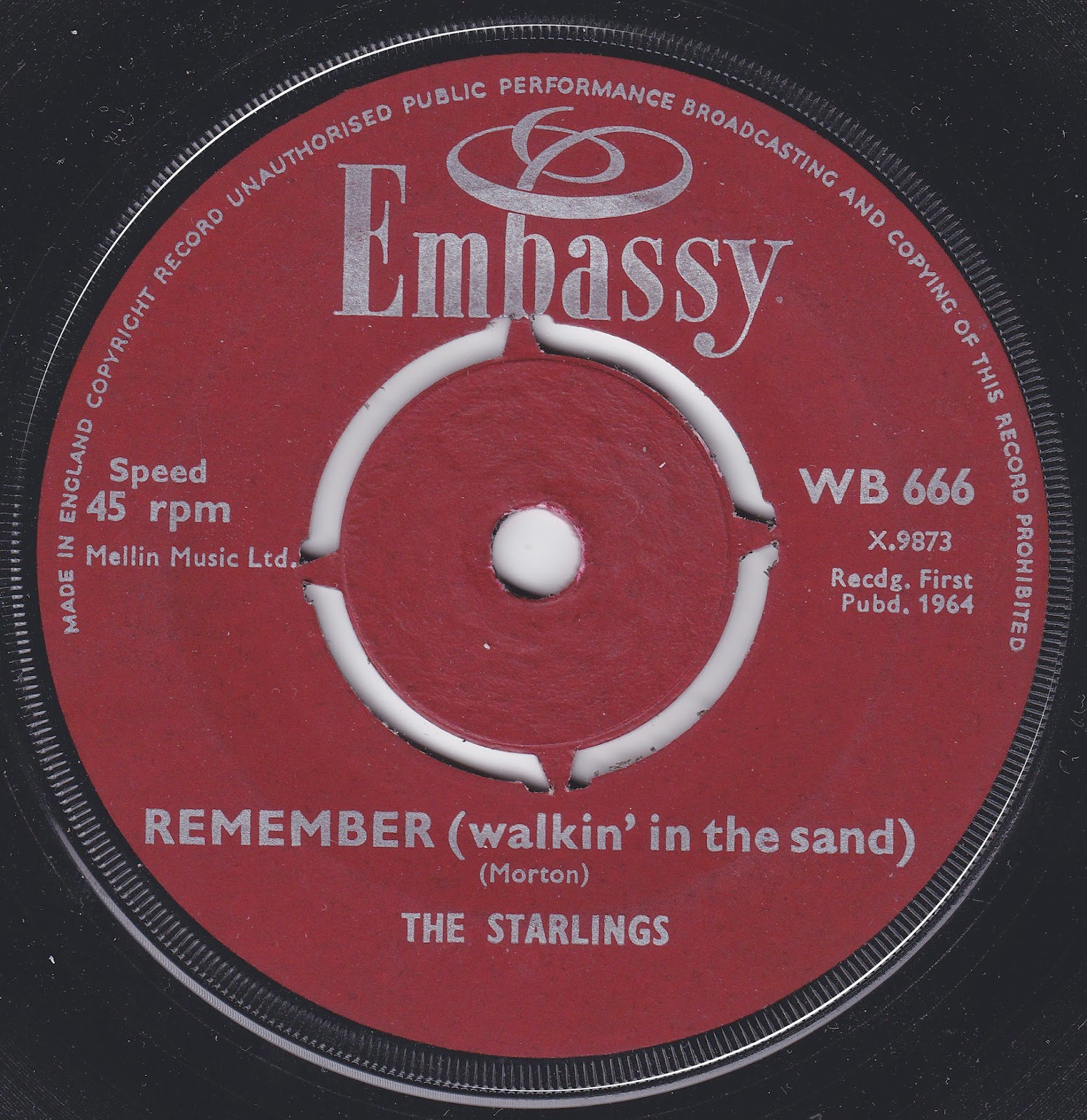
Reupload - Starlings - Remember (Walkin' In The Sand)/ Typhoons - Little Red Rooster


Powerful and surprisingly brilliant cover of the girl-group classic on the budget Woolies label

Label: Embassy
Year of Release: 1964

We've encountered the Embassy label on "Left and to the Back" before, of course. (Yes. We have). It was the label John Lennon referred to in a moment of despondency, jokingly commenting that even they had rejected The Beatles. Pressing up cheap sound-a-like discs for the cash-strapped or just plain unfussy, they were responsible for some truly awful howlers in their time. Just listen to this appalling caterwauling take on "Wimoweh" if you don't believe me, or this underpowered take on The Beatles themselves. 

Occasionally, though, Embassy did turn up trumps, and it's to the credit of the session musicians they hired when things did go to plan. Frequently thrown in at the deep end, given next-to-no time to learn the songs and even less time than that to record them (usually a few takes at most) when these discs sound good, they sound good under the most pressured and unlikely of circumstances. 

So then, if you were pop-picking in Woolworths in 1964, this record would actually have been a rather good buy. The version of "Remember (Walkin' In The Sand)" is a staggeringly effective take on the girl group classic. Joan Baxter handles the lead vocals and positively nails the yearning qualities of the song - so much so that this actually becomes a perfectly strong alternative version rather than just a cheap substitute for the real thing. This isn't some kind of dilute-to-taste ageing session muso's take on teenage heartbreak, there's genuine power and a certain innocence behind the performance, piercing right through everything else. 

15 November 2015

Day Costello - The Long And Winding Road/ Free (Unlimited Horizons)


Label: Spark
Year of Release: 1970

It's common enough to hear talk of how the sons and daughters of successful musicians are almost always eclipsed by their elders and betters. What's perhaps less frequently discussed is how often the offspring of relatively unsuccessful musicians (in chart terms, at least) produce far better and more lasting work. Amy Winehouse, daughter of Mitch Winehouse, is obviously a recent prime example of this, but there are many others. Children growing up surrounded by music will inevitably latch on to it and sometimes take it to more interesting places than their parents.

And obviously enough, Day Costello was an identity assumed by Ross McManus, father of "Elvis" Costello. He issued a trio of flop singles in the sixties on the HMV and Decca labels between 1964-67, and this oddity in 1970, which was never really supposed to see the light of day as a 45. Originally recorded for the purposes of a budget covers LP in Australia with vocals by Danny Street, Ross's services were called for at the eleventh hour when the label disliked Street's final performance.

When it became apparent that The Beatles weren't releasing "The Long and Winding Road" as a single in Australia, Fable Records decided he should try his luck in plugging the gap, in much the same manner as Ray Morgan did in the UK. The results were partly positive. The single was reviewed somewhat critically in some quarters due to the rather ponderous approximation of the Phil Spector arrangement - a criticism I would definitely echo - but it managed to pick up enough airplay to become a minor Aussie hit. A big plus in its favour is unquestionably Costello's vocals, which don't improve on the Beatles original (as if), but add a subtly different interpretation. Delicate, considered and with a lot of strong tremelo in them, he sounds like an ordinary man lost on some distant plain.

Why a UK release was required on Spark Records is something of a mystery, but presumably the label felt that they could potentially out-run Morgan's effort (I could confirm this theory if I could manage to find the Spark release date, but the data is unobtainable). It didn't happen, the single sank without trace, and copies are actually pretty scarce these days. My one is a bit roughed-up in places, but unfortunately it's the only copy I've chanced upon in my lifetime.

The flip side "Free (Unlimited Horizons)" is a defiant sounding number which begins sounding vaguely reminiscent of Pulp's "Sunrise" before revealing its true identity as a piece of middle-of-the-road optimistic pop. It's highly rated by some collectors, but I find it slightly too conservative and lightweight.

Costello, of course - or McManus, if you'd rather - continued to do session work, and after this point his most famed effort was probably the R Whites Lemonade television advert in the UK with son Elvis on drums and backing vocals, which somebody really should have put out as a single in some form. If it could be done for the Humphrey adverts, it could have been done for R Whites, for God's sake. But I'm sure you've all got worries and concerns and issues of your own…

Naturally, in a peculiar twist of fate Elvis Costello eventually worked with Paul McCartney as a co-songwriter throughout the eighties and nineties, bringing the circle neatly to a close.


16 July 2014

Starlings - Remember (Walkin' In The Sand)/ Typhoons - Little Red Rooster


Label: Embassy
Year of Release: 1964

We've encountered the Embassy label on "Left and to the Back" before, of course. (Yes. We have). It was the label John Lennon referred to in a moment of despondency, jokingly commenting that even they had rejected The Beatles. Pressing up cheap sound-a-like discs for the cash-strapped or just plain unfussy, they were responsible for some truly awful howlers in their time. Just listen to this appalling caterwauling take on "Wimoweh" if you don't believe me, or this underpowered take on The Beatles themselves. 

Occasionally, though, Embassy did turn up trumps, and it's to the credit of the session musicians they hired when things did go to plan. Frequently thrown in at the deep end, given next-to-no time to learn the songs and even less time than that to record them (usually a few takes at most) when these discs sound good, they sound good under the most pressured and unlikely of circumstances. 

So then, if you were pop-picking in Woolworths in 1964, this record would actually have been a rather good buy. The version of "Remember (Walkin' In The Sand)" is a staggeringly effective take on the girl group classic. Joan Baxter handles the lead vocals and positively nails the yearning qualities of the song - so much so that this actually becomes a perfectly strong alternative version rather than just a cheap substitute for the real thing. This isn't some kind of dilute-to-taste ageing session muso's take on teenage heartbreak, there's genuine power and a certain innocence behind the performance, piercing right through everything else. 

On the other side, The Typhoons take on "Little Red Rooster" isn't as great, but manages to capture the lazy sleaze of the blues track almost as well as the Stones did. It's hard to pick fault.

At the time it's doubtful any self-respecting teenager would have actually wanted to own this record over the original recordings, but now, with the reasonable passing of time, this has actually become something worth having. A shame the same can't be said for all of Embassy's output, but them's the breaks.


26 November 2012

Avenue AVE 76 - The Beatles, Desmond Dekker, John Lennon, Cilla Black, Beach Boys, Thunderclap Newman


Label: Avenue
Year of Release: 1969

It's been a long while since "Left and to the Back" last focussed on the thrills you can have whilst listening to budget priced "not the work of the original artists!" pop party records.  These discs were actually bought in large numbers and tend to turn up all over the place, but finding one that's both in good condition and either unintentionally funny or admirably well handled is hard work.

This 1969 example does, on the surface, seem to contain plenty of tripwires for unsuspecting session musicians, containing as it does reggae (always a problem for jobbing musos in the sixties, as the Top of the Pops orchestra proved time and time again), counter-cultural commentary, and West Coast harmonies.  It's disappointing to note that in the vast majority of cases, these are handled fairly well.  It seems ridiculous listening to somebody who isn't John Lennon singing about the trials and tribulations of being John Lennon on "Ballad of John and Yoko", but beyond a certain politeness to the vocal delivery there aren't many stumbles apparent.

"It Mek" is probably too polished and clean to sell itself authentically as genuine sixties reggae, but irrespective of that isn't terribly embarrassing, "Give Peace A Chance" sounds like it always did (someone ranting tediously over a bunch of individuals kicking around the contents of a broom cupboard - that can hardly have presented a challenge to everyone at Avenue House), and "Conversations" was never an impressive Cilla Black track in the first place.

It's left up to "Breakaway" before we start to notice serious floundering.  "Breakaway" was never the Beach Boys most heavily produced and arranged track, but when it's left in the hands of anonymous session musicians you are left appreciating the original a great deal more.  The harmonies are strained, and the musicians are very clearly struggling to replicate the Wilson sound here - you can almost hear the strain and panic.  It sounds as if the backing vocalist handling the "doos" is almost sobbing during the intro, while the others contemplate freedom and release in the style of a wedding service hymn sung by a church filled with atheists.  There really is a sense of resentment about the delivery here, as if everyone involved was handed a difficult job and asked to deliver it against an impossible deadline - the net result is a total disaster.  Phil Spector has gone on record as saying that Brian Wilson sent himself mad "trying to become me".  The Avenue jobbers here sound as if they went fairly close to the edge of sanity attempting to ape Wilson.

"Something In The Air" restores some balance at the end of side two by being a fair facsimile, although again lacks conviction given the subject matter.  In summary - bar one appalling stinker on this record, I've heard worse.  Oh yeah, and sorry about some of the pops and clicks and surface noise.

23 January 2012

Embassy Big 4 - Anyway, Anyhow, Anywhere/ Mr Tambourine Man


Label: Embassy
Year of Release: 1965


We've been here before, and regular readers will know the drill, but for the benefit of those of you who have just tuned into this blog... Embassy were a tireless label in the early sixties, churning out endless discs of session musicians covering the hits of the day. Their platters would then end up in the budget rack of Woolworths waiting to be purchased by punters who felt that their approximations of hit singles were affordable alternatives to the real thing. So infamous were their offerings that John Lennon even jokingly referenced the label as a possible home for The Beatles when their chances of getting signed seemed slim.

Like the "Top of the Pops" albums that followed them, Embassy recordings were a decidedly mixed bag, ranging from faithful interpretations to wayward messes. This "Big Four" EP is particularly absurd in that it contains two ballads and two counter-cultural anthems, so Gene Pitney's "Looking Thru The Eyes of Love" shares Side One with "Anywhere, Anyhow, Anywhere" by The Who, and Side Two pairs "Mr Tambourine Man" with Lulu's top ten ballad "Leave A Little Love". If ever you needed proof that such things as youth splinter groups and demographics hadn't been fully defined by 1965, here it is staring at you in the face.

"Left and to the Back" readers are likely to be more interested in "Anyway, Anyhow, Anywhere" by The Who and "Mr Tambourine Man", and their interest will probably be inflated further still when they realise that neither version is particularly faithful. "Anyway, Anyhow, Anywhere" is, in particular, a really interesting approximation due to the fact that Embassy studio band The Jaybirds clearly don't know what to do with The Who's sound. The drumming sounds primitive and punkish rather than copying Keith Moon's ambitious style, the lead vocals yelping, desperate and close to the style of Jim Sohns of The Shadows Of Knight (though don't get excited - I'm not suggesting it is him) and the feedback-heavy break of the original is replaced with something a bit more synthetic and measured. It sounds more like a bunch of teenagers in a garage trying to copy The Who, and whilst I doubt that's actually the case, it's a peculiar old listen to say the least. It doesn't top The Who's original, but something about the hollow, primal simplicity of it almost reminds me of The White Stripes, which is no bad thing at all.

Meanwhile, The Typhoons - a session band previously known to handle The Beatles material on Embassy, although I don't know if the personnel remained the same throughout all their recordings - battle with "Mr Tambourine Man". It's a fey, gentle take which sounds influenced more by English folk than the American folk rock scene that spawned The Byrds, sounding sleepy and contended rather than urgent, preaching and elated. Readers won't be in a hurry to replace The Byrds version on their iPods with this one, but once again the different approach is at least an interesting interpretation.

As for Terry Brandon's take on "Looking Through The Eyes of Love" and Sally Hyde's version of "Leave A Little Love" - I hate to be dismissive, but neither track really captured my imagination in the first place, so my opinions on these reinterpretations are unlikely to be balanced or fair. They're here for anyone who feels curious enough to hear them, though.

And I hate to say it, chaps, but sorry for the surface noise on some of these recordings. It's difficult to find Embassy records in Excellent condition, and what we've got is the best I can obtain at the moment.

Tracklisting:
1. Terry Brandon: Looking Thru The Eyes of Love
2. The Jaybirds: Anyway, Anyhow, Anywhere
3. The Typhoons: Mr Tambourine Man
4. Sally Hyde: Leave A Little Love


13 October 2010

Bud Ashton - Telstar

Bud Ashton - Telstar
Label: Embassy
Year of Release: 1962

Way before those dodgy "Top of the Pops" low budget compilation albums we've already talked about, chock full of frequently inaccurate cover versions of the day's hits, came Embassy Records.  Whereas Hallmark, Pickwick, Contour and endless other budget labels in the seventies crammed non-original artist takes of twelve hot hits across twelve glorious inches, Embassy were a bit more modest.  The racks of Woolworths were filled with their singles offering one song per side.  If you were hard up for cash and not especially fussy, you could walk out with a record by The Typhoons rather than The Beatles and see if anyone noticed at your next house party (they'd have to be either very drunk or tone deaf not to observe the differences, mind you).

For me, it's always more interesting when the session musicians attempt to take on anything with either a technically advanced production or complex arrangement.  The "Top of the Pops" gang managed to create a creditable version of "Bohemian Rhapsody", but for the most part, the least convincing tracks in any budget sound-a-like marketing formula are those which simply couldn't be created effectively in one quick recording spree.  "Telstar", then - one of the most unique sounding records of its day - would surely be screwed, wouldn't it?

The answer is a somewhat surprising yes and no.  Bud Ashton, whoever he may be (somebody hiding behind a pseudonym, I don't doubt) begins gamely, trying to replicate Joe Meek's effects-fest at the start of the record, and not failing entirely, even if there's a tad more squeakiness to it all.  The intro builds convincingly, the keyboards buzz confidently, and it seems like we're blasting off into a reasonable enough replica.  But then the track gets going, the bass line plods in a timid and out-of-depth manner, some of the arrangements sound very muddy indeed, and the faults begin to show.  By the time the record gets to the tail end, Mr Ashton can't even be bothered to re-do the sound effects which clearly bookend Joe Meek's original effort.  Perhaps he ran out of time.

If anything, it shows that many of the strengths of the proper version of "Telstar" lay not in its melody, but in the depth and adventure shown in its production, apparent to this day.  Ashton's version begins to sound boring and repetitive a minute and a half in, whereas Meek's paces its ideas neatly, allows the instruments room to breathe, and is beguiling as a result.

The flip side to this is a version of Adam Faith's "Don't That Beat All" by Rikki Henderson, but please pardon me if I don't waste too much time dissecting it.  I've included it below for the benefit of the curious, however.

20 October 2009

Top of the Spot(ifie)s

Top of the Pops

"A bad cover version of love is not the real thing/ bikini clad girl on the front who invited you in" Bad Cover Version, Pulp

Since we've already touched upon the subject of budget cover albums and EPs this month, we may as well keep the theme rolling with the news that a whole crateload of "Top of the Pops" albums have now worked their way on to Spotify. There's good news and bad news attached to this - the bad news is clearly that a lot of retro bloggers are probably going now to wonder if it's really worth the trouble of uploading those thirty volumes they found in Oxfam last week. The good news, of course, is that we now have unlimited access to these sounds in digital quality - although your definition of good news might vary from mine.

Since this discovery, it's become a game of mine to highlight the good, the interesting, and the awfully inaccurate cover versions that exist in the series. It's been well documented before now that the bargain bin version of "Bohemian Rhapsody" is actually quite impressive given the limited studio and arrangement time the piece was clearly given. Queen spent several half-lives and a country mile's worth of mastertape on the original, so whilst the version presented here may not be absolutely perfect, it shows a low=budget respect for the original arrangements akin to Andy Partridge's Beatles re-recordings.

Given this fact, it's astonishing how far off the mark other efforts are - clearly some session musicians who were hired to do a job had an unhealthy disrespect for other tracks. If BoRap can be nailed, then what's the major issue with "Mouldy Old Dough", for Stavely Makepiece's sake? The piano sounds wobbly and warped, the rhythm inaccurate, and the vocals like Granddad out of "Only Fools and Horses" with half a cheeseburger in his gob. To say that the session musicians concerned must have despised this track to treat it with such contempt is to understate the case to some considerable degree.

Gary Numan's "Cars" isn't quite so maltreated, although the synthesisers used have a touch of the Rumbelows about them, and the vocals appear to be done by a man who sounds like Gilbert O'Sullivan doing an impression of an American new wave vocalist who is in turn doing a poor impression of Gary Numan. If this was the intention, I'm seriously impressed.

And talking of XTC, as we were earlier, that particular band seem to be particularly ill-served by the series. "Senses Working Overtime" suffers from bum notes and miscued rhythms, and is sung with the incorrect lyrics ("I can see his well-turned taste"?) with the vocals of a drunken village idiot being kicked around a bar, wailing for mercy as he goes. "Sgt Rock" fares little better, being an anaemic approximation of the song sung by somebody who'd clearly rather be in Steppenwolf. They put more effort into their Benny Hill impressions, so you have to wonder why Swindon's finest were treated with so little respect.

I could go on, perhaps pointing out other items such as "Virginia Plain", a rather unsympathetic version of L&TB fave Gary Shearston's "I Get A Kick Out Of You" performed with tone-deaf vocals (Arthur Mullard eat your heart out), and a ridiculously Tiny Tim styled version of Sparks' "Something for the Girl With Everything", but if I keep on in this way I'll be rather spoiling your own fun having a dig around. Please do leave a comment if you manage to find anything particularly accomplished or absurd.

Whether you love or hate this series, its popularity was baffling. That the music industry in Britain made the decision to expel these budget cover albums from the main charts in the mid-seventies is an indication of how much the public appeared to have a soft spot for them, and even when they were consigned to their own special "budget chart" they remained strong sellers. The musicians behind the work were often of a high quality, with the likes of Bowie (*cough*)* and Elton John beavering away on the releases, and the latter's work was so extensive that a separate compilation has been created of his own efforts. I'd prefer to think of the series as being a very interesting anomaly, whilst not particularly wanting one of the items to ever be gift-wrapped and given to me again by a cheapskate relative, thank you very much indeed.

(*No, I doubt Bowie or his musicians had anything to do with that linked version of "Space Oddity", but it is rather impressive).

7 October 2009

Yet More Beatles Covers - Avenue Recordings Ltd (and David Byron)


AVENUE EXAMPLE

Label: Avenue
Year of Release: 1969

Discarded budget cover version albums and EPs are bog-standard charity shop fare up and down the United Kingdom.  Some people regard these waxings with affection, believing them to be interesting and entertaining reinterpretations of hits.  Others - and I have to confess, I'm one of the others - feel that they're a bit of a waste of space on the whole, and unless there's some spectacularly odd attempt to nail a style which falls uniquely and entertainingly flat, there's not a lot to be said for them.  I've heard more anaemic, clock-watching rock cover versions on these records than I feel I ever needed to, and the conclusion I've drawn is that they're not a good talking point.

There are exceptions to the general rule, however, and this EP may be one of them.  Many artists who went on to a greater degree of success recorded for the likes of Avenue, Pickwick, Embassy and Contour, knocking out quickie covers of hits for small wedges of money.  Elton John and David Bowie are two of the most famous artistes to bother the budget studios for some spare cash, Elton recording enough to see his attempts reissued on to one full-length CD recently.  There's a certain thrilling absurdity to hearing Reginald Dwight sing "Young, Gifted and Black", or treating your ears to Bowie's unique vocal whine working its way through "Penny Lane".  The logic of entering recording studios for the pair was purely monetary, given that they were both struggling musicians for years before earning a serious living.  Elton seems to regard his efforts with slight embarrassment these days, whereas Bowie's opinions are unrecorded - although the album "Pin Ups" would suggest that he hadn't quite got the covers bug out of his system by the seventies.

Plenty of other musicians recorded for the labels, though, and naturally others went on to success, too.  If the Internet is to be believed, David Byron, the lead singer of seventies rockers Uriah Heep, puts his tonsils around John Lennon's "Cold Turkey" on this particular EP (a fact I only realised after doing a bit of research after buying it).  The version obviously rocks considerably harder and has a great deal more teeth-gritting angst and geetar riffage about it than Lennon's slightly docile original, and Byron makes the song sound very much his own rather than bothering to attempt to make it sound like a carbon copy.  Given that I actually think "Cold Turkey" is probably one of Lennon's weaker efforts I'm still not sold on the song itself, but this is worth pricking your ears up for once, despite the weak quality of the vinyl it originated from.

Elsewhere on the EP, another session muso who probably never got to achieve any degree of fame works his way through a slightly saccharine cover of Harrison's "Something", which fails to really reinterpret or even successfully replicate the original.  Still, you can't have it all - and huge apologies for the jumps and scratches you'll hear in places, and the poor sound quality which I believe has more to do with the standard of the original pressing than anything else.  I've tried remixing this to improve the results, but it's not easy work. I wouldn't be surprised if somebody had used this record to eat their dinner off at some point.

Like a tool, I've also lost this record somewhere in my increasingly cluttered flat, so what you see above is a scan of another Avenue disc taken from the fantastic Seventies labels site.  If the owner objects to its use, please do drop me a line and I'll take it down - I'll probably take it down as soon as I locate the actual copy of what I'm providing here anyway.

Tracklisting:
Ruby Don't Take Your Love To Town
Something
Cold Turkey
Tracy
Loneliness
Baby I Know