JohnTem82387976
Showing posts with label glam rock. Show all posts

17 September 2023

Warwick - Let's Get The Party Going/ How Does It Feel


Chinnichap tap into the Beach Boys sound and make it stomp

Label: RAK
Year of Release: 1975

By 1975, glam rock had entered into a period of decline. A couple of years previously radio and the listening public couldn't get enough of the crunching, stomping sounds, but the template was limited and leant itself poorly to progressive interpretations. The survivors of the genre were those who were always about far more than hard stomping heels and glitter from the WH Smith stationery department; the Roxys and the Bowies always had a flexibility and inventiveness which eluded the sweet old rock and rollers.

The net result of this is that quite a few solid glam records were issued in 1975 and 1976 which struggled to get a sniff of attention. This is without question one of them. Warwick were pulled together as a quick session group to record ex-Tangerine Peel member Warwick Rose's probable hit "Let's Get The Party Going", with Mike Chapman of Chinnichap productions (also an ex-member of the Peel) fronting the song and Nicky Chinn flying solo in the producer's chair. 

Tangerine Peel were one of those late sixties groups who released scores of records across multiple labels, all with a strong pop flavour, but none rewarding the labels who signed them with any hits. "Let's Get The Party Going" excels the quality of their output from that period by a country mile. If The Beach Boys had assembled in RAK studios to record a glam rock single, this is pretty much exactly what you would have got - thrilling close harmonies, and a Californian chorus doused in Party Seven lager and filled with thumping beats and sweet twanging guitar lines. 

3 September 2023

Axe - Monie Monie/Land of A 1,000 Dances/


Glammish take on the dancefloor smash

Label: MCA
Year of Release: 1973

Back when I DJ'ed at sixties nights, I was always careful to keep a copy of "Mony Mony" in my record box. It was a record I liked rather than loved, but nonetheless it's a powerful tool to have put to one side. If it was getting towards midnight and the majority of people in the room were still only twitching their feet on the boundaries of the dancefloor, it was possible to deploy it and cause a forward surge which made my next hour a lot easier. The folk whose feet were only tapping to some soul obscurity moments before would suddenly feel compelled to swing and kick to "Mony Mony" - its evangelical roar seems to lock into something important in the slightly drunken human brain. It does something all DJs love - it turns a slightly shy gathering into a party. 

One of my fellow DJ's, on the other hand, frequently favoured "Land Of A 1,000 Dances" for similar reasons. It was certainly the more credible of the two options, and also caused people to feel the urge to express themselves rhythmically. Something about the utter gibberish about dance crazes spewing from Wilson Pickett's mouth with apparent sincerity, combined with those driving rhythms, caused excitement.

You could argue the single biggest thing both tracks have in common is how they're frantic little records about absolutely nothing tangible or important which absolutely drip with fervour - there's no baggage, regret or alternate meanings you could associate with either, but they scream their nonsense for dear life. They're soul without the meaning soul usually contains, the energy and the fizz without the heartache. That makes them sound like slightly shallow propositions, but at 11pm at night just as the fourth drink of the evening slides down your gullet, and just as you've managed to let the stress finally leave your weekday bones, shallow is sometimes what you're after. 

There's also probably a psychological factor at play with records which are facile lyrically, and the way they persuade people to interact with the dancefloor. If the singer is happy to wrap his lips around some very daft proclamations, why should you be afraid to dance imperfectly to them and be ridiculous together? Not all of us are capable of doing high kicks at Northern Soul nights while listening to high class tales of heartbreak, after all. 

Singer and guitarist Rod Alexander, aka Axe, was clearly on to something here way before I was, because he welded the two songs together into one cut-and-shut glam rock model. Suddenly they're no longer vast, echoing exhortations to dance, but beery footstompers for the social club crowd. This isn't an abuse of their powers, though - this medley has a sledgehammer impact I'd love to try out at a glam night if only I still DJ'ed these days. Maybe one of you can do it for me and report back on the end results. The thud and echo of these versions transforms the tracks into something a bit more brutish, slightly more leaden than carefree, but the principles (such as they are) are still intact.

2 April 2023

Carl Simmons - Angel/ Hold On Ruby


Opportunistic pop-glam from rock and roll stalwart

Label: Antic
Year of Release: 1974

Sometimes it's hard to make a judgement call on whether an artist is opportunistically jumping on a bandwagon, or whether the world around them shifted and enabled them to be sucked into dominant trends. By the early seventies, Carl Simmons was already making something of a living by putting out fifties rock and roll covers on budget labels like Forest and Avenue - then by the time glam rock hit its peak, he suddenly added a glittery thump and thwack to his work. 

In doing so, he didn't really do much more than tinker around the edges of his existing style, bringing him close to the likes of Alvin Stardust in making the noises and poses of deepest rock history relevant for the seventies. Glam rock was always fascinating in this respect; finding room for the weird and wonderful (Bowie, Roxy) as well as revivalists who just wanted to take the best of the past and squeeze it into a spacesuit, hoping the kids could be tricked into eating up a side order of rock and roll if it was painted to look like the future.

Generally they could, but unlike Alvin, Glitter or Roy Wood, Simmons had no luck with his seventies recordings and most ended up in bargain bins as unwanted items. You can hear on "Angel" that he could have been a contender - this is catchy, wiggly glam at its plastic catchiest - but he probably needed something brighter and bolder than this, and ultimately it didn't cut through. 

Prior to this period of career, he had been a drummer in the Ember signed act Count Downe and the Zeros whose solitary release can be heard here. They later morphed into Peter and the Headliners who became the resident group on BBC2's "Beat Club". 

11 December 2022

Bryan Evans - Turnaround Sunday/ Re-united


Glam-tinged gospel from Mumbles star of the stage

Label: Columbia
Year of Release: 1972

We've stumbled briefly upon Bryan Evans before on this blog, documenting his unexpected efforts to de-campify the Howard and Blaikley glam flop "Don'tcha Like Boys" and turn it into a chart sensation. He failed miserably, of course, but had the project been launched a few years earlier than 1978 he may well have been on to something. Timing is everything in pop.

For most of the seventies, though, Evans was an ever-present background figure in light entertainment, appearing in West End productions and also having a long recording career across multiple record labels, starting with CBS in 1971 and finishing with EMI International in 1979. It's rare for an unsuccessful artist to be given so many chances by the music business, and it's usually a display of enormous faith in their abilities, suggesting that Evans was seen as a highly polished performer capable of competing with the big boys (and girls) of the day. 

"Turnaround Sunday" was actually his third single and first for Columbia after a two-single stint with CBS. It's an interesting mix of styles, combining happy clappy gospel influences with a faint tinge of glam. The first time I played this, I accidentally left my laptop speaker on and ended up hearing the track with an unintentional and tinny slap of reverb delay, and when I found out it wasn't supposed to sound like that and the extra high-end slap was just due to my own absent-mindedness, I was faintly disappointed - but still, even without such gimmicks the track has its own euphoric stomp.

15 June 2022

Reupload - Chaser - Red Rum/ Country Boy


A glam rock song about a lovely horse. And it's rather good.

Label: Polydor
Year of Release: 1975

Red Rum was everyone's favourite horse in the seventies. The three-times Grand National winner was given endless excitable press, and ended up with his bemused horsey face on cash-in T-shirts, mugs, posters and probably belt buckles for all I know.

While faintly glam rock tinged songs about racehorses might therefore seem strange from the perspective of the average person living in 2022, in Red Rum's case, it's understandable. You could argue that anyone trying to produce a stomping glam number about him was actually living up to the standards and expectations of their time - a squeaking analogue synth, a glitter beat and a tune about an equine champion was, really, none-more-mid-seventies.

The studio group Chaser also do a solid job of bigging up the champion horse, with buzzing, squeaking guitars, galloping rhythms, and a soaring chorus. Lyrically too, they appear to both celebrate and feel some sympathy for Red Rum, asking "Is that a tear in your eye?" and speculating that he might want to feel "free" - which is both an odd and interesting question for a single of this nature to ask. "There's a bottle of wine at the end of the line" they try to reassure him, which is even more peculiar for reasons I don't need to underline.

22 May 2022

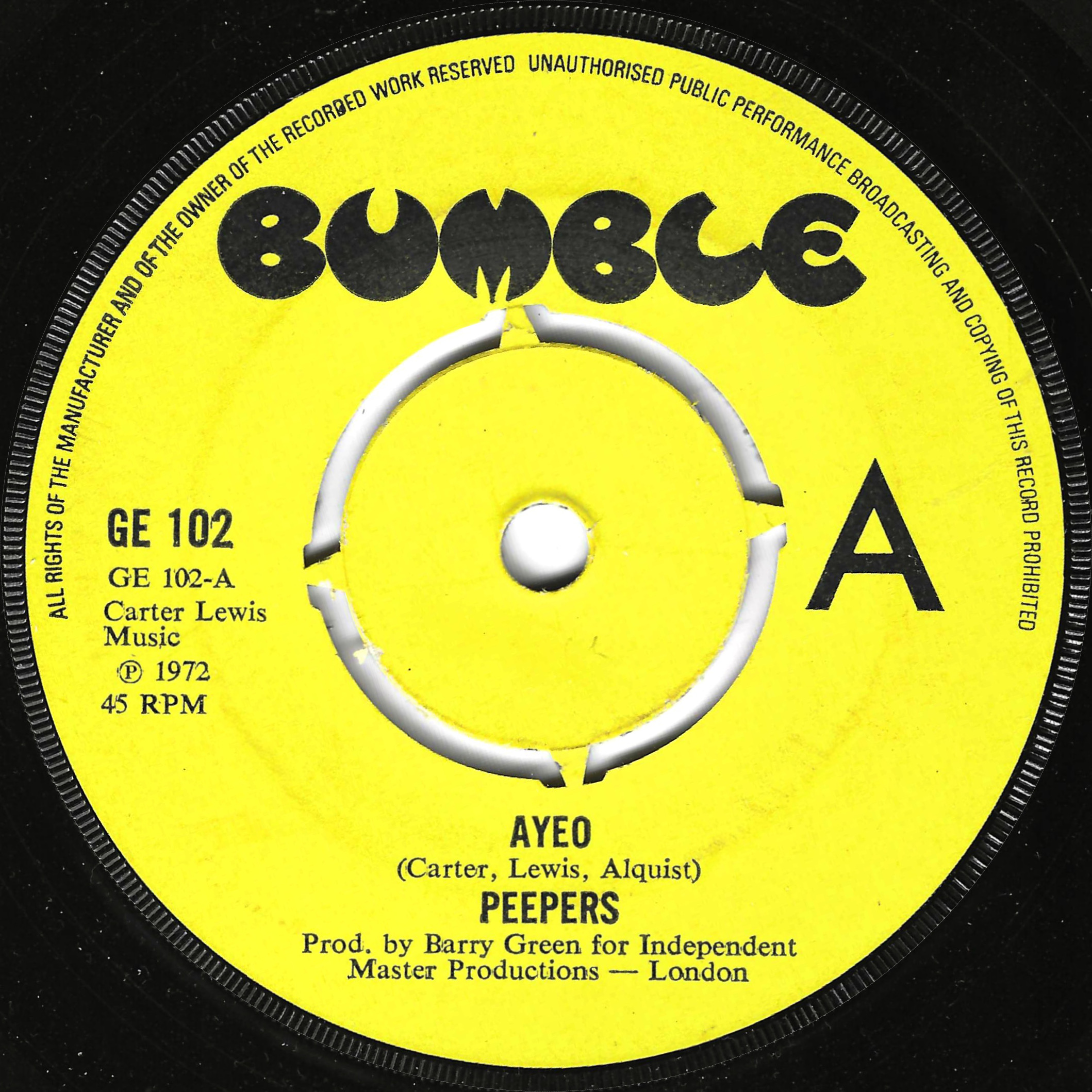
The Peepers - Ayeo/ A Heavy Drinking Ego Shrinking Doctor


Glam glee from act who were known as Express Delivery a mere year before

Label: Bumble
Year of Release: 1972

Sometimes while rooting around record stores and eBay, I stumble upon singles which clearly had serious backing and familiar names attached. And that's exactly what we've got here - a Carter, Lewis and Alquist songwriting credit and a Barry Blue production (aka Barry Green) all of which should add up to a sizeable hit.

That wasn't to be, though, and while in fairness "Ayeo" doesn't sound like 1972's definite monster single, it's groovy, neat and nagging enough that you can only suspect that it might have crept through under other circumstances. The fact it was issued as the tiny independent Bumble label's second single probably won't have helped, leaving its fate to a new, inexperienced outfit who had yet to firmly establish themselves (and as it turned out, never really did).

The flip side, the oddly titled "A Heavy Drinking Ego Shrinking Doctor" is a Rolling Stones-esque groove which isn't quite as freaky as its title would suggest.

6 March 2022

Tag - Off Down The Road/ Guitar Lover


Insistent, stomping and surprisingly under the radar glam number 

Label: Philips
Year of Release: 1975

When the compilation "Velvet Tinmine" first saw the light of day in 2003, I was convinced that record collecting was about to enter its next phase and keen buyers of psychedelic rarities would move on. After all, the paisley wallpapered barrel was beginning to ring rather hollow with collectors raving about non-event discs like Barnaby Rudge's "Joe Organ & Co" - it seemed as if there might be more undiscovered fun to have in the glitter bin on the right.

In retrospect, this was naive of me. There's not an enormous amount of crossover between the two audiences and while psychedelic pop certainly had its heavily manufactured moments, glam rock was often seen - even by serious musicians at the time - as being cheap pop performed by old lags for the ears of teens who knew no better. While glam singles therefore picked up a lot of love from open-minded pop pickers, psych collectors in general couldn't have cared less and there remain quite a few glam gems which don't command excessive prices.

This, naturally, is one of them. "Off Down The Road" hasn't been included on any compilation to the best of my knowledge, and has an astonishing amount of welly. Opening with a pounding piano, it quickly picks up pace with the stomping rhythm entering rapidly, then the group lean so heavily on the song's hooks you fear they might snap, but they never do. The track builds and builds, throwing in the usual foot stomping and chants of "hey!" but never becoming tiresome for all its repetition. It's pop with a capital P, operating somewhere between Kenny and those cheeky scamps Hello.

16 January 2022

Terry Webster - Keep Violence Down/ Someone's Following Me Around


Paranoid, agitated glam pop for the working man

Label: Pye
Year of Release: 1974

Terry Webster is no stranger to this blog. He was the singer and bass player in Wes Minster Five whose solitary single we've discussed on here already, and I've also only just realised that he was behind the seventies novelty track "It's The Fonz" by Tom Catz which we featured way back in 2012. 

From this you would probably fairly deduce that Mr Webster has been a very busy man with a long recording history (and also that this blog has been going for long enough that we're going to bump into the same characters again occasionally). His professional career began to bloom in 1959 when he was the backing vocalist and rhythm guitarist in his sister Patti Brook's backing group The Diamonds. Having won the Soho Fair Vocal Group contest they were promptly given a management deal and signed to Pye, though none of the records were hits despite prestigious tour support slots with The Shadows and Emile Ford and The Checkmates.

By 1962 he had moved on to become the bass player and vocalist in Jet Black's group The Jetblacks, then after Black moved to the USA and that gig ended, he moved on to Wes Minster Five for a number of London gigs and one very obscure, regional release on the Carnival label. 

Arguably one of his most sought-after singles is "Meanie Genie", released under the name Tony Brook and released on Columbia in 1964. An early example of the kind of disc eBayers may now describe as a "pounding mod stormer", copies have become unbelievably hard to obtain. 

Webster's career then turned into a dizzying array of light entertainment, jumping all over the place from comedic cabaret performances to stints in the Rockin' Berries then finally, perhaps almost inevitably, to an attempt at a straightforward pop career in the seventies. As just about every accomplished performer from the sixties from David Bowie to Bernard Jewry (Alvin Stardust) and Kiki Dee began to find the tide turning in their favour in the following decade, accomplished performers with age and experience on their side became in demand in ways they perhaps haven't always been since.

5 December 2021

Wildy - No Smoking/ All The Children (Nice To Be Home)


Distinctive vocals meet track on the cusp of art-glam and New Wave

Label: Paladin
Year of Release: 1976

On occasion, you stumble across a vocalist who style is so distinctive that your initial response is almost to laugh. It's not that they're a terrible singer as such, but that the areas they explore are so weird and so unanticipated that it's a shock to the system - but then, it all slowly and surely begins to make sense, and their efforts seems utterly inspired. 

Wildy definitely falls into the above category. With a voice that recalls Noosha Fox and to a degree pre-empts Cerys Matthews, she purrs, cracks, screeches and belts across the panther prowl rhythms of the A-side "No Smoking", but saves the impressive histrionics for flipside "All The Children" which breaks out the tinkling piano lines and hammering guitars, veering from one extreme to the other in a way which feels exhausting even with its slight sub-three minute running time. It's unlikely Kate Bush was listening, but it manages to evidence that there were other equally inspired and unique types hurling themselves around the outer zones of pop's landscape.

Frustratingly, I can find out absolutely nothing about Wildy beyond the fact that she also seems to have issued a demo tape in 1990 called "Stick To It!" which is apparently more synth-pop in its stylings. If anyone has this or has heard it, I would be thrilled to learn what it contains. 

29 September 2021

Reupload - Anton - Shot Down In Action/ Mine All Mine


Thundering glam single from the Spark stable

Label: Spark
Year of Release: 1975

It really does seem as if the vast majority of Spark's output throughout the sixties and seventies sold a few hundred copies (if, in some cases, even that) before being melted down. Their catalogue is littered with surprisingly good little singles which are astonishingly difficult to track down, and here's another example.

"Shot Down In Action" is a piece of dramatic seventies glam pop with a pounding intro, chiming piano lines, and an excess of drama. It's strident, catchy, flamboyant and has a surprisingly ambitious arrangement for a song of its type - this is no bonehead cruncher. If it's guilty of anything at all, it's perhaps being a little bit past its sell-by date by 1975, just as the spotlights were starting to dim on anything with a vaguely tinsel drenched sound.

The flip "Mine All Mine" is a rather bland Barry Blue penned ballad, and not worth getting fussed about.

8 August 2021

Flight - Overnight Sensation/ It's Only Money


Satirical sneering at the Glam Rock swindle

Label: Buk
Year of Release: 1975

Some years ago a friend of mine found a pop music history book with a publication date of 1973 in a local charity shop, and sat and sniggered to himself about the perspective from that frozen point in time. The closer the narrative got to the year it was released, the wonkier (or less accepted by modern day standards) the perspective got. In particular, the end chapter looked forward to the future and made bold claims for Glam Rock, stating that it was the pop sound of the future with far-reaching influences, a sound that would reverberate throughout the ages and flex the pop sound into brand new shapes. 

I'm a lover of Glam myself and don't want to casually dismiss its influence, but in retrospect it's apparent that there were rumblings, whinings and bleepings going on in the world of electronic music at that time which would hit much harder on the future of pop music than the thud, chant and thwack of glam. David Bowie has unquestionably been a huge influence on numerous 21st Century artists, but even his most ardent fans would have to admit that it's his Berlin era albums (when he had one ear on influential and forward looking German sounds) and "Scary Monsters" that sounded more futuristic and prophetic than the adventures of Ziggy.

These are the perils of trying to predict the future with confidence. It's far too easy to become a cheap and careless soothsayer and predict that in the year 2076 we'll be listening to the music generated by our houseplants. And anyway, even at the time not everyone agreed with the more forgiving mainstream assessment of glam, with many (particularly prog fans) seeing it as little more than tinsel and tat, a circus filled with aged opportunists and their dodgy managers, a cheap passing craze no more relevant than skateboards or hula hoops. 

In 1974, First Class stuck the boot in with "Bobby Dazzler", a brilliant, sardonic and faintly bitter single about ageing rock stars hitching a ride on the glittery comet trail. "What they trying to do to you?" they sang. "They tell you what to wear and how to comb your hair/ and everything else you do". Alvin Stardust might have winced if he hadn't been too busy to hear it (presumably). 

Then in 1975, just as the glam party was truly on the wane, Flight spat on the dying patient by putting this one out, a 10cc-esque sneer at the pop tat around them. The band adopt a Bay City Rollers chug and sing "We're the latest and the greatest to be born" through their teeth. "We're our manager's creation/ and we love the adoration" they add, just to hammer the point home. 

31 March 2021

Reupload - Bryan Evans - Dont'cha Like Boys/ I Cry For Me


Camp glam classic given a straighter approach

Label: Pye
Year of Release: 1978

Keen "Left and to the Back" readers will know that some months ago, I uploaded Starbuck's "Do You Like Boys?" for everyone's delight and delectation. There's much more about the flop disc here (beneath the blurb about the equally fascinating Prowler single) but in a nutshell, it was a gay glam rock record which failed to pick up much radio airplay. "Do you go for a mean, aggressive bear?" Starbuck asked their listeners forcefully.

The plot gets much thicker, because a full five years after that single flopped, Bryan Evans decided to have another bash at making it a hit, albeit with Howard and Blaikley's original lyrics dramatically altered to obscure the original reading. Gone are the references to homosexual attraction, and instead the song could be interpreted as Bryan selling himself as something of a ladies man, seemingly questioning whether the woman of his desires is either asexual or a lesbian. "Dont'cha Like Boys?" he asks, while squealing analogue synths go off around him like personal attack alarms. Of course, if you've heard the Starbuck original first, it's hard to hear the question in quite such a way, and it still manages to seem flamboyant and camp. The directness is lost, and it's become an object of ambiguity instead.

It's a baffling addition to the Howard and Blaikley canon, but you can't blame them for trying to turn a brilliant single into a proper hit. By 1978, though, the analogue keyboard sounds and stomping glam beats really were yesterday's news, and it stood not a hope in hell. A shame, as this is a spirited and different approach which at another point might have lead to success.

6 January 2021

Reupload - The Sad - It Ain't Easy/ Box


Bi-sexual glam rock on the woes of extra-marital sex

Label: Phoenix

Year of Release: 1971

You've probably already guessed from the very fact that I wrote about Starbuck's "Do You Like Boys" not long ago, but overtly gay glam rock fascinates me. To put it into historical perspective, until 1967 homosexual activity was illegal in the UK. Glam rock may have arrived in the middle of a new, forward thinking decade, but it was still a mere few years away from some rather heavy-handed bigotry. There were still plenty of intolerant, prudish, vinegary "silent majority" types on the prowl who might have in some instances accepted the ban on homosexual activity being lifted, but almost certainly still didn't want to hear from the people who "did that sort of thing".

Which makes singles like "Do You Like Boys" and this one, "It Ain't Easy", truly astonishing. David Bowie putting his arms around Mick Ronson on "Top of the Pops" could have been interpreted in a number of ways and shrugged off as an innocent matey gesture. This single, on the other hand, is upfront and blatant, and frankly couldn't give a fig.

Telling the tale of a married rock star who is incapable of remaining faithful to his wife, and happily sleeps with both men and women depending on which mood he's in, it's very daring for 1971. Of course, it's impossible not to feel a little sorry for his wife, though one can only assume that she was forewarned. If not, the issue of this single may have acted as a highly inappropriate public announcement. "It ain't easy for my wife to live with me!" declares the stadium chant chorus, while the singer backs this up with "There's always some young girl or even boy in sight/ and I don't care it's what I take home at night".

26 July 2020

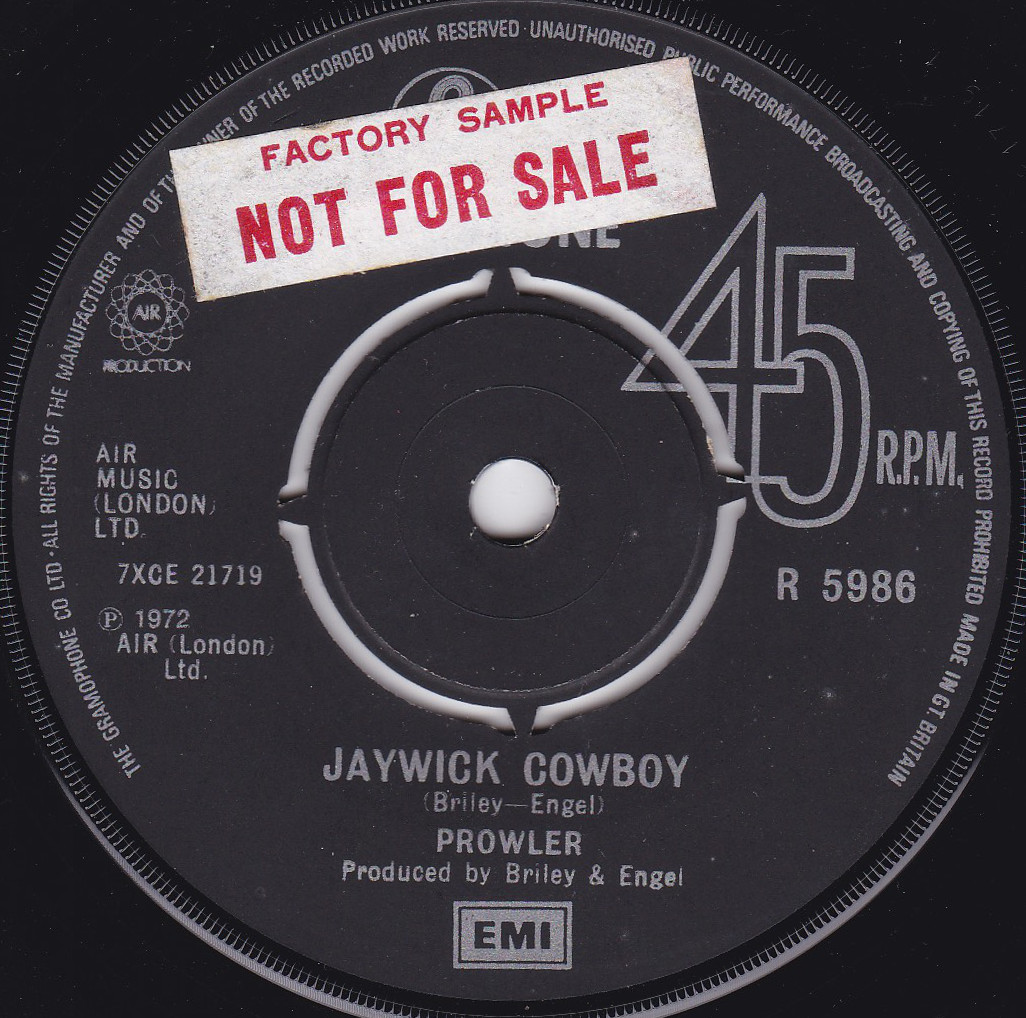
Reupload - Prowler - Pale Green (Hmmmm)/ Vauxhall Driving Man/ Starbuck - Do You Like Boys


None-more-seventies stranger danger 45 and camp glam rock about "mean aggressive bears"

Label: Parlophone
Year of Release: 1972

Mandrake Paddle Steamer's "Strange Walking Man" is one of the more widely compiled psychedelic singles of the sixties, and something of a collector's dream. Operating in a similar sonic space as the most woozy and uncertain sounding post-Barrett Pink Floyd tunes of the period, its exposure perhaps suffered due to it being released in 1969, long after the sun set on LSD-tinged pop.

Mandrake remained skint and struggling around the London gig circuit for some time after the single flopped. Their principle songwriters, Martin Briley and Brian Engel, do not remember the period fondly - somewhat ignobly for an underground circuit figure, Martin Briley remained living at home with his parents. When it became apparent that the group didn't have a viable future, Brian packed his bags first, and Briley followed a year later. 

Martin Briley quickly managed to land a job as a songwriter at George Martin's newly created Air Studios empire, and finding working by himself less successful than the collaborative work he had attempted with Engel before, he got on the blower to his old Mandrake mucker and the pair reunited again.

Scores of songs resulted from this, many of which have been compiled on the RPM Records CD "Between The Sea and The Sky". This, however, was the only single. "Pale Green Vauxhall Driving Man" is arguably one of the more deliberately oily, creepy pieces of work to slip out during the seventies, an era which contained plenty of competition. A slinking, swaggering guitar riff backs the story of a middle-aged pervert attempting to pick up very youthful women (how young? We're not told) in his Vauxhall vehicle, where he then attempts to drug them with "sticky brandy balls". 

To the credit of both Briley and Engel, the track doesn't attempt to remark upon the man in an approving way, stating quite clearly "I'm that nasty, shifty kind/ That greasy nineteen-fifties kind", making it closer to a piece of Lou Reed observational work than a Rolling Stones piece of glorification on the virtues of sleaziness. However, it's a distinctly unconventional subject matter backed with some absolutely killer songwriting - that winding guitar riff and the anthemic chorus are truly brilliant pieces of work.
Sadly, the pair ran into issues with the track almost immediately with the BBC, apparently not due to the subject matter so much as the "commercial placement" in the track, by mentioning the Vauxhall make of cars. The track was hastily redubbed to include a Moog humming noise over the offending "Vauxhall" line, rendering the lyrics a bit mangled, and also somewhat strangely ignoring the fact that "Vauxhall" is still clearly audible outside of the chorus. The title was also changed to the baffling "Pale Green (Hmmmm) Driving Man". What a peculiar situation. Suffice to say, the BBC still wouldn't play the track, and it flopped.

Both the A and the B side are compiled on the aforementioned "Between The Sea and The Sky" album, and I'd recommend you head off to your nearest online audio store to buy "Pale Green..." at least. The flip, "Jaywick Cowboy", is somewhat messy and less deserving of your attention. I've included sound samples below, but the A-side is readily available in full on YouTube.

For the next part of the Engel/ Briley story, please scroll past the soundfiles.


Label: Bradleys
Year of Release: 1973

Despite recording swathes of material for Air, only "Pale Green..." managed to get granted a release. The pair were on the Spark label for one LP under the name Liverpool Echo, and the pair's next dose of fortune would come courtesy of those Tin Pan Alley stalwarts Ken Howard and Alan Blaikley, who needed musicians to get involved in a glam rock project they had on the go.

Rumours have circulated the internet for some time that Starbuck (not to be confused with the identially named USA band) were a studio-based creation, but in fact both Briley and Engel toured with a full group, and they were a "functioning unit" on the British circuit. Three singles were issued by the band, "Wouldn't You Like It?" (on RCA), followed by "Do You Like Boys" and "Heart Throb" on Bradleys. Absolutely all of these are worth tracking down as supremely underrated pieces of glam, but "Do You Like Boys" is truly the jewel in their crown. 

Taking a camp and distinctly Bowie arrangement, the title of the song pulls no punches and the lyrics inevitably do exactly what you'd expect. Subtle references to homosexuality were common enough during this period, with androgynous looking aliens putting their arms around Mick Ronson on "Top of the Pops" being just about acceptable, but "Boys" is a total hammer blow. "Oh, do you LIKE boys?" Starbuck sing pleadingly, like Brett Anderson out of Suede pouting on the back of a pantomime horse, later going on to be more specific - "Do you really long to touch their hair?/ do you go for a mean, aggressive Bear?"

Howard and Blaikley really pushed their luck to the max here, and did so in a popular culture which apparently (according to gay singer-songwriter John Howard, who claims the BBC blacklisted him) was deeply uncomfortable with overt, unquestionable, non-comedic references to homosexuality. Starbuck, however, got utterly behind the material live, despite apparently being straight. They were once booked to play at a skinhead club at Chatham in possibly one of the more baffling decisions a promoter has ever made, and took the stage with full make-up, performing with the campery pushed up to the max. Amazingly, no violent incidents were recorded.

12 July 2020

Reupload - New Inspiration - Medicine Man/ Is It Really Hard To Understand


Fantastically groovy, pounding rocker from Belgian group

Label: Penny Farthing
Year of Release: 1973

Now here's a tricky one - I can happily provide you with some limited facts about New Inspiration, but not bagloads. It would seem that they formed in Ghent, Belgium in the late sixties and were spotted by Dave Berry while he was touring that country. Berry quickly decided to act as their mentor, and penned additional material for the group, undoubtedly acting as a factor in getting them signed to Decca in their native country.

Stacks of singles and three LPs followed their signing, buried among which are apparently some surprisingly psychedelic tracks, including the mournful "Hurry Up and Tell Me". Much of their early work is obscure for a reason, though - faintly under-produced and with heavily accented vocals, it doesn't really stand up against the cream of the period.

By the seventies, however, they had moved in a more successful, rockier direction where the earlier flaws had been ironed out, and it's from this period that "Medicine Man" stems. For all their usual heaviosity, though, this single is something of a dancefloor treat, featuring pounding drums, whooping backing vocals and a chanting chorus so successful that it forms the basis of three-quarters of the track and gets away with it. Elements of it do drift frightening close to Creme Brulee's "Voodoo Lady" conceptually, but it's no piece of half-arsed plastic glam. This is actually fantastically and insistently groovy, in a manner which Bobby Gillespie might approve.

21 June 2020

Greengage - 20 Flight Rock/ Don't Cry Little Girl


Under-the-radar Moog-infested glam rock

Label: Philips
Year of Release: 1975

Given the numerous CD compilations which have sought to hoover up the best glam rock offcuts of the seventies, it's surprising how many decent singles are still lying beneath the radar of even most collectors. Take this one, for example - it's a cover of Eddie Cochran's "20 Flight Rock" which rips the original out of the fifties and slams it nose-first into a Moog with loose greetings card glitter all over its keys. 

Clearly, Greengage were working to a successful formula here already, and they wouldn't be the first or last artists of the era to take a fifties rock and roll classic and paint it dayglo. It's an unfamiliar joy, though, and will have you stomping your feet around your boudoir and distressing your downstairs neighbours in no time. Those Moog screeches and whines only add to the sense of crunching anarchy and excitement.

Greengage consisted of Denny Brooks, Geoff J. Lord, Lee Stevens, Mike Brooks, Paul Haines and Phil Stonehouse, and managed to put out seven singles in the seventies, four on RCA and three on Philips. Despite the faith shown by both labels, they never managed to produce a hit, and as the eighties dawned only appeared on vinyl again through vanity pressings presumably intended for the cabaret and working man's club circuit. Judging from the noise on offer here, there's little doubt they'd have been in demand for knowing their way around a rocker, and the B-side hints at their abilities with starry-eyed weepies too, although it's a little bit too teenie in its tones for my taste.

29 April 2020

Philadelphia Brown - 1-2-3/ Philadelphia Rock


Glammish pop take on the soul classic by ex-Angel members

Label: Strawberry
Year of Release: 1975

Well, here's a strange flop from the barren pop wastelands of 1975. According to the ever-reliable Seventies Sevens website, Strawberry Records was a teen orientated label launched by the Vogue Choice management agency in August of that year, but only issued three singles, two of which were by this bunch.

Who were they and why we were only briefly subjected to their charms? That's where things get slightly confusing. Music Week at the time referred to them as an "unknown soul singer" rather than a fully fledged group, which would suggest that Strawberry's press department only did half a job of launching them, as all other sources clearly state they were a pop band. Despite these unnecessary red herrings, it looks reasonably certain that both the guitarist Bob Banasiak and the drummer Brian Johnson were both members, and given that both were previously also involved with the Cube Records signed Angel, it seems safe to assume that Philadelphia Brown were their next project following that group's split.

It's hard to mess up a song as strong as "1-2-3" and they don't, choosing instead to add a bit of teen stomp, sparkle and sunshine to the tracks rather more gritty origins. The repetitious nature of the song means that it doesn't carry quite so well as something slightly less dancefloor orientated, though, and I can't help but wonder if that's half the reason it flopped. Far more interesting to me is the dubby wah-wah instrumental version on the B-side which was probably tossed off in half-an-hour, but showcases the group's abilities in a way that at least makes your feet twitch. 

23 February 2020

Reupload - Buzz - The Digger on Mars/ Jubilee Rock


Fascinating bit of atmospheric proggy glam on the flip of a Silver Jubilee novelty 45

Label: Crystal
Year of Release: 1977

Another record with something unusual and interesting on the flip, and something utterly insubstantial on the A-side. The 1977 Silver Jubilee only really produced one single which anyone still talks about, and that's The Sex Pistols "God Save The Queen". There were others which took a much more positive tone, such as Neil Innes' seldom referenced (by him or anyone else) "Silver Jubilee", or a multitude of associated singles BBC Records and Tapes slipped out. None made any real impact with the public, and it might be tempting to think that's because we're a bunch of Republicans at heart, but I rather suspect it had more to do with the quality of the material on offer.

Take this A-side, for example, a forgettable piece of chugging pop-rock with some boy scouts and girl guides singing on it. It was surely intended as a joyous party record, but nobody involved sounds enthused enough to really carry it. The vocals alone sound like the work of somebody who was keen to get the whole business over and done with as quickly as possible.

The B-side gives us some clues as to why, and makes it apparent that this clearly wasn't a band whose ambitions lay with Royal event novelty tie-in singles. It sounds out-of-time for 1977 but also notable. Clearly taking its cues from both the David Bowie and Pink Floyd back catalogue, "The Digger On Mars" combines whizzing analogue synths, chugging Glam Rock guitars, and a surprisingly ambitious arrangement. Just when you think the song has settled into a knuckle-dragging, punchy glam rut, there's a superb middle-eight which sounds almost prog in its leanings, a "Dark Side of The Moon" inspired piece of spacey introspection. Then the drums burst in again, the song returns, and this time buzzes full-throttle into something much more minimal and repetitive and almost - but not quite - motorik. A three minute song of clear thirds, then, and the last thing on Earth you'd expect to find buried on the back side of a Royal Family tribute record.

1 December 2019

Reupload - Edwina Biglet and The Miglets - Thing/ Vanessa's Luminous Dog Coat


Absurd and inexpliable novelty Moog single with atmospheric flip

Label: RCA
Year of Release: 1972

Nothing causes me to gravitate to a flop record more than a completely ridiculous group name, and if the song titles are off-the-wall as well, then my money is as good as yours (provided, of course, we're not talking excessive amounts. I'm not that stupid). Edwina Biglet and The Miglets is arguably as stupid a name as seventies glam rock ever spawned, and for that at least we have to salute the individuals involved.

More than that, though, "Thing" is is a chirpy Moog-infested track about... er... well, it's not really clear exactly what it's about, actually, and I doubt if you asked anyone involved they'd be able to tell you either. The intro promises an utter proto-techno noisefest, but it quickly calms down and establishes itself as something altogether more vacant and silly. The lyrics seem to involve various characters with different English accents bragging about a "thing" they own. It could be sexual innuendo at work, but the descriptions given defy logic and reason, as the "thing" is described with electronic squelches, buzzes and bleeps. It lights up, it's fun to play with, people think it should be banned, and your guess is as good as mine. 

More appealing to Moogheads out there is probably the B-side, "Vanessa's Luminous Dogcoat", an almost groovy jam which, had it been released by some obscure French artist would probably be commanding insane money on eBay now. As it stands, we're left with a record that neither charted - despite receiving modest amounts of airplay - nor really holds its head high in the collector's market, which given the double-sided oddness on offer seems a bit unjust. It won't be the best single you hear all year, but there's something irrepressibly charming about it. 

6 October 2019

Reupload - Hackensack - Moving On/ River Boat


Seering, high-paced and relentless rocker from 70s circuit faves

Label: Island
Year of Release: 1972

In the late sixties and early seventies, music began to be appraised by certain selective punters not just by how melodic or innovative it was, but how loud and heavy, especially in the live environment. Bands began to obtain huge amplifiers and stacks affordably, and thus acts such as Blue Cheer described themselves as being capable of turning the air to cheese with their sheer racket. Presumably nobody asked for a refund when the venue around them didn't transform miraculously into rich Brie.

Hackensack were renowned for being one of Britain's heaviest blues rock bands in the early seventies, and became quite a draw on the live circuit, chalking up 270 gigs - but naturally, their high voltage and volume attacks failed to cross over into record shop sales. 1974's Polydor released album "Up The Hard Way" was cultishly successful, but not enough to convince anyone that they had a reasonable commercial proposition on their hands, though it has since become a highly collectible item. Thus Hackensack were kicked back on to the small venue circuit before giving it all up, an unissued live album apparently languishing in the Pye vaults.

This is their solitary single, and consists of two quite different halves. The A-side "Moving On" chugs along and swings merrily, and actually has an almost glam rock chorus which sounds like it might have been borrowed from Iron Virgin or one of the many flop tinseltowners of the day. It's perfectly good, but it's the B-side that really shows what Hackensack were capable of. "River Boat" is an absolute dumb-ass assault, riddled with a primal, almost garage rock riff which needles away throughout. Vocals scream, cymbals crash, and the whole thing is a fine example of how the 60s punk tradition naturally morphed into Serious Rock in the early seventies. So downright distorted and compressed is the track that I had to have three goes of ripping it from vinyl before getting the right volume control - it sends all the needles flying into the red even at low recording volumes. I still can't decide if I over or under did it.