JohnTem82387976
Showing posts with label The Beatles. Show all posts

5 November 2023

The Pineapple Chunks - Drive My Car/ Dream About You


Label: Mercury
Year of Release: 1966

Maybe it's a generational thing, but when I hear "beep beep, beep beep, yeah!" the first thing I think about isn't The Beatles "Drive My Car" - as it damn well should be - but Radio One's traffic news jingle from the eighties. You know, the one which cheerily went "Traffic neee-eews, on Radio Wuh-hu-hun!" while various motorists probably seethed in frustration out there in the real world (it's on YouTube if you really want to relive those bygone days).

This is stupid of me, because while it was never a Beatles single, "Drive My Car" was a well-known and highly appreciated number, included on many of their compilations, including the cheapo MFP release "Rock and Roll Music" I owned myself on cassette. It just wasn't such an ever-present feature as Radio One's persistent jingles. 

The BBC obviously weren't the only people to realise the track's potency, though, and the mysterious Pineapple Chunks took the long-favoured sixties route of recording a careful cover of a Beatles album track in the hope chart success would follow. With a tailwind behind it and the right production, the song of course could have become a smash - this probably isn't quite what the doctor ordered, though. The Chunks deliver it smoothly, gleefully and competently, but the driving, clopping rhythm and the occasional bursts of wildness on the Fabs original are obliterated here, replaced by something calmer and less edgy. It's not a bad performance, but the rhythm section in particular undersell the song; say what you want about Ringo Starr, but this is evidence that the man really did know what to do with Beatle tunes. 

The flipside "Dream About You" is more interesting, having an almost garage rock feel to it, with a droning organ riff sitting beneath the band's vocal harmonies and a twitchy, hyperactive but steady beat. 

22 June 2023

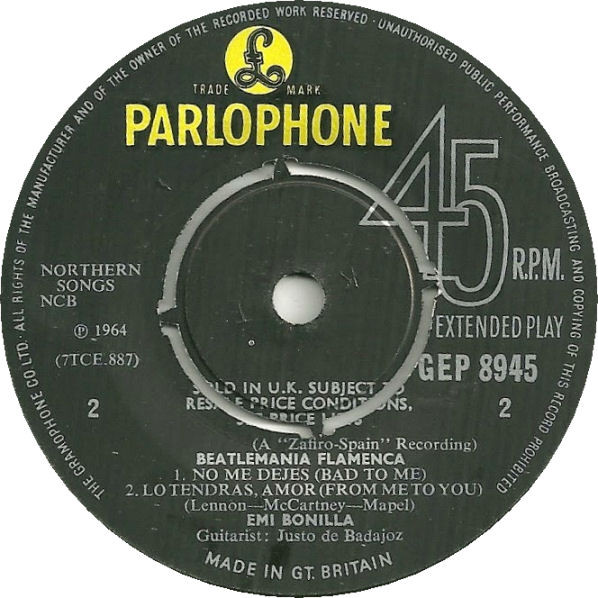
Emi Bonilla - Beatlemania Flamenco (EP)


The Fabs Take the Costa Brava Plane

Label: Parlophone
Year of Release: 1964

The sheer variety and quantity of Beatles cover versions out there never fails to astound me, and when I see a Beatles tribute record sitting on a shelf, I'm one of those suckers who just can't walk past. It's not that I'm expecting the efforts to usurp the originals, I just want to hear what new avenues have been explored, and any prospect at all of their recordings being bashed into weird and unusual shapes or thrust into unlikely contexts and cultures gets my heart racing.

Some of my purchases have been dire. The Band of the Royal Military Academy Sandhurst issued an entire LP of Beatles covers on the Hallmark label. This feels like an experiment in stuffing the Lennon and McCartney songbook into a beaker of water and boiling it with a bunsen burner until all that's left is a fine, tasteless grey powder. Sandhurst's square marching men remove all swing, emotion, mood and groove from the Fabs and reduce their songs to perfunctory marches, managing to make their output sound formulaic and drab. Still, some might call that a statement. 

Emi Bonilla, on the other hand, was (is) a wild, impassioned flamenco peformer who stuffs so much energy and loud vocalisations into the Beatles ouevre that at points here, it sounds almost unrecognisable. There's no questioning its authenticity either - this isn't polished, slickly produced tourist shop flamenco (if such a thing existed in 1964) - this is a dusty, stomping lo-fi racket which despite lacking a beat actually sounds more raucous and uncontrolled than The Beatles were at this stage of their careers. It's not as if any of it was going to get teenagers screaming, but it's rough and raw and probably gave George Martin panic attacks rather than provoking fainting fits among the youthful hordes. 

31 May 2023

Reupload - Rhys Eye - Yellow Submarine/ I Just Can't Lose That Tune


Fascinating but sombre reading of the jaunty Beatles tune

Label: Epic
Year of Release: 1975

"Yellow Submarine" is probably one of the less analysed Beatles songs in their oeuvre, despite being one of the best known. At my infant school, it was wheeled out for sing-a-longs in school halls that whiffed of chips and baked beans, and it was a track I was used to hearing soundtracking cartoons or during intervals at local children's theatre shows. Marrying upbeat melodies to nonsense lyrics, it seemed like the very definition of "harmless fun".

Clearly not everybody thought that way, though. Paul Phillips, who would later on find brief fame as Driver 67, was troubled by the sense it was an "other-worldly excursion into all sorts of sub-conscious emotions that I couldn’t put my finger on". When he eventually had gainful A&R employment at CBS he was surprised to find someone who agreed with him turning up to an audition.

Peter Bennett, who recorded and wrote under the name Rhys Eye, dropped by insisting he had a fantastic idea, but if he simply told Phillips what it was there was every possibility he would be cut out of the picture and find it being used by another artist on CBS. Phillips arranged for a legal waiver to be signed stating that whether he accepted or rejected the idea, it would remain the intellectual property of Mr. Eye.

And this, amazingly, was it - something that confirmed Phillips wasn't the only one bowing his head solemnly to Ringo's honking about strangely coloured submersible warships. Bennett's idea was a heartfelt, bluesy, troubled take on a Beatles song most listeners haven't really bothered to read much into. In Rhys Eyes' hands, "Yellow Submarine" becomes reflective and regretful, sounding like a hymn to lost childhood, lost friends and perhaps lost innocence - or, more than that, a nostalgia for absurd, exaggerated things that were never truly as the singer believed them to be eating away at him like a slow poison. 

Whether it works is something not everyone is going to agree on, but it certainly fits the modern music business model of finding opportunities for plaintive, melancholy expression in the most unlikely source material. If an advertising executive from John Lewis hears this and doesn't use it in their next Christmas campaign, then I'll be lost for words.

21 May 2023

The Zoo - She Said She Said - Good Day Sunshine/ Where Have All The Good Times Gone


Two song Beatles medley (and Kinks cover) from Ohio garage rockers

Label: Parkway
Year of Release: 1967

One of the more finely observed aspects of "Spinal Tap" is the way the group went through so many name changes before settling on their sinister moniker. Digging up facts about obscure sixties groups comes with plenty of challenges already, but the fact so many of them struggled to settle on a working group name complicates matters further. 

Ohio's The Zoo were yet another one of those restless cases. Starting life as the Beau Denturies in 1964, they gigged around the local area and following a victory in a WAKR battle of the bands contest issued "Don't Quit Now" on the Encore label in 1966. 

Perhaps realising The Beau Denturies was a pretty awful name, they promptly changed it to The Yellow Pages to issue this track on Encore in March 1967. The directory company they'd named themselves after promptly objected, and it was shelved and subsequently released again under the name The Zoo in May the same year, this time on the Parkway label.

It's a curious attempt to wedge the last track on Side One of "Revolver" and the first track on Side Two together; the uneasy, disassociated "She Said She Said" and the bouncy "Good Day Sunshine". By rights, the two don't feel as if they should be existing in the same 45rpm space, but the group find a way of making it work, partly by virtue of taking the rubbery bounce of "Sunshine" and hardening it up somewhat with distorted buzzing chords, and taking the trippy darkness of "She Said" and adding some perk. 

Is it a worthwhile artistic endeavour? Good question. The liberties taken with the original arrangements are hardly radical, and there's probably no particular reason you'd need to reach for this record over the original "Revolver" tracks. Despite this, it's a cheery bit of work which predates The Beatles own "Abbey Road" device of meshing their work together in medley form (and Stars on 45, for that matter, but let's not go there).

17 May 2023

Reupload - Tony Merrick - Lady Jane/ Michelle


A Stones cover one one side + Beatles cover on the other = near-hit single

Label: Columbia
Year of Release: 1966

Depending on how far you want to push or stretch the term, Tony Merrick could be regarded as a one hit wonder thanks to this single. It spent a solitary week at number 49 in June 1966 before dipping back down under the waves again - so close and yet so far.

It's not too surprising it was at least faintly in-demand for awhile. Both sides cover the two biggest hitting bands of the sixties, with "Lady Jane" taking on Jagger and Richards and "Michelle" naturally being another cover of The Beatles track. The A-side here is beautifully arranged, sounding like a touching and innocent piece of baroque styled pop, with strumming harpsichord sounds meeting plucked nylon guitar strings. Merrick's vocal performance is gentile and ever so slightly arch, suiting both the song and the arrangement.

"Michelle" on the flip side is less interesting, unfortunately, though it's not a Beatles track of which I'm especially fond, so your experience of it may differ.

28 September 2022

Reupload - Symbols - Blackbird/ Great Swamp Symphony


Mike Post produced Soul/ gospel reworking of The Beatles track

Label: Bell
Year of Release: 1971

Just when you think you've been made aware of all the one-single wonder groups whose sole effort was a Beatles cover, another rears its head. Sometimes it's like one big game of whack-a-mole where all the rodents are wearing Woolworths Beatle wigs.

Soul and reggae covers of Beatles tracks are by no means uncommon, and "Blackbird" should perhaps be considered one of the most appropriate choices for politically minded groups during the sixties and seventies. Apparently written by McCartney partly in response to the black civil rights struggle in America, "Blackbird" may act as a discreet, delicate, folksy moment on "The White Album", but its background message had a far greater power potentially waiting to be amplified. 

This clearly wasn't lost on The Symbols (or the ska group The Paragons in 1973) who deliver a much punchier, less subtle version of the song here. Gospel vocals holler "Fly blackbird fly!" at regular intervals while the arrangement of McCartney's original finger-plucked version is swamped by strings and roaring vocal harmonies. It's transformed from a plaintive and pretty tune into a sweeping, panoramic piece, like something you would expect to hear in the concluding dramatic moments of a motion picture. 

16 September 2021

Reupload - The La De Das - Come Together/ Here Is Love


Slick and likeable cover of Beatles track from Kiwi heroes

Label: Parlophone
Year of Release: 1969

The La De Das were one of New Zealand's premier rock groups in the sixties, scoring regular top ten hits in their home country and styling themselves in a slick mod fashion. Their 1966 number 4 NZ hit "How Is The Air Up There" has such a raw, raucous sound that it was an obvious shoe-in for the "Nuggets II" box set issued by Rhino Records, holding its own very comfortably alongside the garage and psychedelic rackets offered up by other international groups on the compilation.

In the manner of many groups "down under", they got itchy feet and began to seek out touring opportunities in the northern hemisphere by the late sixties. These plans included a stint in Britain in 1969, resulting in recording sessions which created this particular single. Clearly hearing an opportunity in the singles market place for a cover version of The Beatles "Come Together", this slick, reverb-ridden version emerged at the beginning of October 1969 (under the name The La De Da Band for some baffling reason) a mere week after "Abbey Road" was released, and a few clear weeks before The Beatles "Something/ Come Together" double A-side hit the shops. It's an interesting cover which doesn't take many liberties with the original arrangement, but somehow does have an unfamiliar, mellow warmth. While The Beatles version has a faintly threatening edge, this one beckons the listener into the studio jam in a welcoming fashion.

Suffice to say, most members of the British public were quite happy to wait until The Beatles version was released before parting with their money, and this single was a complete flop (and to be honest, even The Fabs could only get it as high as number four). The group eventually made their way back to New Zealand and continued to have a recording career there until the mid-seventies. They remain thought of incredibly fondly as one of New Zealand's most significant and popular homegrown rock bands, and were admitted into the Australian Blues Foundation's Hall Of Fame in 2003. 

21 July 2021

Reupload - Hard Meat - Rain/ Burning Up Years


Brilliantly sludgy, hazy, slacker cover of the Beatles classic

Label: Island
Year of Release: 1969

Hard Meat were a late sixties rock outfit consisting of two Brummie brothers, Michael and Steve Dolan, who were joined by Mick Carless on drums and other fellow travellers later on in their careers. Generally specialising in progressively leaning material, they're not a rich or fertile source for psychedelia.

Nonetheless, their debut single on Island was a cover of The Beatles "Rain" which predates the nineties trends for slow, stoner/ slacker rock by some margin. The band take the original song, tie it to their ankles and drag it across a swampy landscape. It's a lazy, hazy redraft of the track, and while at first there's a temptation to force the disc to spin at a slightly higher speed to bring it closer to the original beats per minute, eventually their sludgy vision starts to appeal. Those shimmering, clanging guitars soon win you over and cause you to flop back in your chair in blissful admiration. 

The B-side "Burning Up Years" reveals a more typical side of the group, being a six-minute melodramatic workout which takes the recorded grooves very close to the edge of the Island label. It has been compiled in other places and was covered by Kiwi psych-heads Human Instinct - take a listen on YouTube if you want to hear what the fuss might be about.

Hard Meat issued two LPs, neither of which featured "Rain". The first eponymously titled album emerged on Warner Brothers and is a cultishly popular hard rock effort which gets some denim-clad collectors hot under the collar. The second, "Through A Window", is more acoustically inclined and less frequently discussed.

28 April 2021

Reupload - Drew Ross - Close Your Eyes And Go To Sleep/ Let It Be


Zingy piece of pounding pop from Inverness solo artist

Label: CBS
Year of Release: 1970

In common with almost all the solo artists I seem to be finding singles by at the moment, I really can't find a scrap of information on Drew Ross. I know that he had two 45s out on CBS, this one and the 1971 follow-up "I'm Going Home". I know that both records sold poorly and are difficult to find copies of these days. Beyond that... nothing. Nowt. Nada. Zip. My best guess would be that he was a keen cabaret/ working man's club performer who got the chance to release a couple of singles on a major label, but that's based on the laws of probability rather than the conclusive results of my research.

I can't speak with any confidence about any of his other recordings, but "Close Your Eyes..." is really rather good. It starts off with a similar pounding gusto to Love Affair's "Everlasting Love" and continues in a similar plastic Northern Soul vein. Packed with optimistic brassy blasts and bouyant drumming, it's actually something of a tonic - a skippy, bouncy record, and the kind of bright, immediate sixties pop that absolutely nobody seems to be either attempting to emulate or take seriously anymore. It could have been a hit at the time, but quite clearly wasn't.

The flip is a rather pedestrian cover of The Beatles "Let It Be", which really doesn't add anything new to the song, and isn't as worthy of your time. 

17 March 2021

Reupload - Monsoon - Tomorrow Never Knows/ Indian Princess


The first Asian pop star in Britain (arguably) covers The Beatles
 
Label: Mobile Suit Corporation
Year of Release: 1982

Back in the early nineties, we were all told that the sudden deluge of pop stars from Asian backgrounds was an entirely new phenomenon. While it's true to say that the sudden arrival of Cornershop, Apache Indian and Asian Dub Foundation felt like a huge sea change, successful Asian influenced pop, performed by someone from that background, was actually nothing new. Sheila Chandra of Monsoon (previously an actress on "Grange Hill") had actually already broken down the barriers in the early eighties, a fact which seemed to have become largely forgotten.

The first single "Ever So Lonely" was released on the minor Indipop label initially, and was a surprise number twelve hit when it was reissued through Phonogram in 1982. It was a seriously unusual record in a year where the British charts seemed to have their arms wide open for the unexpected. Propelled along by a hypnotic rhythm and Indian melodies - albeit Indian melodies performed by Western musicians - it was almost like a slice of late sixties psychedelia being given a rather more authentic Eastern edge.

Follow-up "Shakti (The Meaning Of Within)" only just missed out on a Top 40 place, and was followed up with this, a Beatles cover. One has to wonder whose idea it was, but the finger of suspicion points at the record company. "Tomorrow Never Knows" is a Beatles track which has never been improved upon or really developed across the various cover versions its spawned (Danielle Dax, Brian Eno, Junior Parker, and er, sixties flop act Mirage have all had a stab at it). The original was a staggeringly forward-thinking piece of work with its studio effects and astoundingly persuasive drumming, to the extent that I actually believe the stories about nineties club DJs spinning it and being asked by their Ravy Davy punters "What was that wicked tune?!" It's the sound of The Beatles hive mind using the studio in the ways that sample-heads and drum loop fanatics would later rediscover. All the subsequent covers of it have actually been somewhat reductive - taking the frenzied activity of the original and simplifying it to something calmer, taking it away from its manic beginnings and into the psychedelic chill-out room. And I've never been wholly convinced by that approach, unfortunately. Half of its appeal lies in its mayhem.

Still, Monsoon's cover of this has a feel and attitude of its own, and is far from the worst example. It's probably most notable for also featuring Bill Nelson, David Balfe out of Teardrop Explodes on keyboards, and Merrick out of Adam and the Ants. Chandra's vocals are wonderful as ever, and drop a large dollop of innocence into the mix. None of this was enough to turn it into a hit, though, and at this point the tide went out on Monsoon's success.

20 September 2020

Reupload - Y Dyniadon Ynfyd Hirfelyn Tesog (EP)


Truly fantastic cover of The Beatles "Yesterday" from Welsh language folkies

Label: Sain
Year of Release: 1970

Judging from the sleeve, you'd think that Y Dyniadon Ynfyd Hirfelyn Tesog were a bunch of old-time swingers, a Welsh language version of the Pasadena Roof Orchestra producing good-time music for the gents and ladies. You would, however, be wrong. All four tracks on this EP have heavy folk leanings, albeit particularly wonky folk music infused with brassiness and, so far as I can judge, a bizarre wit.

The sleeve notes are in Welsh, which is frustrating from my point of view but entirely to be expected under the circumstances. The user TheJudge on 45cat has been kind enough to translate them, however, and hopefully won't mind me presenting them here:

"The Dyniadon Ynfyd Hirfelyn Tesog happened in the third quarter of the twentieth century, and already they are safe of their place in the gallery of pillars and pioneers of the rich culture of our dear Western Civilisation, walking alongside greats such as Ysbaddaden, Spartacus, the Son of the Hills, Mr Wimpy and others (i.e. Y Tebot Piws). Despite this, their debt is great.

It started as a group of 79, but because of transportation and other problems, there was a purge, and by today there are only 7 (oops) 6 left.

i.e. (in alphabetical order):

Aric Dafis - a pretty face and red curls; piano, guitar, trumpet
Bai Meical - a pretty smile and big glasses; guitar, banjo, cello
Cruffydd Meils - a hairt face, Nye Bevan specs; cello, foot, nose
Chenfin Ifans - one gold tooth, £5 glasses; trumpet, fingers
Dili Ifans - "like the young Mozart", "a gentleman"; fiddle, guitar
Ddewi Ddomos - the gentle giant with the fair hair; viola, washboard.

And the voices of the group. I quote the (innumerable) critics:

"Lovely"; "Ha, ha", "That second tenor's a bit flat"; "Jew, jew, they're singing in Welsh"; "That big one's on Tregaron choir"; "Fair play to them for trying, eh".

The Songs

Full Belly - written by everyone in the group except G. Meils; sung by Aric and Ddewi; won the Inter-college Eisteddfod 1970.

Yesterday - written by The Beatles; adapted to the Welsh by G. Meils; Aric's charming voice.

Bitch - written by G. Meils; having thoroughly read the cover of D. Thomas' book "Portait Of The Artist As A Young Dog".

Dixie Of The Ears - music by Kurt Weil; adapted to the old language by G. Meils; a song of tribute to the heroes of the Dyniadon.

DYNIADON CLUB CORNER

Here's an opportunity for every member who has paid the membership fee (£3-5-9d) to get a kiss from every Dynad every ten years until 1980. Send your name and car number along with 2 (broken) Tebot Piws records on a postcard to the correct address.

Sain company does not accept any responsibility for the effect of this record on your record player."


None of which really leaves us much the wiser, if I'm being honest, but at least gives us the line-up details and the sense that the Dynads had an obvious sense of mischief and humour. Apparently the word"Jew" in this context is a phonetic spelling of the Welsh word for "God", and is therefore not meant as some kind of anti-semitic insult. 

5 August 2020

Danny McCulloch - Blackbird/ Time of Man


"Waiter! Waiter! There's an animal in my soup!"
"No sir, you are mistaken, that's not an animal, it's Danny McCulloch who used to be in The Animals..."

Label: Capitol
Year of Release: 1969

Having been ignobly sacked from The Animals by Eric Burdon in 1968, Vic Briggs and Danny McCulloch picked themselves up, dusted themselves down, and set about working on a new project. McCulloch was quickly offered a solo deal by the American label Capitol, and Briggs sat contentedly in the production booth overseeing what would become the "Wings Of A Man" LP.

Despite its sumptuous psychedelic packaging and a relatively keen promotional push, that album has become somewhat lost at sea since its 1969 release. Never officially reissued on CD nor mentioned much in the adult rock press, it's been allowed to become an obscure Animals related curio which despite its scarcity can still be picked up for reasonable sums of money. 

Neither side of this 45 was included in the tracklisting, and it looks as if Capitol were keen to go for the old trick of using a Lennon and McCartney cover to ease McCulloch's passage to fame as a solo artist. This version of "Blackbird" latches itself firmly on to the struggle inherent in the lyrics, transforming the song from a delicate, finger-picked, country-boy ballad into cry of desperation. McCulloch wouldn't be the last person to attempt this - as we documented on here back in 2018, The Symbols also latched on to the undercurrent of black civil rights messages in the track and gospelised the song in 1971. However, rather like that version, this also sold poorly.

Following the failure of this single and "Wings Of A Man", McCulloch released one further American only 45 ("Hope") then finally slipped out the ecstatic mescaline inspired "Colour Of The Sunset" for the Australian Festival label in 1970, which was promptly picked up by Pye International in the UK but - perhaps due to its subject matter - sold poorly.

5 April 2020

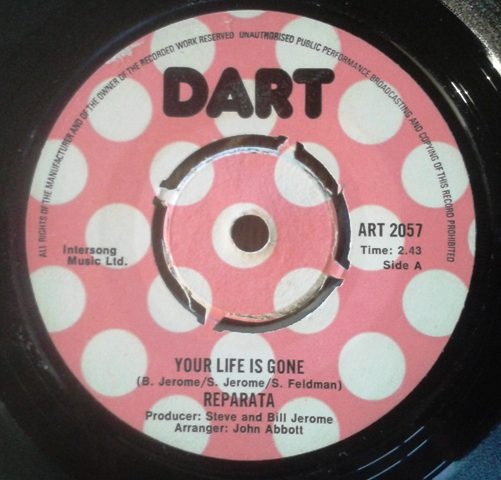
Reupload - Reparata - Your Life Is Gone/ Octopus's Garden


The most OTT death disc ever backed with Starr's finest. You can't lose. 

Label: D'art
Year of Release: 1976

I wrote quite a bit about Reparata, of Reparata and the Delrons fame, in this blog entry where I covered the utterly magnificent "Shoes", which existed like a mongrelised version of girl group pop, glam, and Roxy art-rock. It's one of the finest pop accomplishments of 1975, certainly, and only weird legal issues surrounding its release have prevented it from becoming far better known.

While "Shoes" flopped in 'real' terms, it created enough interest in Reparata's solo career for the small indie D'Art (or Dart, as they now seemed to be known) to reissue some stuff from their vaults in 1976. And what an odd reissue it is too, with it consisting of her Octopus's Garden/ Your Life Is Gone single from 1972 with the sides flipped.

Someone at the label clearly realised that their best shot at following up the art-pop of "Shoes" was the rather ace death disc styled number "Your Life Is Gone" which had previously been hidden under the jolly Beatles cover somewhat like a collection of writhing earthworms under a rock. While it's not an original idea by any means, the track takes the basic premise of "Leader of the Pack" and "Terry" and seriously ups the ante, adding car smash noises and ambulance sirens (and, for some reason, a sitar) to the mix. "Can't go on much longer!" wails Reparata. "Soon they'll have to put me away!", then the sound of crunching metal follows soon afterwards. As OTT as it sounds, the pleading melody is very faithfully and beautifully done. It's the kind of track retro revivalists such as The Pipettes might have turned their attention to in the noughties, had anyone involved in that project wanted to inject some black humour into the proceedings.

29 December 2019

Reupload - Day Costello - Long and Winding Road/ Free (Unlimited Horizons)


Elvis Costello's Dad versus Lennon, McCartney and Spector

Label: Spark
Year of Release: 1970

It's common enough to hear talk of how the sons and daughters of successful musicians are almost always eclipsed by their elders and betters. What's perhaps less frequently discussed is how often the offspring of relatively unsuccessful musicians (in chart terms, at least) occasionally produce far better and more lasting work. Amy Winehouse, daughter of Mitch Winehouse, is obviously a recent prime example of this, but there are many others. Children growing up surrounded by music will inevitably latch on to it and sometimes take it to more interesting places than their parents did.

And obviously enough, Day Costello was an identity assumed by Ross McManus, father of "Elvis" Costello. He issued a trio of flop singles in the sixties on the HMV and Decca labels between 1964-67, and this oddity in 1970, which was never really supposed to see the light of day as a 45. Originally recorded for the purposes of a budget covers LP in Australia with vocals by Danny Street, Ross's services were called for at the eleventh hour when the label disliked Street's final performance.

When it became apparent that The Beatles weren't releasing "The Long and Winding Road" as a single in Australia, Fable Records decided he should try his luck in plugging the gap, in much the same manner as Ray Morgan did in the UK. The results were partly positive. The single was reviewed somewhat critically in some quarters due to the rather ponderous approximation of the Phil Spector arrangement - a criticism I would definitely echo - but it managed to pick up enough airplay to become a minor Aussie hit. A big plus in its favour is unquestionably Costello's vocals, which don't improve on the Beatles original (as if), but add a subtly different interpretation. Delicate, considered and with a lot of strong tremelo in them, he sounds like an ordinary man lost on some distant plain.

13 October 2019

F.R. David - Symphonie (EP)


F.R. David explodes all over the blog for you

Label: Polydor
Year of Release: 1967

Outside of France, the singer F.R. David - born Robert Fitoussi - is mainly remembered for one thing; his global hit "Words". Its ringing, chiming and despairing melodies about his emotional constipation seemed to appeal to all the women of the world who liked to think that beneath their man's stony exterior lay hidden affections and depths. Perhaps along the way, it attracted the men that applied to as well. On first release, I must admit I found it somewhat wet and irritating, but in my old age I've developed a sneaking affection for "Words".

The problem with having one large hit is inevitably it overshadows the rest of your career - how many times have we heard that before? - and in F.R. David's case, that's particularly unfortunate. He's a much more interesting performer and songwriter than he's been given credit for in the UK, having somewhat credible sixties origins. He began his career in 1965 as a member of the garage band Les Trefles who changed their name to Les Boots after one EP. Success was not forthcoming, so he split to go solo and initially issued this, which was pretty wigged out by the usual standards of French pop.

Track one "Symphonie" is the tune to pay attention to. Riddled with meandering orchestral arrangements, David's falsetto trilling and accompanied with a somewhat psychedelic promotional video which seemingly references Synesthesia, it's French chanson pop with a microdose of LSD. Like many French releases of the period, you can tell the production and arrangements are hemming in the potential wildness of the track - the stench of freshly laundered recording studio lab coats and conductor's bow ties never feels far away - but it's a fascinating piece of work from an unlikely source.

Track two is a cover version of "Strawberry Fields Forever" which reduces the grandness of The Beatles original vision to a melancholy, reflective ballad. It's not the worst version of the song I've heard, but it lacks a real point. The cover version of "Knight In Rusty Armour" and the likeable "Rien De Plus" on the flipside are more interesting.

19 September 2019

Tony Hatch and the Cherry Children - Yoko/ Bahama Sound


There's no-one quite like Yoko/ And I know you will agree...

Label: Pye
Year of Release: 1970

If popular perception is to be believed - and, in fact, if John Lennon himself is to be believed - Yoko Ono did not enjoy a particularly warm welcome in the UK after she met Beatle John. Indeed, that refrigerated reception dipped down further to chest freezer levels when she allegedly "broke up The Beatles" (who seemed to be doing an excellent job of drifting off in separate directions without her alleged influence anyway).

The fact this single exists is more than surprising, then - rather, it's outright shocking. Surely, a novelty single filled with children merrily chirping their love and happiness for Yoko would have stood absolutely no chance of being a hit? Most Beatles fans, who would have been the core target market, wouldn't have cared for it, and Yoko Ono's own fans - at this point, either modern art enthusiasts or some of the hairier lovers of her peace protests and avant-garde pieces of "difficult listening" on Lennon flipsides - weren't going to buy a novelty record inspired by her. It sank into oblivion, and it's hard to understand how anyone thought it would do anything else. 

Musically, it's a sweet little concoction which is too innocent lyrically and well-arranged to be irritating, and while you probably won't rush to put it on your digital playlist, it's a fun few minutes. I'm glad it exists, and I only hope Yoko Ono heard it and it raised a smile with her too.

26 May 2019

Tony Merrick - Lady Jane/ Michelle


A Stones cover one one side + Beatles cover on the other = near-hit single

Label: Columbia
Year of Release: 1966

Depending on how far you want to push or stretch the term, Tony Merrick could be regarded as a one hit wonder thanks to this single. It spent a solitary week at number 49 in June 1966 before dipping back down under the waves again - so close and yet so far.

It's not too surprising it was at least faintly in-demand for awhile. Both sides cover the two biggest hitting bands of the sixties, with "Lady Jane" taking on Jagger and Richards and "Michelle" naturally being another cover of The Beatles track. The A-side here is beautifully arranged, sounding like a touching and innocent piece of baroque styled pop, with strumming harpsichord sounds meeting plucked nylon guitar strings. Merrick's vocal performance is gentile and ever so slightly arch, suiting both the song and the arrangement.

"Michelle" on the flip side is less interesting, unfortunately, though it's not a Beatles track of which I'm especially fond, so your experience of it may differ.

16 May 2019

Rhys Eye - Yellow Submarine/ I Just Can't Lose That Tune


Fascinating but sombre reading of the jaunty Beatles tune

Label: Epic
Year of Release: 1975

"Yellow Submarine" is probably one of the less analysed Beatles songs in their oeuvre, despite being one of the best known. At my infant school, it was wheeled out for sing-a-longs in school assemblies in halls that whiffed of chips and baked beans, and it was a track I was used to hearing on cartoons or during intervals at local children's theatre shows. Marrying upbeat melodies to nonsense lyrics, it seemed like the very definition of "harmless fun".

Clearly not everybody thought that way, though. Paul Phillips, who would later on find brief fame as Driver 67, was troubled by the sense it was an "other-worldly excursion into all sorts of sub-conscious emotions that I couldn’t put my finger on". Whether this was something he talked about to his friends or decided to keep to himself, when he eventually had gainful A&R employment at CBS he was surprised to find someone who agreed with him turning up to an audition.

Peter Bennett, who recorded and wrote under the name Rhys Eye, dropped by insisting he had a fantastic idea, but if he simply told Phillips what it was there was every possibility he would be cut out of the picture and find it being used by another artist on CBS. Phillips arranged for a legal waiver to be signed stating that whether he accepted or rejected the idea, it would remain the intellectual property of Mr. Eye.

And this, amazingly, was it - something that confirmed Phillips wasn't the only one bowing his head to Ringo's honking about strangely coloured submersible warships. Bennett's idea was simply a heartfelt, bluesy, troubled take on a Beatles song most listeners haven't really bothered to read much into. In Rhys Eyes' hands, "Yellow Submarine" becomes reflective and regretful, sounding like a hymn to lost childhood, lost friends and perhaps lost innocence - or, more than that, a nostalgia for absurd, exaggerated things that were never truly as the singer believed eating away at him like a deadly, slow poison. 

Whether it works is something not everyone is going to agree on, but it certainly fits the current decade's model of finding sorrow or opportunities for plaintive, melancholy expression in the most unlikely source material. If an advertising executive from John Lewis hears this and doesn't use it in their next Christmas campaign, then I'll be lost for words.

12 May 2019

Mortimer - Dedicated Music Man/ To Understand Someone


New York garage rockers The Teddy Boys taking an unexpectedly folk-pop turn prior to becoming Beatle proteges

Label: Philips
Year of Release: 1967

The late sixties saw lot of groups suddenly changing tack stylistically, some because they took the special tablets so widely associated with the later era, and others because they realised the times they were a-changin' and didn't want to be seen as irrelevant. It's impossible to say how many had authentic, pure motivations and how many were just being cynical - and in the end, it doesn't matter terribly if the results are worthwhile.

Mortimer, consisting of Guy Masson, Tom Smith, and Tony Van Benschoten, had largely operated under the name The Teddy Boys, who were a storming garage rock group perhaps best known for their single "Jezebel". By February 1967 they'd changed their name to Pinnochio and The Puppets to issue "Fusion" on Mercury, then they appeared to throw all their electrified instruments into a skip to pursue a rather more semi-acoustic, hippy-ish, harmony driven direction.

Tony Secunda's (Move/ Procol Harum manager) cousin Daniel Secunda swooped down to take over the group's affairs, and they became quite hot property in New York, regularly performing to enthusiastic audiences. "Dedicated Music Man" was probably their closest crack at the hit parade, and showcases their abilities, which bear a strong and striking resemblance to the folk-rock scene of the time. The song has a strong, determined pop chorus as well, but was possibly not powerful enough to stand a chance in the very crowded 1967 marketplace.

8 May 2019

Offered With Very Little Comment #6 - Dora Hall, Dick James, Afro Akino, Tony Hatch, Chamber of Kommerce

Five 45s from the back of the box

Once again, readers, it's time to delve deep into the dusty crevices of my 45 collection and focus on a load of weird and occasionally wonderful cuts.

As usual, I've uploaded these en masse purely because I've ummed and ahhed over the contents of the recordings and researched the groups in question and can't really think of much to say beyond the observations you see below. Sometimes less is more (and anyway, you didn't seriously expect me to write a sixth Dora Hall blog entry, did you? I really don't want any of my friends to feel they need to stage an intervention).

If any of you feel you want to discuss the contents in more depth or highlight something I might not know, feel free to comment away.

(And remember, readers - simply refresh the page if Box is deciding to be an arse today).