JohnTem82387976
Showing posts with label psychedelia. Show all posts

12 June 2023

The Great Homebrew Compilation Revival


When I first launched this blog over fifteen years ago, there was a trend across the Internet for pulling what I described as "homebrew compilations" together.

These were usually about 80 minutes long (enough to fit on a single CD should the reader decide to "burn" them to one) came with some slightly scrappy cover art you could download if you wanted, and a lot of sleeve notes. They were a great way of giving people an immediate impression of the music your blog would focus on in one giant gulp.

For a whole bunch of reasons these became less common as the noughties turned into whatever the hell we want to call the second decade of the 21st Century, but of course, it's a bandwagon I jumped on, leaving a series of compilations live on here for a few months before the download links evaporated. After that, I was always bothered by the fact that there were whole chunks of very popular pages of this blog lying redundant and unused, shopfronts and billboards for beautiful trinkets nobody could actually hold and admire anymore. 

While skimming around Spotify a few weeks back, I couldn't help but notice that most of the tracks on these compilations were now largely covered by the Spotify database, and obviously couldn't resist creating the appropriate playlists there. And YouTube was like shooting extraordinarily large dolphins in a bathtub - almost all of the tunes were present and correct. 

With that in mind, consider these compilations back (partially, admittedly) on Spotify for your love and attention again:

Wallpaper - the very first one I pulled together in 2008, full details archived here.

Lysergic Diversions - original webpage here

Turnoffs To Nowhere - original webpage here

pop - original webpage here

And if you find Spotify's catalogue gaps aggravating, the above and more are available as YouTube playlists at the following links:

Wallpaper

Lysergic Diversions

Turnoffs To Nowhere

pop

Pictures of Marshmallow Men - original webpage here

Music Soothes The Savage Breast - original webpage here

20 November 2022

Take 6 - Whiter Shade Of Pale/ There Goes My Everything/ Carrie Anne/ Groovin/ Okay/ Here Come The Nice


Pocket money covers of tip-top chart hits, from the faithful to the ghastly

Label: Take 6/ Avenue
Year of Release: 1967

While they're probably never going to command huge prices, budget sound-a-like hits compilations have been picking up casual interest from collectors of late, not least because some of the session players on these stocking filler discs later went on to become famous. Elton John grabbed the opportunities that were afforded keenly and was noted for his adaptability in the studio, although sometimes the results were rather unexpected. Likewise, David Byron of Uriah Heep wasn't averse to popping in for a cup of tea and a rendition of one of the day's hits in exchange for a few pounds (such as this cover of John Lennon's "Cold Turkey").

"Take 6" was a short lived and not particularly successful six-track EP series issued by Avenue Records which worked to the same familiar business model as all the others - get some seasoned musicians in quickly to accurately record the hits of the day (and absolutely no fannying about with "alternative interpretations" or fresh arrangements) then get the product on the shelves whip-smart to rival the official versions. They retailed at the cost of a standard seven inch single and must have been tempting to the uniformed or the unfussy who deemed it worth their while to own six A sides for the price of one. 

To give them full credit, the session musicians mostly managed to produce fair forgeries of the original work, and that's borne out by track one here, a cover of "Whiter Shade Of Pale" which just about manages to retain the mystical heat haze of the original. True, it sounds more like Van Morrison singing than Gary Brooker (but don't get excited, it's almost certainly not) but the rest is a faithful replica with only the thinness of the production showing itself as a marked difference.

And so the pattern follows throughout most of the EP, being filled with competent, efficient versions of top hits,  until you get to the main track I bought this for, The Small Faces under-the-radar paean to drug purchasing "Here Come The Nice". This was actually a very smartly, carefully produced and arranged number in its official incarnation with a depth, tricksiness and slickness which was going to be very difficult to pin down by any would-be interpreters, and so it proves. The pinging guitar notes at the start quickly give way to ludicrous falsetto vocals somewhere between Tiny Tim, The Pipkins and Donald and Davey Stott, then the session players deliver a Youth Club bash-through the song, which it really didn't deserve. Still, it's as terrible as I'd hoped, and sometimes hearing people fall flat on their arses trying to perform something wonderful is actually masochistic fun. I hope for their sake that nobody famous was involved in this monstrous three minutes; as no credits are ever given on these releases, we will probably never know.

27 February 2022

The Oxford Watchband - Diagnosis (One Way Empty & Down)/ Welcome To The World


Disorientating and dramatic psychedelic soul

Label: Hand
Year of Release: 1969

I'm an absolute sucker for psychedelic singles which appear to be pulling in six different directions at once, and this one has been high on my "wants" list for years. It's delirious, dramatic and almost hysterical soul music set to lysergic shifts and changes, a rambling warning about nothing remotely coherent - similar to a nightmare you've woken up from at 3am with no conscious recollection of any meaningful thread which would help you to understand why you're drenched in cold sweat.

The song starts with urgent soulful singing about a bad medical diagnosis, then references an almighty downpour, before the music fades out and an ambient thunderstorm begins, combined with crashes, bangs, screams, shouts, arguments and mayhem. Then, naturally, the song returns and reaches its conclusion with one guitar whining alone in the distance. I'm none the wiser, but it's a bewitching three minutes which has more ideas on one 7" single than some bands manage on one side of an album. Over the years I've come to think of it as being a snippet from a film shorn of all context, three minutes razored out from the most dramatic moment.

 The Oxford Watchband were formed in Rochester, New York by brothers Brad and Jeff Wheat after they left the group The Heard, who issued the single "Laugh With The Wind" on Audition in 1966. Adding Jim Gilbert, Franke Previte and Jai Mate to their line-up, this was, to the best of my knowledge, the only single on their own Hand Records and while it benefited from a distribution deal with Capitol, clearly stuff like this wasn't going to sell by the shipload and it only registered on a cultish level in the local area. 

Previte went on to bigger things with the hard rock group BullAngus, and eventually wrote the smash hit "I've Had The Time Of My Life" for the "Dirty Dancing" soundtrack, which is obviously epic in a completely different and more coherent way. The movements of the rest are not clear, but please do fill in the blanks below if you can.

24 November 2021

Reupload - Sasha Caro - Grade 3 Section 2/ Little Maid's Song


Cat Stevens produced singer-songwriter with top quality psych 45

Label: Decca
Year of Release: 1967

Sasha Caro was one of those interesting characters who was everywhere but nowhere on the sixties London scene. He was born in Rangoon in 1940, but his family fled to England when Burma was invaded by the Japanese, remaining on these shores thereafter. A love of music quickly sucked him into both the business and creative side of the "industry", and he took some promising steps at commercial songwriting. Originally beginning his career under the name Rick Minas, he co-wrote the non-hits "Lease On Love" by the Graham Bond Organisation and "I Won't See You Tonight" by Hamilton and The Movement, besides setting up the cheap recording studio RayRik with his business partner Bruce Rae. He also had a deeply obscure solo folk 45 out on Polydor in 1965 entitled "Well I Want No Part Of It". 

Very few of their other songs managed to gain a release, though several appeared on an episode of "Dangerman" in the sixties as part of the episode "Not So Jolly Roger", which took place on a pirate radio station. All the "top sounds" the DJs spun throughout the episode were actually just recordings of Rick Minas's work, though none of these gained a commercial release after the episode aired. 

Somehow, Cat Stevens managed to discover Rick through his songwriting demos, and took him under his wing to attempt to launch him as a star in his own right. His name was changed to Sasha Caro, and the two resulting Stevens-produced Decca 45s are damn good - it's astonishing that they didn't find a place on "Rubble" or one of the other many compilations that swept up the best of the Decca and Deram labels psychedelic output. On the sprightly and intricate folk-pop styled "Grade 3 Section 2" Rick's voice is on fine form, swooping beautifully all over the song. The track manages to be rustic sounding without losing any catchy pop appeal, and while it does share a similar sound to Cat Stevens' own work, it's nonetheless a fine single. 

Sadly, I can't include the flip side "Little Maid's Song" below as it was recently compiled on the "Piccadilly Sunshine" series, and therefore remains commercially available. However, you can listen to it on YouTube if you want. 

31 October 2021

Illusive Dream - The Electric Garden/ Back Again


Epic soft orchestral psychedelia from a somewhat illusive - sorry, elusive - act

Label: RCA
Year of Release: 1969

A lot of soft harmony popsike or progressive orchestral tracks have been unjustly ignored by collectors and listeners. At the time they were never really hip or underground sounds, despite the highly respected Jimmy Webb originally setting the ball rolling in a wobblier direction, and in subsequent years they've never slotted neatly alongside the phased electric output of the non-music school graduates on compilations. 

Nonetheless, this is an example of how rambling, engaging and unpredictable a lot of the orchestrated stuff could be. The A-side of this disc is five-and-a-half minutes of winding, meandering, dream-like pop with a euphoric chorus about an "Electric Garden", whatever that may be. Rather than racing to the chorus, it stretches, sprawls and twitches contentedly, shifting groovy, delirious sixties pop melodies into a slightly more formal context. The group share close vocal harmonies adeptly and in a manner which could have pleased the variety circuit while singing lyrics which would have been utterly incomprehensible to that same audience. 

Sometimes if your music falls between two stools it ultimately fails to impress any audience sufficiently, and I'd hazard a guess that's what happened here. Too buttoned up for the hippy crowd, and too way-out for the easier side of the street, "The Electric Garden" has been somewhat ignored in subsequent years but really deserves your ears.

The B-side "Back Again" is more straightforward and snappy but isn't mere filler, combining deft harmony pop with Sergeant Pepper styled fanfares. 

19 July 2020

Erehwon - The Hero (I Might Have Been)/ Tiny Goddess


Godfathers of British Psychedelia decide to go New Wave - what you hear might really surprise you!!!

Label: Harvest
Year of Release: 1980

While most of the non-first division sixties groups focused on the nostalgia circuit to earn their crust when the decade ended, a few tried to move with the times to varying degrees of success. Perhaps one of the most successful were The Easybeats, who renamed themselves Flash and The Pan and bothered global hit parades with wigged-out New Wave styled tracks with Knopfler-esque vocals, such as "Down Among The Dead Men" and "Waiting For A Train". 

Were Patrick Campbell-Lyons and Alex Spyropoulos of Nirvana (the British psychedelic group, not the nineties grunge one, obviously) closely watching the activities of their antipodean friends closely, pencils and bookie's notepads in hand? If so, they've never said, but this one-off single under the name Erehwon certainly seems as if they were hoping for similar trojan horse action.

The A-side here is so far away from Nirvana's usual style it's actually genuinely astonishing. "The Hero" isn't just New Wave in its stylings, it also shows an art-school leaning that their sixties records perhaps never went overboard on. The droning synth rumbles and pulsing bass patterns of the track recall Gary Numan and eighties Wire far more than they do the light and airy world of their past. So dark and moody is the single that it sounds more like an album track than something which had any rightful place in the charts, but it's such an impressive shift away from the group's norm that I can only look on aghast. Very few groups can shift genres as convincingly and as successfully as this.

The track later re-emerged on Campbell-Lyons' solo LP of the same name in 1982, alongside tracks like the bafflingly titled "Naked Robots Watching Breakfast Television".

2 January 2020

The Sound Barrier - She Always Comes Back To Me/ Groovin' Slow


Mediocre mod-pop backed with killer popsike cut

Label: Beacon
Year of Release: 1968

A constant problem I have with flop sixties singles is how frequently their flipsides out-perform their official A-side. On occasion, it's not necessarily that the more buried work is lost hit material, but rather that it's of a higher quality and leaves me hungry for more by the group, and hoping there's a lost album out there somewhere. In other cases, I find myself thinking "Seriously? You left this to rot on the backside of this slice of stale Denmark Street leftovers?"

The Sound Barrier's only single is a definite case for the latter phenomenon. The almost never-heard "She Always Comes Back To Me" isn't necessarily a bad tune, but is hampered by a somewhat uncertain, limp performance by the group. In the hands of Geno Washington or a Motown recording artist, it might have cut it, but here the vocals strain to be soulful without success, and the backing is too loose for its own good. What this track needed was intensity and conviction, and what it gets is a fairweather approach. I doubt the woman in question actually came back, and they sound more deluded about the chances of her returning than anything else ("Maybe that's the point" - a voice).

Lurking on the B-side, however, is the Small Faces and Traffic aping "Groovin' Slow" and this is a complete delight, sounding far more powerful and demanding on vinyl than on any bootleg or semi-official psychedelic compilation it's appeared on over the last twenty years. Pitched somewhere between "Lazy Sunday" and "Hole In My Shoe", it's a red blooded cockney walkabout through city life which, had it been released at the height of Britpop, would probably have been welcomed as a knowing nod and pastiche to the mid-sixties era. "Take-a-good-look-out-your-window-at-the-sidewalk-see-the-people-rushing-byyyyyyy" the vocalist bleats at breakneck speed in the first few seconds, and the hippified, contemplative chorus eventually cuts in after several more frantic lines, acting as a slightly psychedelic break between the speedy verses. 

The track fades on what sounds like a faintly piss-taking parody of "Hole In My Shoe" - the group sound as if they might be tittering to themselves at one point - and while I suspect tongues were firmly in cheek, it's marvellous pop which is clearly up to its gills in the summer of love era.
4 December 2019

Matthew Bones - I Am The Pixi/ Two Sugars


Skippy, impersonation-ridden popsike from 1971 (not 1967, like YOU thought)

Label: Pye
Year of Release: 1971

Once every so often, I stumble on a record so strangely out-of-time and absurd in its ambitions that I'm forced to stop what I'm doing and think "How the hell did this even get released?" The music industry is traditionally an unforgiving place where fashion faux-pas are given short shrift - but once every so often, a weird time traveller escapes out of the traps.

"I Am The Pixi" starts off like a vanity pressing of a comedy routine to be sold in working men's clubs, with Matthew Bones doing rather accurate impersonations of the singing styles of McCartney, Presley, Dylan and Lennon for nearly a minute. Then, having affectionately imitated the four biggest influencers in the pack of fifties and sixties rock, he launches into his own sprightly, skippy, orchestrally arranged melody about... er... being a pixie and having half his body underground. This would be fine fare for Middle Earth obsessed 1967, but by 1971 this would have seemed extraordinarily passé. There's not a guitar solo in sight here, just simple Nirvana (UK) influenced merriness.

For all of its fashion failings, though, "I Am The Pixi" is actually one of the most lovably cheery pieces of popsike I've heard in years, and it's utterly impossible not to be charmed by it. Innocent, silly, and sprightly, it will probably irritate the kind of people who find most material of this ilk trying, but for the rest of us it's pure joy. It could feasibly have been a hit in 1967 with a sympathetic summer release date, but what the hell the A&R Department of Pye were on in 1971 is a mystery.

30 October 2019

The Giant Jellybean Copout - Awake In A Dream


Bizarrely named studio bunch worshipping at the feet of Brian Wilson

Label: Poppy
Year of Release: 1968

While Brian Wilson's talent caused jaws to drop globally when "Pet Sounds" was closely followed by "Good Vibrations", it left the groups who admired him most somewhat snookered. Those who loved The Beatles could put their own spin on the moptop sound without seeming like total clones (though admittedly The Knickerbockers seemed happy to ape their style with very few embellishments). The Beach Boys, though? How can you sound like a 'psychedelic barbershop quartet', as Hendrix put it, in your own way? Wilson not only developed but essentially owned that template.

This is exactly where the ridiculously named Giant Jellybean Copout came unstuck. "Awake In A Dream" is essentially The Beach Boys during their "Good Vibrations"/ "Smile" phase on a much lower budget. It's a very astute imitation, to be fair, and the tremendously psychedelic "lucid dreaming" lyrics and perfect close harmony vocals combine with a meandering structure to create something that must have been a satisfying listen for Wilson fans hungry for the delayed "Smile" LP.

As the group's name might suggest, there's more than a bit of sickly sweet bubblegum running through the core of this record too, but it's syrupy pop with a rather confusing and conflicting aftertaste. 

The main man behind this group was Jim Ryan of The Critters (EDIT - It wasn't! Please see the comments for a corection!) who is probably best known in the UK for his minor hit "Younger Girl". It's a thing of pure sunshine loveliness which probably doesn't get played much these days due to the fact the lyrics seem slightly paedo-friendly if you're the cynical type. If you hear it as what I suspect it's supposed to be, though - a dreamy song for teenagers about the girl two forms below - it's a thing of beauty. 

Ryan eventually went on to become Carly Simon's touring guitarist, before becoming a studio based session musician. 

11 August 2019

Reupload - Epic Splendor - A Little Rain Must Fall/ Cowboys and Indians


Zesty Northern Soul styled sounds on the A-side, psych on the flip, and everyone wins

Label: Hot Biscuit Disc Company
Year of Release: 1967

The Epic Splendor were formed from the ashes of the New York based act Little Bits of Sound, and we've already covered their excellent and supremely under-rated single "It Could Be Wonderful" elsewhere on this blog. They were signed to the short-lived (and million dollar funded) US Capitol subsidiary Hot Biscuit and this was the first single the label issued.

"A Little Rain Must Fall" is generally treated with either huge enthusiasm or shrugging indifference by a lot of collectors these days, being regarded as a lost Northern Soul floor-filler by some commenters, or a slice of summery, breezy bubblegum by others. For my money, it's a beautiful, life-affirming little disc and I'd actually spent the last few years looking for a copy at a reasonable price. The lyrics are filled with gentle picture poster philosophy, filled to the brim with observations about how a "little rain must fall" before we get to enjoy the sunshine, but it's delivered with such spring and zest, and such an uptempo light soul arrangement, that it does indeed mirror the heartbreak and the passion necessary for a top northern soul spin. Its slightly gentle production may doom it for some in this respect, though - I can fully understand how it won't (and doesn't) win the rubber stamp of approval from everyone.

The B-side "Cowboys and Indians", on the other hand, is sneery outsider psychedelic pop about the marginalised life of a man with an alternative lifestyle, at total odds with the top side. "I suppose the way I live would blow people's brains/ but then the way they live has always blown mine" sneers the vocalist, bringing back images of an "Easy Rider" character on the dusty highway. 

Whatever you expect from sixties music, either the A-side or the B-side is bound to be a winner for you. 

5 August 2018

The Almond Lettuce - Tree Dog Song/ To Henry With Hope


Bouncy but marginally deranged popsike from this mystery band

Label: Columbia
Year of Release: 1968

Arguing about what constitutes a "psychedelic" record has been an intense political debate for collectors for decades now. People the length and breadth of the country have screamed and shouted at each other in pubs demanding to know what exactly is so "way out" about the contents of some of the "Rubble" series. Why, I even have a scar on my forehead from the time someone angrily threw a copy of Barnaby Rudge's "Joe Organ & Co" at me, yelling the words "You couldn't listen to that while taking a trip, you moron, it sounds like a third-rate sixties Bowie out-take" (Some of the above may be lies).

I'm using the word "psychedelic" to describe this record advisedly, then. It's hardly "See Emily Play", but then again... both sides are infused with a pie-eyed, child-like worldview, and arrangements which are prone to sharp diversions. "Tree Dog Song" on the A-side has one of the worst and most irritatingly child-like intros in the world, but gradually settles down into sounding like The Kinks at their most skewiff and countrified singing about God knows what. 

The B-side is the real winner for me here, though, delivering absurd lyrics about domestic failures and marital break-up over a melancholy organ sound and insistent, minimal, chiming guitar line. "Oh Henry... I know that the rhubarb pie was under-done/ and your cricket pads were stained with eggy juice" the singer explains, and it's hard not to empathise. Henry sounds like a monster. The song also has a McCartney-esque bounce to it which is compelling. 

22 November 2017

Sasha Caro - Grade 3 Section 2/ Little Maid's Song


Label: Decca
Year of Release: 1967

Sasha Caro was one of those interesting characters who was everywhere but nowhere on the sixties London scene. He was born in Rangoon in 1940, but his family fled to England when Burma was invaded by the Japanese, remaining on these shores thereafter. A love of music quickly sucked him into both the business and creative side of the "industry", and he took some promising steps at commercial songwriting. Originally beginning his career under the name Rick Minas, he co-wrote the non-hits "Lease On Love" by the Graham Bond Organisation and "I Won't See You Tonight" by Hamilton and The Movement, besides setting up the cheap recording studio RayRik with his business partner Bruce Rae. He also had a deeply obscure solo folk 45 out on Polydor in 1965 entitled "Well I Want No Part Of It". 

Very few of their other songs managed to gain a release, though several appeared on an episode of "Dangerman" in the sixties as part of the episode "Not So Jolly Roger", which took place on a pirate radio station. All the "top sounds" the DJs spun throughout the episode were actually just recordings of Rick Minas's work, though none of these gained a commercial release after the episode aired. 

Somehow, Cat Stevens managed to discover Rick through his songwriting demos, and took him under his wing to attempt to launch him as a star in his own right. His name was changed to Sasha Caro, and the two resulting Stevens-produced Decca 45s are damn good - it's astonishing that they didn't find a place on "Rubble" or one of the other many compilations that swept up the best of the Decca and Deram labels psychedelic output. On the sprightly and intricate folk-pop styled "Grade 3 Section 2" Rick's voice is on fine form, swooping beautifully all over the song. The track manages to be rustic sounding without losing any catchy pop appeal, and while it does share a similar sound to Cat Stevens' own work, it's nonetheless a fine single. 

Sadly, I can't include the flip side "Little Maid's Song" below as it was recently compiled on the "Piccadilly Sunshine" series, and therefore remains commercially available. However, you can listen to it on YouTube if you want. 

The follow-up "Molatov Molatov" is also worthy of investigation, being a slice of Russian-tinged psychedelia which is far more OTT and decidedly bizarre. It's already worked its way on to my "wants" list for being such a full throttle collision of chaotic ideas.

As for what became of Rick (or Sasha, or whatever we want to call him or he would prefer us to call him) nobody seems to know. He apparently gave up music and took up a career as an accountant not long after his two Decca records flopped. This seems like a horrible waste of some very obvious talent, so I can only hope he had a change of heart somewhere along the line and still occasionally plays and writes. 

19 November 2017

The Waterproof Candle - Electrically Heated Child/ Saturday Morning Repentance


Label: RCA
Year of Release: 1968

It sometimes feels as if we live in an age where absolutely every last drop of psychedelic goodness has been mopped up, remastered and presented for public consumption on a compilation series, but some baffling little discs remain unappreciated affairs selling at bargain basement prices.

Take "Electrically Heated Child", for example. An oddly titled record performed by the equally oddly named Waterproof Candle, it was also produced and arranged by Jimmy Webb - enough reason, under ordinary circumstances, for it to be considered a collectible even without considering eccentric song titles in the valuation equation. Strangely, though, you can regularly buy it for around a fiver and some people online are also rather dismissive of its contents.

I blame that partly on the fact that it doesn't quite live up to the weirdness of its title, and instead turns out to be a carefully produced piece of faintly far-out harmony pop. Despite that, it drips with a weird and almost autumnal atmosphere, being filled with plucked acoustic guitar lines, hushed vocals, and even by the standards of the era, some incredibly rum lyrics. "Steelwomb lightbulb chi-iiild", they sing, "is your mother/ you have no other". "To be free," they conclude, "you must be dead".  I have no definite idea what on Earth it's all about, obviously, though I'd suggest The Candle are musing on the antiseptic lifestyle of a modern child in a heated, hi-tech apartment block. Thom Yorke would no doubt nod in agreement at their observations.

The B-side "Saturday Morning Repentance" is neat too, being much more uptempo and groovy (though these things are relative) as well as having lots of unexpected chops and changes to its arrangement. In common with the A-side, it has a commercial pop edge which is skewered somewhat by all the surrounding weirdness. Fascinating stuff, though.

The Waterproof Candle were apparently an Indianapolis based band who featured Rob Swaynie, Steve Foster, Wayne Wilson and Michael Rea. Rob Swaynie also featured in the line-ups of other bands in the area such as The Urge, Clarence Brown, and Memorial String Band. Steve Foster and Wayne Wilson previously served in the garage group Sounds Unlimited.  More than that, I do not know, but please feel free to fill in any blanks.

[Edit - the suggestion has been made since that the lyrics to the A-side are likely to be about child incubators, which is an even darker, less subtle, but  - let's face it - probably correct interpretation]. 


2 July 2017

The Cisum - Medal of Honor/ Mrs Orange


Label: Epic
Year of Release: 1968

God knows why, but whenever summer arrives it becomes exceedingly hard to find interesting rare records. This isn't something I've ever had cause to think much about before starting this blog, but because I now have to keep finding new material to write about here, I notice the change of the seasons much more these days. It's almost as if as soon as mid-June hits, everyone decides they can't be bothered to cash in their old vinyl at the local second hand record store.

Still, this is a very recent cheap find I'm quite pleased with, and it's in better condition than the horribly battered label might lead you to believe (this isn't saying much, admittedly). This is actually two sides of interesting American psychedelic pop - the A-side bounces along with a sarcastic smile on its face, mainly concerning itself with a dead relative returning from Vietnam and the insulting ceremony surrounding a post-humous medal of honour. "Thanks a lot for all you've done!" the band trill with a sneer, acknowledging the futility of the gesture.

The flipside "Mrs Orange" is actually as strange as the title would suggest, focussing its attention on a lonely, troubled woman and her citrus fruit peeling obsession - it's the kind of lyrical idea which could have come from the pen of Brian Wilson. Both sides showed the band were obviously far more creative and interesting than many of their more earnest, free-form psychedelic rock brothers and sisters, but despite this (or perhaps because of it) the record was a flop.

The group hailed from New York and consisted of Phil Galdston on keyboards and vocals, Dave Brightman on lead guitar and vocals, Rich Bronsky on rhythm guitar and vocals, Gary Mandel on bass and vocals, and John Glowa on drums. Apparently a full album was recorded, but never released - now might be a good time to think about putting that one for sale online, chaps. Just a thought.


6 November 2016

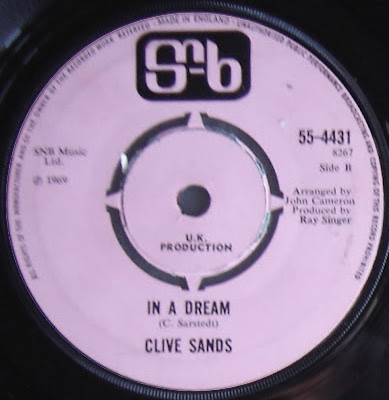
Reupload - Clive Sands - Witchi Tai To/ In A Dream


Label: Snb
Year of Release: 1969

"Witchi Tai To" is one of those songs which - despite its relative obscurity in the grand scheme of things - has been covered half to death.  Originally produced by the songwriter and saxophonist Jim Pepper as an adapted Native American chant which he learned from his grandfather, the single surprised a few people by getting to number 69 in the US Billboard charts.  It apparently remains the only track to chart in America which features an authentic native chant (although before anyone argues about it, I'm no expert when it comes to definitions of authenticity for such things).

It was then covered by counter-culture figures Brewer and Shipley, then somehow gained the attention of major league pop impresario Simon Napier Bell in the UK who decided to produce this slick version of it for the British market.  This was fronted by the mysterious Clive Sands who was, in actual fact, Peter Sarstedt's less successful brother.  This version of "Witchi Tai To" has picked up abuse from some quarters for being too poppy and inferior to the original, but I happen to think it's wonderful.  With an arrangement that increasingly swells as the song progresses and an almost hymnal organ underneath, it's no bastardisation of Pepper's intentions, just another brilliant piece of summery late sixties pop.  Where the original occasionally verges towards the pious, this is the sound of blissed out glee, almost explosively happy - even the needle damage on my copy can't destroy its intentions.  That it's been almost completely overlooked since its release is surprising - a recent compilation focussing on the output of Napier Bell's SNB label completely ignored it.

The flip "In A Dream" is rather more traditional popsike fare, but is also sweet in its own way.

Clive Sarstedt later changed his name to Robin Sarstedt - presumably to confuse people researching blog entries years in the future - and had a hit in the UK with "My Resistance Is Low" in 1976.  For my money, however, this flop is far, far better than that track, and it's certainly a notch or two above his brother's "Where Do You Go To My Lovely".


25 September 2016

Reupload - After Tea - The Time Is Nigh/ Not Just A Flower In Your Hair


Label: Decca
Year of Release: 1967

The Dutch music scene of the late sixties is an embarrassment of riches, and despite the fact that various compilation series - most prominently Rubble - have hoovered up a lot of the best material, a quick trip to an Amsterdam vinyl outlet can leave a buyer feeling spoiled for choice (as well as utterly bemused as to which records are duds and which ones are worth the asking prices quoted).  The Amsterdam music scene in particular out-freaked a great many of the oddest London bands, and initially moved Paul McCartney to once claim that it had a more finely developed underground than that city.

After Tea, however, can't claim complete and total membership of the Nederbeat clan, for they had ex-Syndicat Ray Fenwick on guitar at this point in their careers.  A mere one year after putting his instrument through grevious punishment with Joe Meek for "Crawdaddy Simone" he hopped across to the Netherlands to join After Tea, who were being formed by ex-member of The Tee Set Hans Van Eijck.  The band's name presumably served two purposes - to act as an homage to the Spencer Davies Group single of the same name, and also to insinuate that there was life for Hans beyond The Tee Set (in case this joke needed to be heavily highlighted for any of you readers).

This, their debut single, is a bit of a winner.  A-side "Not Just A Flower In Your Hair" is a piece of tongue-in-cheek Move inspired pop which chirps along confidently.  Whilst I suspect the song is as genuine a statement about hippy-dom as anything Scott MacKenzie produced, lovers of popsike will be pleasantly amused.

The B-side "The Time Is Nigh", on the other hand, is as mad as a bag of Jack Russells who have been fed acid-spiked dog treats, although the message seems to be in favour of abstinence from that particular drug.  "Throw your LSD away/ because meditation is the thing for today!" the group demand, whilst a swirling organ workout squawks along behind them, and various children manically "la la la" their way through their chorus.  Sounding like something existing between the theme music from "Rentaghost" and The Small Faces having a jam whilst on a cocktail of various conflicting drugs, this track is fully in keeping with some of the more berserk moments in the Dutch music scene of the time.

Sadly, as soon as Fenwick's work permit expired he was sent home and, through an interesting quirk of fate, joined the Spencer Davies Group to record "Time Seller".  After Tea plodded on without him back in the Netherlands and steadily became more progressive in their style, before eventually settling on a heavy rock/ blues sound for their final album "Joint House Blues".


28 August 2016

Life 'n' Soul - Ode To Billy Joe/ Peacefully Asleep


Label: Decca
Year of Release: 1967

The flipside to this single "Peacefully Asleep" was compiled on both the "British Psychedelic Trip" and Rubble series of psychedelic compilation LPs, and remains readily available to this day (you can hear it on Youtube here) - it's a distinctly woozy, strange kind of record where the band delivered strangulated, delirious vocals and added a doomy, disorientating cello line. It shimmers, buzzes and meanders away, never having much of a coherent chorus (unless those "bap-ba-ba-da-bap-ba-ba-da-baaaaah!" moments are supposed to it) but holding your interest through sheer use of atmosphere. 

Interesting, then, that the band really weren't fully paid up members of the UFO Club, but a pop group from Manchester, consisting of Stuart Charles on lead vocals, and John Brennan, Colin Brock, Clem Lee and Andy McCann (I can't find any references to who played what). The A-side is a version of Bobbie Gentry's "Ode To Billy Joe" which makes their usual direction perfectly clear. Taking a choppy, stripped-back acoustic approach to the track, it reduces the level of mystery and intrigue in the original and turns it into something slightly more uptempo. 

One more single would come forth from the group, the equally scarce but actually superior A-side "Here Comes Yesterday Again", which hints a bit more towards their roots performing regularly at the legendary Twisted Wheel club. After that flopped, Decca decided enough was enough. 


27 April 2016

Black Swan - Echoes and Rainbows/ Belong Belong


Label: Ember
Year of Release: 1971

Now here's a rum release. While Black Swan may seem like a group name, it would appear that this was entirely the work of Cherbourg born sixties star Billy Bridge, who enjoyed some minor success in France with tracks such as "Le Grand M". For the Black Swan project, he apparently played absolutely all the instruments himself with no input from other sources.

Unlike his early approximations of beat pop and Rock and Roll, however, Black Swan is essentially very organic late period psychedelia, and in the context of the material he was best known for is as unexpected as finding a Cliff Richard 45 with a heavy hippy feel. Actually recorded across the water in Britain, the A-side "Echoes and Rainbows" has a minimal trance-like insistence, complete with kazoo overload, whereas the flip "Belong Belong" is - illogically enough - much poppier, riddled with merry hooks akin to a slightly lighter version of Aphrodite's Child. In all, the two sides amount to a very hazy, dope-fuelled campfire listening experience.

A full album entitled "Da Ga De Li Da - Echoes and Rainbows" was issued in mainland Europe, but not (so far as I'm aware) the UK. It's been unavailable for some time since and, while it's getting picked up by a few psychedelic aficionados now, remains rather obscure. What became of Billy after this weird footnote in his solo career is not clear to me, but the Black Swan project was clearly a one-off never to be repeated.

Sadly, Billy passed away in Paris in November 1994.

Both sides of this single are available on iTunes as part of the "Ember Pop" compilation, but "Echoes and Rainbows" can be heard in full on YouTube. Very brief clips are also available below to give you a flavour of the single.


6 March 2016

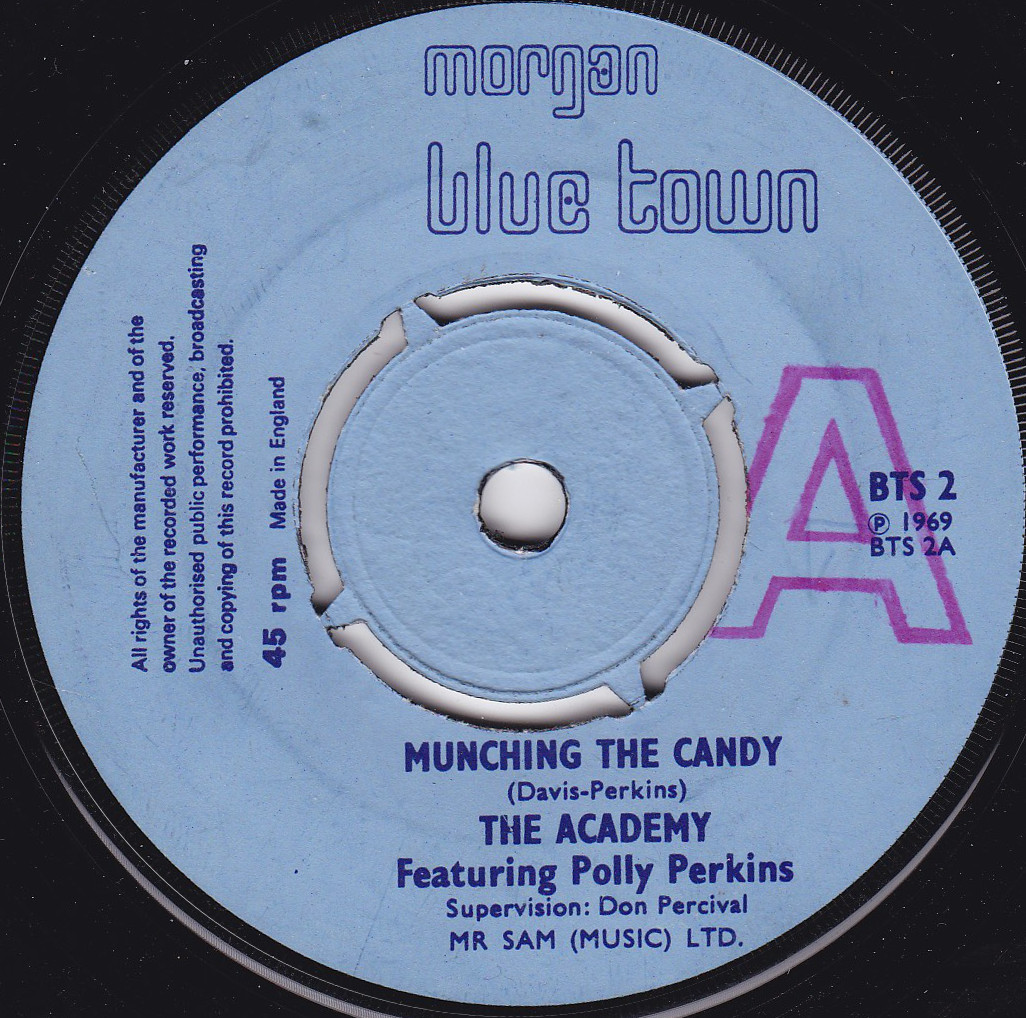
The Academy featuring Polly Perkins - Munching The Candy/ Rachel's Dream


Label: Morgan Blue Town
Year of Release: 1969

Life wasn't easy for independent labels in the sixties, and Morgan was no exception. Constantly dealing with shambolic distribution networks, very few of them scored hits. President Records broke the mould in the later part of the decade, but Joe Meek's struggles with Triumph and the financial struggles experienced by Strike Records spoke volumes about the hurdles many truly independent businesses had to deal with.

Far from being just an independent label, though, Morgan was also a large and well-respected recording studio in North London, with an in-house session team of musicians and songwriters who regularly bypassed the Morgan label and licensed their product to majors (The Smoke's "My Friend Jack" probably being the most famous example). The best Morgan recordings, such as those by The Smoke, Bobak Jons Malone and Fortes Mentum, were compiled on a superb Sanctuary Records release called "House of Many Windows" some years ago. This is now out-of-print, but copies are well worth tracking down - the team had developed a distinctive and actually incredibly agreeable sound by the late sixties, filled with tricksy and classical inspired arrangements, a low-end bass fuzz, and peculiar woozy but nonetheless poppy psychedelia. Whereas a lot of other psychedelic pop of the period sounded like the melodic equivalent of cheap Christmas cracker toys, Morgan took their mission seriously - in anyone else's hands, a track like Fortes Mentum's "Saga of a Wrinkled Man" would have possibly sounded cheap and nasty. Not for no reason did one prominent Morgan man Will Malone go on to become the arranger for The Verve in the nineties (and it is just about possible to hear the similarities if you really try).

Morgan Blue Town was an incredibly short-lived offshoot of the main label which attempted to reposition their product in a more progressive vain, appealing to the hippy and student markets. Any recordings on the label tend to be hopelessly scarce now, including this single by actress, Ready Steady Go compere and singer Polly Perkins.

This is actually a somewhat threadbare inclusion to their usually heavily produced catalogue. Polly Perkins had failed to score any hit singles in her music career, but was nonetheless a "known name" at this point who had already put out some commercial sounding grooves - so her sudden shift to progressive sounding music must have seemed bizarre at the time, a bit like Twinkle suddenly going a bit way-out and boarding the weed bus to rural Cambridgeshire. Nonetheless, "Munching The Candy" is a very folky, campfire effort which nods and winks in the direction of naughty drug-taking behaviour. "Rachel's Dream", on the other hand, is a rather more epic B-side which considers the plight of the Jewish people. No, really.

Like everything else on the label, it failed miserably. Polly only issued one other single in its wake, 1973's "Coochi Coo" on Chapter 21 Records, and seemed to focus more on her acting career afterwards. Perhaps that was the right decision. Between 2011-12 she scored a job on "Eastenders" as Dot Cotton's estranged sister Rose, and had numerous other jobs on the go in the run-up to that moment. While there's nothing wrong with her musical output, it certainly seems as if her strengths lay in theatre and screen work. For the rest of us, however, this single will always feel slightly like Dot Cotton's sister singing about a "hole in my head" where "the light's shining in" while a flute puffs in the background. And that's something that stays with you. Honestly, you'd have thought Dot had enough to deal with having Nick in the family.

The Academy and Polly Perkins also put out an album entitled "Pop-Lore According To The Academy" in 1969 which failed to do much business but was recently reissued to some fanfare.


10 January 2016

Trevor Burton - Fight For My Country/ Janie Slow Down


Label: Wizard
Year of Release: 1971/72

After Trevor Burton left The Move, he had huge plans for his future. Not for him the usual course of putting an advert in Melody Maker for musicians and waiting for the results - on the contrary, he wanted to tap into the much in-vogue (at the time) practice of forming a supergroup of respected and talented musicians.

The ridiculously named Balls were born, consisting of Brummie wunderkinds like Steve Gibbons of The Uglys, Richard Tandy (later of ELO), and Denny Laine from The Moody Blues. In truth, the formation of the group was muddy, complicated and fraught with difficulties and intense arguments. A revolving doors policy appeared to be in operation, and describing the personnel coherently here would be a task and a half. If you're really interested, the excellent Brum Beat website has patched together a very patient and detailed overview of their history here.

During the chaos of rehearsals and recording, it would seem that only one usable piece of work emerged, and that was this single, which consisted of Burton, Steve Gibbons and Denny Laine. Originally released under the group's name Balls in January 1971, it failed to sell, and was subsequently reissued as an edited version in 1972 under Trevor Burton's name. That also flopped, and the track was then reissued again on Birds Nest Records in 1975 under the name B L and G (with the track retitled as "Live In The Mountains"), where it also did precisely nothing. After that point, clearly everyone involved simply gave up.

I suspect the single's sales chances were harmed by the fact that it only appeared an entire year after Balls ceased to exist, but it's not hard to hear why many people felt the track had enormous potential. Strident, cocksure, anthemic and unusual, the buzzing analogue synths spin throughout the track like helicopter rotary blades while Burton and the boys build a naive but relatable anti-military message over the top. "Why don't we all go and live in the mountains?" Burton roars, and far from being the usual pile of old hoary supergroup mush, this actually sounds like psychedelic Brum beat crossed with early electronica and glam - a squidgy, messy soup of ideas taking place on the cusp of two decades which shouldn't really work, but does so brilliantly. I'd be willing to bet that at least one member of the Super Furry Animals likes this one...

After Balls petered out, Steve Gibbons went off to form The Steve Gibbons Band, and Denny Laine enjoyed colossal success with Paul McCartney in Wings, co-authoring "Mull of Kintyre" in the process. To my ears, both sides of this record are preferable to that bagpipe festooned anthem, but your feelings may differ.