JohnTem82387976
Showing posts with label sixties. Show all posts

3 March 2024

The Bunch - Red Rover Red Rover/ Happy Like This


Label: Beacon
Year of Release: 1969

"Happy sounds are really happening and Red Rover Red Rover is right in today's idiom, a stomping "bubblegum" number with driving bassline and a catchy sing-a-long chorus.

Of course, the heart of the "bubblegum movement" is in New York and that's where The Bunch come from.

They're a talented foursome who generate a great feel both on record and in live performance. Discovered in their home city by the forward-thinking Sire Records company, this lively group are sure to win a powerful British following too with this strong chart challenge".

Thus spake Beacon Records on their press release for this 45, but can you spot the deliberate mistakes, readers? Firstly, there was never really a "bubblegum movement" as such, with neither kids storming city hall demanding more frothy pop discs, or groups of teenagers swanning around the town centre dressed up as members of The Archies. 

Secondly, there was to be no strong chart challenge either here in the UK or the USA for this one. In fact, Beacon getting their mitts on it is a bit of a mystery - they certainly weren't picking up a track with a proven success rate, so we can only assume they bought the rights for it cheaply, crossed their fingers and hoped it would take off here as an exotic and of-the-moment North American disc. 

Thirdly, even if it had been a chartbound sound Stateside, Sire Records weren't directly responsible - rather, the track saw its release on the Candy Floss label across the pond, and far apart from that, the group weren't actually called The Bunch in America but The Puddle. It's not altogether clear why Beacon changed their name for the British market, especially as there was already a group called The Bunch operating here of "We're Not What We Appear To Be" fame; were they ignorant of the other band or hoping to potentially cadge a few of their sales from confused fans? Your guess is as good as mine. 

Hopefully the above facts can serve as a statutory lesson as to how unreliable press releases are as historical documents. Naughty Beacon Records. 

25 February 2024

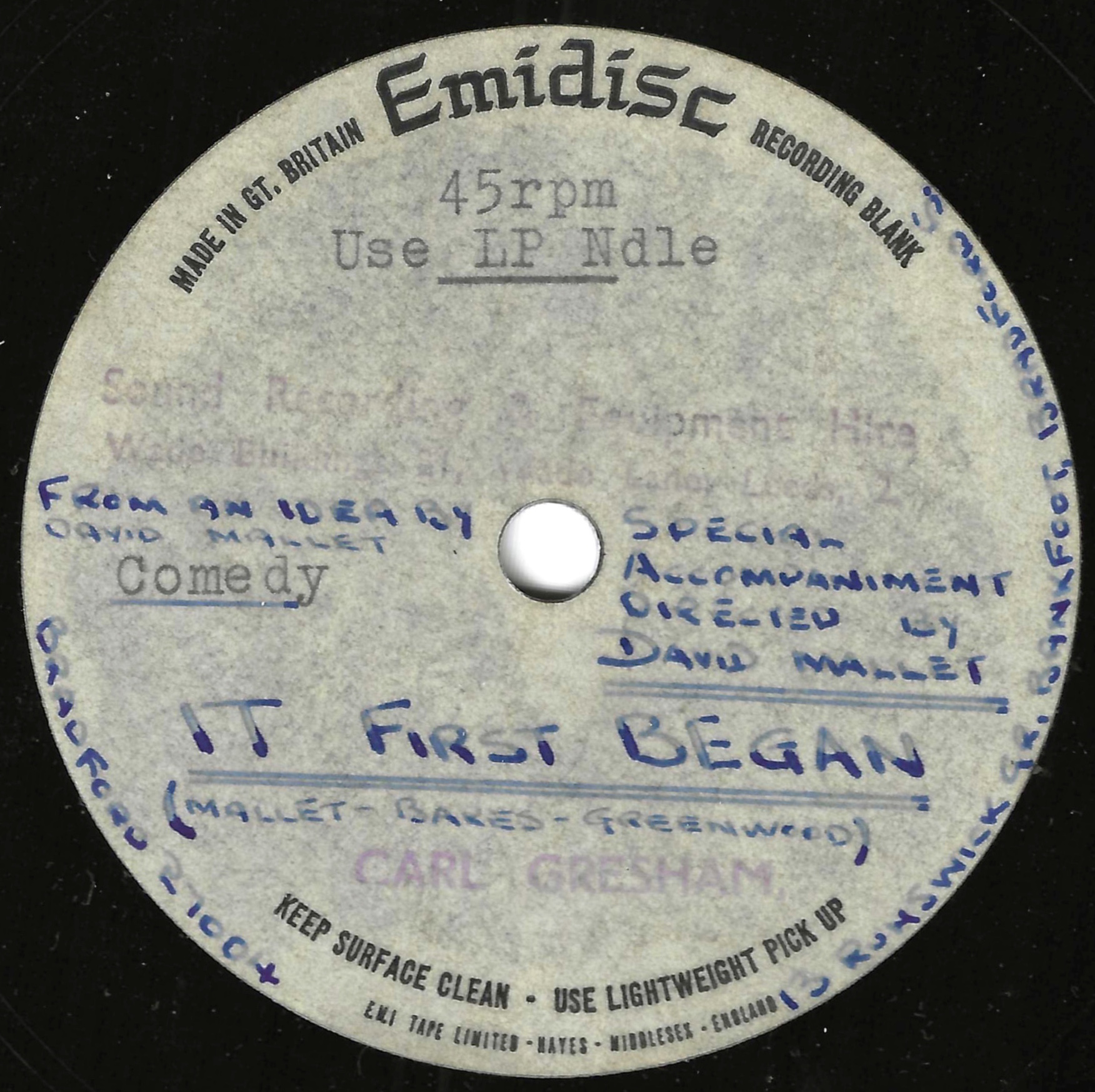
Carl Gresham - It First Began/ Comedy Version


Label: None
Year of Release: not issued


Acetates are an expensive folly in the average record collector's life. If you see one in a second hand record shop or on Discogs or eBay, the price is usually ratcheted sky-high, the seller knowing that the scarcity and uniqueness of the offering is going to make it very enticing. Yet when you do purchase one, what you usually get is a songwriter warbling over some basic piano melody they've written, or a half baked beat idea from some smalltown group whose ideas and style hadn't moved on from 1962.

And then, of course, there's stuff like this which surely had a backstory, but I'm damned if I know what it is. Carl Gresham was a highly influential man about town in Bradford, being a record store manager and club DJ at the turn of the sixties, and occasional actor - he was Tom Courtenay's stand-in for "Billy Liar" - and a "personal appearances" agent to the stars, offering them work opening supermarkets and department stores (which begs some serious questions about that 'supermarket opening' scene in the film "Billy Liar", which does not feature in the novel at all. Was this a sneaky, knowing nod to Gresham's sideline business?)

Gresham - or "The Gresh" as he was known to friends and associates - gradually grew into something of an establishment figure in Bradford, appearing in pantomimes and having his own weekend breakfast radio show on Pennine Radio, so it wouldn't have been unexpected to see him pushing out a novelty single at some point.

The trouble is, though, this sounds like a very early sixties demo with very simple Freddie & The Dreamers styled melodies, which dates it ahead of Gresham's rise to minor fame. On the A-side you've got a frivolous, cheery melody buried in a terrible mix which he chirps along to serviceably. It's a pleasant enough early beat offering but nothing to crack open the cheque book for. 

Over on the flip, however, is a very strange "comedy" version of the song, which was apparently arranged and conceptualised by the director and producer David Mallet, who worked with Les Dawson and Kenny Everett later in his career, as well as becoming one of the most successful music video directors of all time. In this The Gresh whacks out, screaming and shouting, making panicky asides about "falling down the hole in the middle of the record" and generally acting the giddy goat. It's not clear what this piece of work is connected to or why an acetate of it was pressed. It's possible it was to accompany a comedy show or idea which never got commissioned, but equally likely it was just Gresham dicking around in his remaining studio time.

28 January 2024

The Whales - Come Down Little Bird/ Beachcomber


Label: CBS
Year of Release: 1968

Televised talent shows are unforgiving affairs - they enable club acts or even aspiring bedroom singers to give a mass audience their best shot, but if they lose (and especially if they lose ignobly) they are likely to forever be considered damaged goods. A performer who didn't impress either a panel of judges or a television audience of several million people may even never work professionally again. 

And the winners? Well, the preferred narrative is that they will become new superstars, but even in today's market that's usually only the case for a brief period of time. The victors in talent contests usually sell well in the media aisle to supermarket shoppers for the first six months after receiving their gong, and are regarded as a safe booking by live venues and cruise ship events organisers, but only in rare cases do they really shake Britain or the world with their abilities. 

Barnsley's The Whales, for example, were Opportunity Knocks winners in 1968 and were given a fantastic opportunity to break through afterwards; a contract with CBS was duly inked, and the group were paired with the brilliant Mark Wirtz to produce a debut single. "Come Down Little Bird" was the outcome, and while it has since been compiled on "Piccadilly Sunshine", making it well known amongst the popsike cognoscenti, it was perhaps a bit too lacking in pizazz for the mass market. Wirtz clearly offered them a solid enough tune, but not one which sounded like a hit - the chorus is gently lilting rather than forceful, while the verses are too childlike and gentle to compensate. It's not bad, it's just clearly no "Teenage Opera".

18 January 2024

Reupload - Fuzz Face - Mighty Quinn/ Voices From The Sky


Label: Page One
Year of Release: 1968

Anything I write about the progression of "Mighty Quinn (Quinn The Eskimo)" from a "Great White Wonder" Dylan bootleg track to a major hit for Manfed Mann is probably going to be a bit of a waste of energy - everyone knows the story, after all. Dylan's songbook was continually plundered throughout the late sixties (and indeed beyond) by bands desperate for both cred and hits, and the adventures of Quinn the Eskimo were possibly the poppiest of options on offer, as well as handily buried on an unofficial release.

While Manfred Mann had shot to number one with their version of the track by February 1968, Fuzz Face here - who I'm 99.9% confident were some sort of American studio group - were latecomers to the party, issuing their version in April of that year. In fairness, it puts a slightly different spin on things, loading an instrumental version of the track with guitar effects, sitars, organs and decidedly "groovy" backing rhythms, making it prime fodder for anyone's house party. You can dance to this with much greater ease than the Mann's rather stompier take. 

Commercially, though, there wasn't much room in the charts for two versions of the same song at roughly the same time, and this sank on both sides of the pond. A shame, but it wasn't at all unusual for instrumental versions of pop hits to do this, however innovative or otherwise faintly psychedelic they were.

14 January 2024

Ulysses Smith - Jet Aeroplane/ The Next Train In The Morning


Label: RCA
Year of Release: 1968

For a songwriter who experienced such huge success with Sandie Shaw, and a reasonable run of hits in his own right as a solo artist, it's surprising how many of Chris Andrews' compositions failed for other people. What should have been a guaranteed badge of hit status and press attention sometimes slipped unhelpfully under the radar.

In this case, the oddly named Ulysses Smith is the benefactor of Andrew's helping hand. His real name was actually George Davies, a Barnsley-born singer and guitarist with the hitless act Me And Them. The group recorded for Pye in 1964, but none of their singles had any impact, from the inappropriately peppy Buddy Knox penned pop of "Think I'm Gonna Kill Myself" to their cover of The Beatles "Tell Me Why". 

Following their failure, Davies appears to have struck out on his own under a new name to try his luck under Andrews' production and songwriting guidance with this 45. In common with a lot of Chris Andrew's later work, it's a record which whiffs of Soho basement bars, with its brassy arrangements, swinging rhythms and punchy vocals sounding as if they would be more at home on the live circuit than tightly hemmed in a recording studio.

It probably wasn't confident or strident enough to be a bona-fide hit. Still, the occasional bursts of reverb and fruity brass on the flipside make it a much more groovy listen.

17 December 2023

The Victors - Take This Old Hammer/ The Answer Is No


Label: Oriole
Year of Release: 1965

While other labels splashed slogans like "Where The Stars Are!" or "The Place The Hits Happen!" across their company sleeves, Oriole were arguably an early example of a label taking the outsider indie approach, opting instead for "Young - New - Exciting". With no exclamation marks, a daring surfeit of hyphens, and a simple statement of fact, Oriole's company bags were bright yellow, used modernist typography and pushed a hipper approach. "We're where it's at", they seemed to say, "whereas EMI, Decca and all those old showhorses are way back where it used to be".

It's a fascinating label, featuring material which was sometimes way ahead of the marketplace, albeit often licensed (they were the first UK label to press up records by Stevie Wonder, for example, thanks to an early deal with Motown) and quaint, clodhopping attempts to capture that fast-moving youth market, through Joe Meek produced novelty singles to under-produced beat based fare.

They actually scored a number of hits during the fifties and at the turn of the following decade, but by the mid-sixties were beginning to look neither young, new or exciting, but rather middle-aged, weary and distracted. Besides the main label itself, their Embassy subsidiary (providing Woolworth department stores with cheap, knock-off cover versions of the day's hits) was a good cash cow, and their pressing plant was often hired out to the likes of EMI for pressing over-runs of Beatles records and other major singles where their plant in Hayes was struggling to keep up with demand. With all this going on, it's perhaps inevitable that marketing of the main label began to seem half-hearted by comparison. 

Oriole's approach to master tapes was also unbelievably cavalier, with label bosses believing that they should be continually be wiped and reused, even for hit recordings, rather than waste money keeping a library of tracks to reissue or license to others. It's enough to make a pop music historian's ears bleed with shock.

So then, nestling somewhere in the "missing believed wiped" file is this 1964 beat single from the mysterious Victors. The A-side is a cover of the blues standard "Take This Old Hammer", which in the manner of a lot of Brit Blues of the period is drenched in harmonica and nasally lead vocals. It probably didn't put the fear of God into the Rolling Stones, but it's as good as many of the UK beat-blues efforts of the period.

6 December 2023

Ted Rogers - I Can't Stop Thinking Of You/ All I Need's The Baby


Label: Piccadilly
Year of Release: 1965

Only truly lucky famous people get to choose what they're famous for. Talent doesn't always help - even the very talented usually only have one breakthrough moment which resonates with the public and defines them forevermore.

Ted Rogers was a man of many light entertainment skills, performing on the Billy Cotton Band Show, hosting Sunday Night At The London Palladium, and touring and singing alongside Bing Crosby. To most British people, however, he's probably best known as the host of the mind-bendingly complicated quiz show "3-2-1", a programme filled with riddles so obtuse they even caused my father, a keen crossword solver, to throw his newspaper to the floor with exasperation. 

Was Ted then the host of one of the few intellectual quiz shows of the seventies and eighties, or the captain of a crooked ship with fixed prizes? Answering that question would involve an analysis of multiple episodes of "3-2-1", and if you've got the time to do that, be my guest and submit your dissertation to the usual email address by 5th January 2024. All essays which are more than 2,500 words long will not be accepted.

Naturally, Ted's days with Dusty Bin also overshadowed his talents as a singer which, to be blunt, were serviceable but never exceptional. He released three singles in the sixties, of which this was the first. It's exactly as you'd expect, except with a deep depressive streak - Ted closes his eyes and croons away to his ex, telling her that he's essentially obsessed with her and will cry to infinity and continue to keep "hurting himself". Put the razor blades away, Ted, she's bound to come back to you when you have your own hit show on Yorkshire TV.

3 December 2023

The Paupers - Southdown Road/ Numbers


Label: Verve Forecast
Year of Release: 1969

The Paupers were not exactly a blessed Canadian band. Formed in Toronto in 1964, they prided themselves on a (possibly exaggerated) work ethic and heavily hyped "live tightness", offering audiences in the area a dependable experience for the price of their gig tickets. 

What they sadly lacked was a steady line-up. Between their debut single "Never Send You Flowers" emerging in 1965 and this final effort in 1969, they lost two key original players - vocalist and rhythm guitarist Dan Marion and bass player Denny Gerrard - and were sent on long American tours which didn't result in significant success across the border.

Despite internal HR struggles, their musical journey was surprisingly fast. The debut 45 is without question a naive, slightly ramshackle, spindly fawn of a record which sounds as if it may fall over at any moment. The follow-up "If I Told My Baby" is punchier but still clearly a product of the beat era. 

By 1967's "Simple Deed", however, the group were hairy, laidback and were finally settling into a much more progressive sound, which resulted in a number 21 Canadian hit.  The chart success didn't last, though, and the following album and accompanying single "Magic People" didn't create a huge impression despite a lot of record label backing and hype, managing only to climb to number 178 on the US charts. 

By the time "Southdown Road" emerged the band were on their last legs, skint and in a state of disarray, but it doesn't show in these grooves. While the A-side isn't as memorable as it might be, the flipside "Numbers" is mean, heavy slice of hippy rock which provides no hints to the band's imminent demise. 

29 November 2023

Reupload - Mike Wade - On The Make


Label: [acetate]
Year of Release: [n/a]

Acetates, particularly ones of unreleased songs, spark huge excitement in me. It doesn't necessarily matter if the song isn't a lost gem - I've been getting my knees dirty digging in plastic crates for long enough now to know that's a very rare occurrence - it's just interesting to get hold of a polished recording which never made it past the private studio pressing stage. If a record that only sold fifty copies is scarce, then an acetate which was only shared among a handful of people is always going to feel a bit like a "precious thing" to a record collector.

The trouble is, acetates usually aren't very cheap either, and if I'm being honest, they tend not to overly enthuse "Left and to the Back" readers, who perhaps sense that if it wasn't good enough to make it into record shops, it's probably not worth clicking to investigate further. If I'm being fair, that's not usually an unreasonable assumption. "So what have we here?" you may well ask while stroking your chins, and let me tell you...

Mike Wade was one of many theatrical, big-voiced male solo singers in the sixties, who issued one 45 on Beacon ("Lovers", backed with the danceable "Two Three Four") and two on Polydor ("Happiness" and "Lovin' You Lovin' Me"). With a singing style which does seem rather reminiscent of Scott Walker at times, he nonetheless failed to take the kind of creative risks our dearly departed friend did - there were to be no songs about death or Stalin, nor meat punched for its percussive qualities round at Mike's house.

As Scott became ever more introspective and experimental, perhaps record label bosses saw Mike Wade as being somebody who could be wheeled into his place. That really wasn't to be, though - all his singles sold poorly, and it's very tricky to track down any of them now. Scott's, on the other hand, have been reissued time and time over.

26 November 2023

Val and the V's - I Like The Way/ With This Theme


Label: CBS
Year of Release: 1967

It's astonishing that so few family groups emerged in the sixties. Parents were still popping out sprogs in the fifties at a rate where there often wasn't much of an age gap between them, the beat boom tempted any kid with the means into a group, and say what you want about your family (and I know you will) but... well, they're just there, aren't they? You've lived with them for long enough to already have a firm impression about their talent and reliability, and living in the same house makes organising rehearsals a doddle.

Val Melfi and her Vs (Vinnie Melfi on guitar and Viv Melfi on drums) firmly kept things in the family way, though, and were circuit veterans by the time they inked a deal with CBS, having played working man's clubs and cabaret clubs across the land, even gaining a residency at the Piccadilly Club in London. Their material wasn't purely middle of the road and had enough verve and swing to keep the kids happy.

The CBS debut "Do It Again A Little Bit Slower" was perhaps a little too rigid and understated, but this follow-up makes up for it. "I Like The Way" is a cover of the Tommy James and The Shondells song, and Val's tones are seductive here, snaking their way around a superb Keith Mansfield arrangement and a strident groove. By the time the organ break seeps in, you too will be wiggling your hips around the living room. This is pure Radio London stuff, and on a lucky week may actually have become a hit.

19 November 2023

The Nocturnes - Why (Am I Treated So Bad)/ Save The Last Dance For Me


Label: Columbia
Year of Release: 1967

Birmingham's The Nocturnes have featured on numerous psychedelic compilations, but you could be forgiven for wondering why. They could probably be more realistically and fairly defined as a harmony pop group with occasional tinges of Jimmy Webb's influence around the edges; indeed, their sprightly version of his track "Carpet Man" was compiled on the EMI CD "Psychedelia at Abbey Road" where it felt only slightly out of place.

"Why (Am I Treated So Bad)" was their second single after their debut release "I Wish You Would Show Me Your Mind", and is another interesting interpretation. "Why..." was originally written by Roebuck Staples of The Staples Singers in response to an incident at the Little Rock Central High School in Arkansas. Nine black students attempted to enrol at the school in 1957 and were met with protests and blocked by the National Guard - the song is a response to this incident and in its original incarnation is a gutsy, bluesy, gospel-tinged protest.

The Nocturnes, however, obviously heard some of the gospel elements, noticed a discernible eeriness to them and decided to amp up these aspects. This version opens with a droning organ then introduces vocals which sound as if they've escaped from the mouths of the spectres on "Johnny Remember Me". Thudding, echoing beats occasionally introduce themselves like funeral drums, and the end effect may not be quite what The Staple Singers had in mind - in fact, there's a whole debate to be had here about whether a white Brummie group deviating from Roebuck Staples' intentions is appropriate - but it is startling. It's not exactly the precursor to The Specials "Ghost Town", but it does nonetheless take a politically charged topic and cut it through with a desolate, windblown feel. 

The B-side, on the other hand, is a fairly hollow pedestrian jog through The Drifters classic which sounds as if it may have been recorded in one take. You can't have everything.

5 November 2023

The Pineapple Chunks - Drive My Car/ Dream About You


Label: Mercury
Year of Release: 1966

Maybe it's a generational thing, but when I hear "beep beep, beep beep, yeah!" the first thing I think about isn't The Beatles "Drive My Car" - as it damn well should be - but Radio One's traffic news jingle from the eighties. You know, the one which cheerily went "Traffic neee-eews, on Radio Wuh-hu-hun!" while various motorists probably seethed in frustration out there in the real world (it's on YouTube if you really want to relive those bygone days).

This is stupid of me, because while it was never a Beatles single, "Drive My Car" was a well-known and highly appreciated number, included on many of their compilations, including the cheapo MFP release "Rock and Roll Music" I owned myself on cassette. It just wasn't such an ever-present feature as Radio One's persistent jingles. 

The BBC obviously weren't the only people to realise the track's potency, though, and the mysterious Pineapple Chunks took the long-favoured sixties route of recording a careful cover of a Beatles album track in the hope chart success would follow. With a tailwind behind it and the right production, the song of course could have become a smash - this probably isn't quite what the doctor ordered, though. The Chunks deliver it smoothly, gleefully and competently, but the driving, clopping rhythm and the occasional bursts of wildness on the Fabs original are obliterated here, replaced by something calmer and less edgy. It's not a bad performance, but the rhythm section in particular undersell the song; say what you want about Ringo Starr, but this is evidence that the man really did know what to do with Beatle tunes. 

The flipside "Dream About You" is more interesting, having an almost garage rock feel to it, with a droning organ riff sitting beneath the band's vocal harmonies and a twitchy, hyperactive but steady beat. 

29 October 2023

The Collectors - I Must Have Been Blind/ The Beginning


Label: London
Year of Release: 1970

While this was their first and only UK release, The Collectors had a long and complicated history in Canada prior to landing here. They initially formed as The C-Fun Classics in 1961, then eventually changed their name to the Canadian Classics, and were the house band of the British Colombia station CFUN-AM. While I haven't been able to track down all the records they released in this guise, the few sips I've tasted are more-or-less what you'd anticipate given the band's purpose - slick, professional and sweet but not anything to telephone your friends about. 

As the years moved on, however, a slightly rougher edge began to work it's way into their sound. 1965's "I Don't Know" has sulky vocals and snappy fuzz guitar lines, and may have been a hint of things to come. By 1966 they had experienced a reshuffling of their line-up which prompted a name change to The Collectors, with the line-up of this act consisting of Howie Vickers on lead vocals, Bill Henderson on guitar, vocals and keyboards, Claire Lawrence on Saxophone, Flute, Keyboards, Harmonica & Vocals, Glenn Miller (no, not THAT one, you dolts) on bass and vocals, and Ross Turney on drums.

They became the house band at Torch Cabaret in Vancouver, grooving their way through the dancefloor hits of the period, but gradually began to introduce original material of their own. Most of this output deviated from the old style of The Classics and had folk rock and psychedelic arrangements cut through the centre. Some bona fide hits subsequently arrived in the form of "Looking At A Baby" (number 23 in the Canadian charts) and "Fisherwoman" (number 18) but perhaps the most fascinating artefact of all is the album "Grass and Wild Strawberries", written as the soundtrack to a theatre play by George Ryga. Considered by some to be a lost progressive work of some worthiness, the contents were also played live by the band throughout the play's entire run.

22 October 2023

The Gallants - Man From U.N.C.L.E/ The Vagabond

David Axelrod and HB Barnum with a groovy instro take on the classic theme

Label: Capitol
Year of Release: 1965

While digging around in my record boxes a couple of weeks ago, I found this one dozing forgotten and unloved in front of the Elmer Gantry's Velvet Opera 45s. I bought it in a job-lot auction 15 years ago and had just allowed it to fester there in the meantime, never entertaining the idea of either DJ'ing with it or uploading it here.

This is proof that I'm not always the most organised cookie when it comes to these things, and the obvious gems in job lot auctions sometimes blind me to the charms of the other candidates in the batch. Both sides of this are worth a spin - the A-side is not the actual "Man From U.N.C.L.E." theme, but a more guitar-heavy approximation of it pulled together by the legendary arranger HB Barnum. The spindly guitar riffs intertwine with a driving beat and sinister organ lines to create a slightly menacing, clippy affair. 

For dancefloor movers, though, the B-side "The Vagabond" is where the action is. This is a Barnum composition which shakes with verve and sassiness. It's apparently found its way on to a number of mod night playlists over the years, although I have to confess I never did hear it blasting its way across the floor at any night I attended in London. 

Barnum probably needs little introduction, but began his career in doo-wop groups before gradually shifting over to arrangement and songwriting work, which saw him collaborate with Frank Sinatra, Aretha Franklin, The Supremes, Chubby Checker and numerous other legends besides. As a songwriter, his most credible outing is probably Judy Street's "What". 

Nestling uncredited on this label (but firmly credited on the US pressing) is also another production king David Axelrod, for whom The Gallants appeared to be a commercial "themes" project rather than anything more artistically significant. Their other US singles included The Batman Theme and The Theme From Laurel and Hardy, proving that Axelrod was just trying to produce popular hits from familiar themes, and little more - but it's proof that even when given such a factory line task, he could infuse it with a certain spark. 

8 October 2023

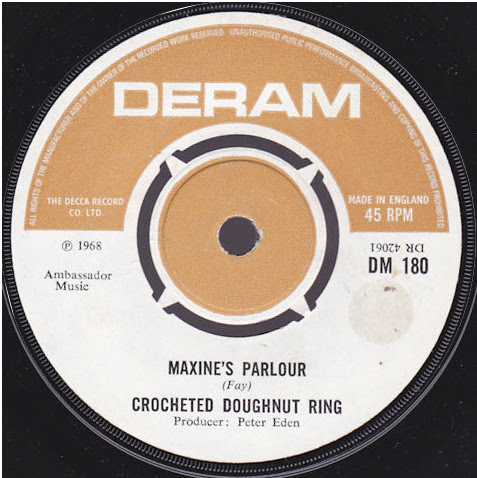
Crocheted Doughnut Ring - Maxine's Parlour/ Get Out Your Rock And Roll Shoes


Southend freaks give the Teds something to think about

Label: Deram
Year of Release: 1968

The Crocheted Doughnut Ring were not quite as freakish as their absurd moniker made them sound. While the group arguably had their roots in the London psychedelic underground - several of their members originated from The Fingers, a group who once heckled Pink Floyd for "selling out" - in reality they were about as far from AMM as you could get. Music business producer Peter Eden managed them and gave them their name (after a Peter Blake collage) and most of their singles are sugary McCartney-esque pop with the lightest of feathery touches on the cosmic trigger.

Their career is notable for having accidentally birthed a genuinely freaky classic, though. "Two Little Ladies (Azalea And Rhododendron)" emerged on Polydor in 1967 and was a gentle piece of whimsical popsike, but was backed by a piece of Eden-led mania in "Nice" which was essentially the A-side remixed and retooled to become an ambient masterpiece. The Orb and The KLF might have "invented" the Ambient House genre, but all "Nice" lacks is a series of car engines and train horns before it becomes the future of the chill out room. A number of forward-thinking Pirate Radio DJs opted to play it over the more conventional A-side.

The group might have used that opportunity to fly their psychedelic banner higher, but in reality their other singles on Deram are much more conventional, with 1967's "Havana Anna" sounding like a bubblegum track being shoved rudely and ignobly on to a bouncy castle and 1968's "Dance Around Julie" being yet more clappy paisley party tweeness.

Nestling between those two singles was this one, however, which restores the balance somewhat. The A-side "Maxine's Parlour" was written by the legendary Bill Fay and is muscled up into a towering epic; mellotrons meeting a huge moody (blue) chorus and Eleanor Rigby styled loneliness. It's not really commercial enough to be a hit single, and indeed it wasn't - but it's a fine reminder of other potential avenues the band might have explored. The track is available for download on iTunes and elsewhere.

The flip, however, has fallen out of circulation and is the brittle underside to the disc, being a full-blown rock rave-up referencing Jerry Lee Lewis, Elvis Presley and the whole damn quiffed up gang. While there's no doubt it was largely formulated by a studio jam, it's still a blistering and forceful listen, showing that the rock and roll spirit was alive and well even in such long-haired bodies.

4 October 2023

Reupload - Giant Jellybean Copout - Awake In A Dream


Bizarrely named studio bunch worshipping at the feet of Brian Wilson

Label: Poppy
Year of Release: 1968

While Brian Wilson's talent caused jaws to drop globally when "Pet Sounds" was closely followed by "Good Vibrations", it left the groups who admired him somewhat snookered. Those who loved The Beatles could put their own spin on the moptop sound without seeming like total clones (though admittedly The Knickerbockers seemed happy to ape their style with very few embellishments). The Beach Boys, though? How can you sound like a 'psychedelic barbershop quartet', as Hendrix put it, in your own way? Wilson not only developed but essentially owned that template.

This is exactly where the ridiculously named Giant Jellybean Copout came unstuck. "Awake In A Dream" is essentially The Beach Boys during their "Good Vibrations"/ "Smile" phase on a much lower budget. It's a very astute imitation, to be fair, and the tremendously psychedelic "lucid dreaming" lyrics and perfect close harmony vocals combine with a meandering structure to create something that must have been a satisfying listen for Wilson fans hungry for the delayed "Smile" LP.

As the group's name might suggest, there's more than a bit of sickly sweet bubblegum running through the core of this record too, but it's syrupy pop with a rather confusing and conflicting aftertaste. 

The main man behind this group was Jim Ryan of The Critters, who is probably best known in the UK for his minor hit "Younger Girl". It's a thing of pure sunshine loveliness which probably doesn't get played much these days due to the fact the lyrics seem slightly paedo-friendly if you're the cynical type. If you hear it as what I suspect it's supposed to be, though - a dreamy song for teenagers about the girl two forms below - it's a thing of beauty. 

Ryan eventually went on to become Carly Simon's touring guitarist, before becoming a studio based session musician. 

1 October 2023

The Sceptres - Something's Coming Along/ What's The Matter With Juliet


Strident beat pop from the Montreal wonders

Label: Spark
Year of Release: 1968

While there were certainly exceptions to the general rule (particularly in the folk scene) Canadian musicians often got overshadowed by the work of their American cousins in the sixties. A quick scout around any Canadian record shop or eBay sales listing will reveal an assortment of surprising garage groups and pop outfits who never seemed to get far south of Niagara Falls, from Eastern groups who struck a careful compromise between French pop and American rock to Western bands making a fierce homespun racket. 

The Sceptres were a predominantly English language group from Montreal who released a brace of singles from 1965-1969, from the debut "Boy Like Me" on the Fi-Sound label through to their final release on Polydor "Good Morning New Day". The group made a huge name for themselves on the Canadian gig circuit due to their professional vocal harmony sounds, sufficiently getting enough acclaim to enable them to also tour the Eastern strip of the USA as well. Sadly though, no US record labels appear to have ever approached them with contracts, so no Billboard chart appearances resulted.

"Something's Coming Along", however, did sneak out on to Spark Records in the UK despite the group's largely unknown status in this country. There are two possible reasons for this outcome - firstly, the band had recently experienced a huge French language hit in Quebec with a cover of "I Never Had A Love Like That", and secondly both sides were co-written by John Carter, an individual who had a close working relationship with both the Spark label and particularly their parent company Southern Music. While the tracks were recorded in Canada by legendary producer Martin Martin rather than at Spark's studios in London, this association combined with the exotic North American connection must have made licensing the UK release too tempting to resist.

These are two solid sides as well. "Something's Coming Along" tip-toes between commercial beat pop and swinging mod rock successfully and could have been a potential UK hit. The flip side "What's The Matter With Juliet" is also a bold, brassy arrangement which highlights the group's vocal strengths. Some might call this popsike, but I'd draw short of describing it as that.

24 September 2023

Nancy Whiskey - Freight Train/The Game


Plaintive re-recording of huge fifties skiffle hit

Label: CBS
Year of Release: 1967

"Freight Train" was one of the few huge hits on the independent Oriole label in the fifties, hitting number five in 1957. It was also a bit of an anomaly in skiffle terms - its singer Nancy Whiskey was a Scottish folk singer on the Topic Records label rather than some kid bashing on a pot lid in a cafe in the West One area. Her collaboration with the Chas McDevitt skiffle group to produce a record was not necessarily a natural fit, and was one she needed to be persuaded to undertake; with a rootsy, authentic folk pedigree and a recording contract of her own, she was somewhat doubtful of the change of direction. In fact, by all accounts she didn't even like skiffle that much. 

She would stay with McDevitt's group for four more singles, including the minor hit "Green Back Dollar", before returning to her solo career. Oriole persisted with their hitmaker and a few other 45s did pop out with her name attached, with most returning to the folk idiom she appeared more comfortable with. When it became clear that her mainstream appeal had been lost, the label let her go and she re-emerged on Fontana for "Bowling Green" in 1965 and then seemed to revisit her glory days for this CBS release in 1967, a whole ten years after the song's original release.

This version tones down the steamy, woody rattle of the original version and replaces it with a simple yearning, strings and all. Perhaps CBS perceived that a radical reworking of "Freight Train" on its tenth anniversary would attract the public's interest, or perhaps this is the way Whiskey had always wanted it to sound - but whatever the truth, it was roundly ignored by a public who weren't really nostalgic for skiffle in 1967. While it was true to say that some old Teds wandered the streets bigging up the idea of a rock and roll revival, nobody was dreaming wistfully of those threadbare days when spoons and brooms could be used as musical instruments by ration-starved youths. 

Her self-penned flipside here is interesting, though, showing a writer and performer capable of producing complex and very contemporary material. "The Game" isn't a million miles away from one of Scott Walker's "Scott 3" era efforts - brief, stupendously arranged, mysterious and leaving you feeling slightly uneasy by the time it leaves it your life for the first time. 

13 September 2023

Two Much - Wonderland Of Love/ Mr Money


Male-female pop duo with their less sought-after 45 (sorry kids)

Label: Fontana
Year of Release: 1967

The sixties gobbed out obscure singers by the spittoon load, and the Middlesex based duo Two Much (where in Middlesex? Don't ask me, I'm telling you all I know) were another fairly mysterious pair in the barroom bucket. We know for a fact that they were Andrea and Steve Gerome, but whether they were brother and sister, or husband and wife, remains lost to the record company archives. 

Their second single "It's A Hip Hip Hippy World" is becoming increasingly sought after, though, with record collectors using the shorthand of "It's like Abba gone popsike" (which it is) to shift the single towards high prices. I've been after a copy at a reasonable price or ages and will continue to hunt high and low.

This was their debut 45, and is altogether more straightforward, zingy, stringy pop. "Wonderland of Love" actually sounds a little bit dated for 1967, too wholesome, toothy and cuddly for a world where Sonny and Cher were showbiz's King and Queen. It could just as easily have been released in 1962 without anyone noticing anything innovative and strange, so it's therefore not totally inexplicable that it failed during the summer of love. "Hip Hip Hippy World", on the other hand, would probably have fared better if it had slid out in 1967 and not 1968. Sometimes timing is everything.

6 August 2023

Sheffield University Rag Week Record - 1964


Cheap multi-genre flexidisc fun - "it's for charity, y'know!"

Label (of sorts): Lyntone
Year of Release: 1964

"Yes! Here it is folks! The very first Sheffield Rag Record, presenting for your entertainment four well-known sound (sic) of Sheffield:

Los Caribos: purveyors of West Indian Carribeat music. The university is fortunate in possessing such an outstanding example of this genre.

The Addy Street 5: the University jazz band. The only traditional band to reach the finals of the inter-University Jazz competition.

The Vantennas: extremely popular beat group, both in the University and in the City.

Dave Allen Big Band: regular performer in the university union. Well-known throughout Sheffield".

Ah, rag week at university. The history of the concept is a slightly complicated one with less than honourable origins. Rags in the nineteenth century were often noisy and destructive and involved pitched battles between rival universities, frequently leading to destruction of property or injury of persons - football hooliganism for the wealthy, essentially. 

Some students disliked their good name being sullied by the tribal actions of a violent and aggressive minority, and set out to subvert the principles and aims of Rags, making them about delivering positive things for local good causes and embedding the university more firmly into the local community. As time moved on, Rag Weeks emerged which involved fund-raising in innovative ways - the publication of jokey "Rag Mags" or production of student-friendly novelty items to raise money. These steadily became annual fixtures on the university calendar.

By the time I went to university in the nineties, Rag Week seemed to mostly involve students standing around in the student union shaking plastic buckets filled with coins and screaming "RAAAAAG WEEEEK!" at the tops of their lungs. Whether this was because time had shown this paid just as many dividends for local charities as producing inventive or humorous items, or the nineties were just a very shouty, screechy time anyway, or both, I will probably never know. I just threw 50p in the bucket and tried to get away as quickly as possible. I didn't ask questions.

This means that products like this 1964 flexidisc from Sheffield University feel like strange artefacts from a more ambitious time. Recording these university groups and getting the record pressed up for public consumption shows an unbelievable degree of commitment and effort, while also handily providing us with a lasting memento of the sounds of campus life during that period. 

While the fragile nature of the medium causes this history to be occasionally muffled by scuffs and groove wear, it shows a university embracing beat, West Indian sounds and jazz as well as the unstoppable and obligatory Big Bands, a traditional feature of universities right through the century. 

All examples here are competent and professional sounding, but as you'd expect none highlight stars in the making. "Left and to the Back" readers are probably going to be most interested in The Vantennas (the only pop group to be named after BBC licence detecting vans?) They turn in a thumpingly acceptable performance with a cover of The Hollies' Miller and Ford penned "Baby Don't Cry", though the polite, restrained backing vocals and sparse, steady rhythms seem as much like the product of the pre-beat boom era as they do of 1964 - University Rags might have traditionally involved chaos and destruction, but there's nothing going on here to incite that feeling on record. 

The rest do very much what the enterprising student (or students) set out in their blurb, although The Dave Allen Big Band regrettably turn out not to have any associations with the Irish comedian of the same name.