JohnTem82387976
Showing posts with label Morgan Studios. Show all posts

19 April 2023

Mandy Montgomery - In My Fantasy/ Sail Away


Geoff Gill turns his studio skills to actress/singer Mandy Montgomery

Label: Rocket
Year of Release: 1982

Let's all take a brief moment to drink in that sleeve, shall we? The fascination with all things Futuristic in the late seventies and early eighties saw some interesting styles and designs being used which dated quickly despite everyone's best intentions. The calculator styled font on this sleeve would be one prime example, then there's the clothes and backdrop for Montgomery herself. I'm not sure I quite understand what's happening here - did someone have an interesting premonition about a Dyson hoover? - but full credit to her for managing to rise above it all and seem extremely charismatic and confident. You notice Mandy's powerful gaze before you really look at any of the other "stuff".

Of course, it's the contents inside the sleeve we should be more concerned about, and perhaps also another credit on the label. Geoff Gill was an ex-member of sixties group The Smoke as well as a house musician at Morgan Studios in London, cropping up on all manner of celebrated popsike ditties of the period. Later, he would go on to write "Heartbreaker" for Pat Benatar as well as see his sixties psych classic "My Friend Jack" covered by Boney M, both of which must have kept him in reasonable royalties ever since.

This is an interesting outlier in his later career, though, which is seemingly an attempt to score a synth-drenched rock hit with an aspiring young performer. "In My Fantasy" wants to have its cake and eat it, filled with soft rock hooks and flourishes, but also a lot of synthetic space-age whooshing noises and propulsive bleeps. If it has an obvious influence, it would probably be Kim Wilde, but interestingly a middle-eight hovers into view which sounds faintly like the Blake's Seven theme (which would remain untouched again until Pulp used it as a reference point in the nineties). It's a reasonable piece of work, just not quite good enough to cut through the piles of innovation occurring throughout 1982, probably one of pop music's finest years. 

6 March 2016

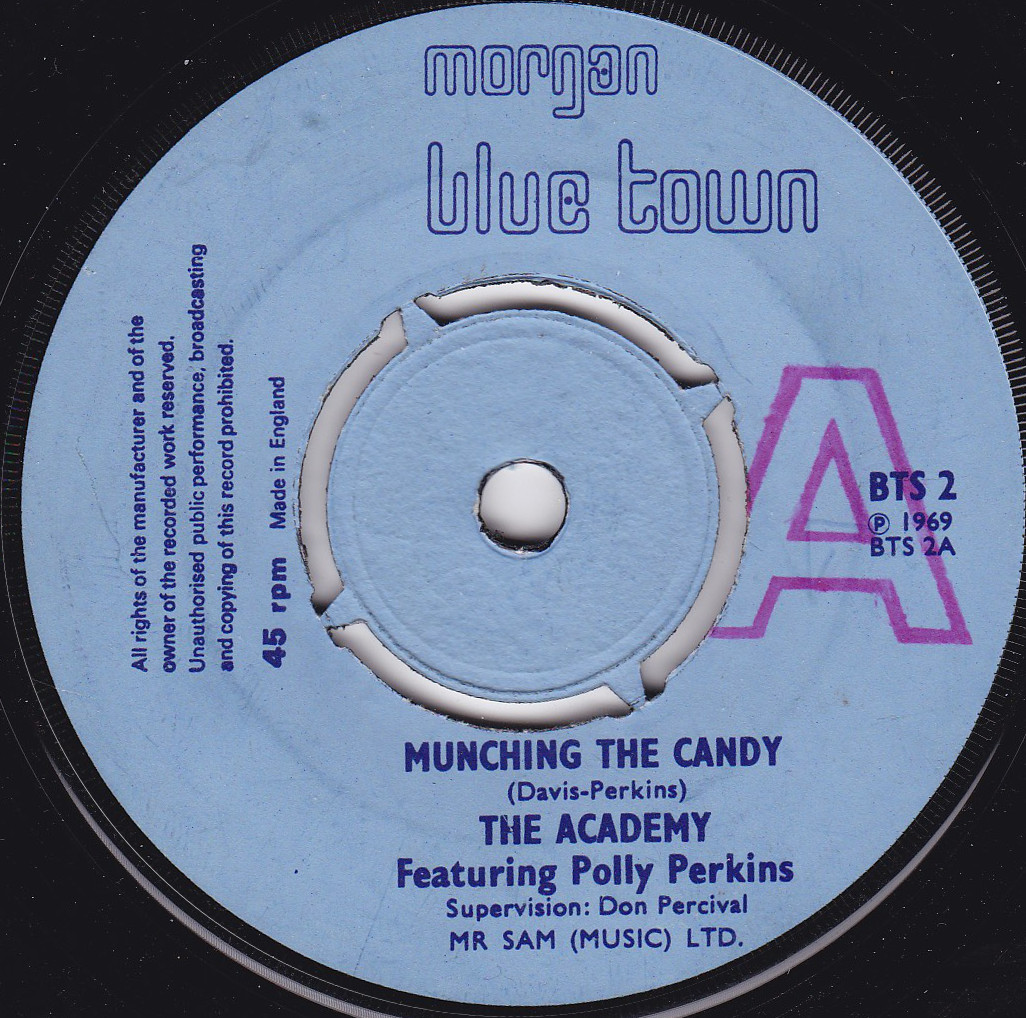
The Academy featuring Polly Perkins - Munching The Candy/ Rachel's Dream


Label: Morgan Blue Town
Year of Release: 1969

Life wasn't easy for independent labels in the sixties, and Morgan was no exception. Constantly dealing with shambolic distribution networks, very few of them scored hits. President Records broke the mould in the later part of the decade, but Joe Meek's struggles with Triumph and the financial struggles experienced by Strike Records spoke volumes about the hurdles many truly independent businesses had to deal with.

Far from being just an independent label, though, Morgan was also a large and well-respected recording studio in North London, with an in-house session team of musicians and songwriters who regularly bypassed the Morgan label and licensed their product to majors (The Smoke's "My Friend Jack" probably being the most famous example). The best Morgan recordings, such as those by The Smoke, Bobak Jons Malone and Fortes Mentum, were compiled on a superb Sanctuary Records release called "House of Many Windows" some years ago. This is now out-of-print, but copies are well worth tracking down - the team had developed a distinctive and actually incredibly agreeable sound by the late sixties, filled with tricksy and classical inspired arrangements, a low-end bass fuzz, and peculiar woozy but nonetheless poppy psychedelia. Whereas a lot of other psychedelic pop of the period sounded like the melodic equivalent of cheap Christmas cracker toys, Morgan took their mission seriously - in anyone else's hands, a track like Fortes Mentum's "Saga of a Wrinkled Man" would have possibly sounded cheap and nasty. Not for no reason did one prominent Morgan man Will Malone go on to become the arranger for The Verve in the nineties (and it is just about possible to hear the similarities if you really try).

Morgan Blue Town was an incredibly short-lived offshoot of the main label which attempted to reposition their product in a more progressive vain, appealing to the hippy and student markets. Any recordings on the label tend to be hopelessly scarce now, including this single by actress, Ready Steady Go compere and singer Polly Perkins.

This is actually a somewhat threadbare inclusion to their usually heavily produced catalogue. Polly Perkins had failed to score any hit singles in her music career, but was nonetheless a "known name" at this point who had already put out some commercial sounding grooves - so her sudden shift to progressive sounding music must have seemed bizarre at the time, a bit like Twinkle suddenly going a bit way-out and boarding the weed bus to rural Cambridgeshire. Nonetheless, "Munching The Candy" is a very folky, campfire effort which nods and winks in the direction of naughty drug-taking behaviour. "Rachel's Dream", on the other hand, is a rather more epic B-side which considers the plight of the Jewish people. No, really.

Like everything else on the label, it failed miserably. Polly only issued one other single in its wake, 1973's "Coochi Coo" on Chapter 21 Records, and seemed to focus more on her acting career afterwards. Perhaps that was the right decision. Between 2011-12 she scored a job on "Eastenders" as Dot Cotton's estranged sister Rose, and had numerous other jobs on the go in the run-up to that moment. While there's nothing wrong with her musical output, it certainly seems as if her strengths lay in theatre and screen work. For the rest of us, however, this single will always feel slightly like Dot Cotton's sister singing about a "hole in my head" where "the light's shining in" while a flute puffs in the background. And that's something that stays with you. Honestly, you'd have thought Dot had enough to deal with having Nick in the family.

The Academy and Polly Perkins also put out an album entitled "Pop-Lore According To The Academy" in 1969 which failed to do much business but was recently reissued to some fanfare.


8 November 2012

Reupload - Buggy - Harry The Keeper


Label: Parlophone
Year of Release: 1970


This is the kind of thing you dream about digging up when you approach the bargain section in the corner of the second hand record shop, dipping in for possible underpriced gems. The clues are there for all to see, and whilst I'd be happy to print them upside down at the bottom of this blog entry as some sort of quiz feature, it's probably more sensible if I just outline them. This is a Morgan production by Danny Beckerman and Geoff Gill. The former would be enough to make this a compelling curiosity, but the fact that Beckerman and Gill are involved makes it doubly interesting, as the pair have been engaged with some of the more cultishly successful collectable psychedelic records of the period.

Buggy's "Harry The Keeper" has been late to pick up any sort of critical praise from the usual British Psychedelic websites (it only began to get noticed shortly after I bought this, actually) but it is beginning to be appreciated by lovers of the twee, toytown end of the spectrum. It's the usual sort of twisted childlike nonsense about a zookeeper cheerily feeding his friends to the lions, the kind of lisping innocence with a nasty underbelly that the period churned out in enormous quantities. There's no question that it will be best appreciated by those who like "that sort of thing", and utterly despised by everyone expecting something akin to The Grateful Dead. If you have an aversion to the frothier end of McCartney inspired psychedelic pop, you'd do well not to bother clicking on the download button.

The flip side "Rolly Pole Coaster" would indicate that rather like Kidrock's "Ice Cream Man" (see the "Circus Days" entry) this single may have been aimed at the junior market whilst still retaining a period sound. I'm sorry to say that the effects put on the vocals on the B-side make it sound as if its being sung by Joe Pasquale, and subsequently it becomes extremely irritating within a matter of seconds. Still, I'll leave it bundled in so you can be the judges of its quality (or otherwise).

(This blog entry was originally uploaded in November 2008.  Still not a great deal of extra information available on it, unfortunately, but I think what we've got is probably enough). 


15 March 2012

Geraldo 1969 - QE2/ Hello Again


Label: Morgan
Year of Release: 1969


You'll never be able to convince everyone of the benefits of a lot of easy listening and lounge music, but sometimes it's hard to understand why. Frequently perceived as laidback, smooth and blending into the background, it could actually often be quite rowdy, speedy, and bold, like both sides of this mysterious outing from the late sixties.

Side One opens with what sounds like a forgotten ident for an ITV regional station, then - POW! The horns blast into life, a guitar joins the party, and eventually after a few more horn blasts, a stylophone steps in. It's true to say I'm probably losing a few readers here, but such cynical types need to remember that there was a time in musical history when the stylophone was considered a novel enough instrument to be given pride of place on professional recordings, and not just a toy (David Bowie, we were continually reminded, used it on "Space Oddity"). The way the device is used as part of the arsenal of a lounge orchestra in this instance is peculiar and strangely likable, and the tune swings along at a merry, almost mod beat speed.

At the risk of repeating a refrain very familiar to this blog, it's actually the B-side I prefer. "Hello Again" starts off sounding exactly like the work of a freakbeat outfit before establishing its easy credentials - but again, the speed, vim and vigour of the thing shouldn't be underestimated. If placed mid-way through a standard mod DJ set, nobody would flinch (much).

I know nothing about Geraldo 1969 who I'm going to assume were a session ensemble put together by the Morgan Studios team. The Morgan label itself was of course owned by the recording studios of the same name, and failed to produce any hits at all during its existence. We've covered its history in a bit more depth elsewhere, and the compilation "House of Many Windows" is well worth tracking down, highlighting as it does some marvellous pieces of psychedelic pop which came out of that stable at the time.


19 July 2009

The Best Of and the Rest Of British Psychedelia (aka Morgan Blue Town)

The Best of and the Rest of British Psychedelia/ Morgan Blue Town


Label: Action Replay/ Morgan Blue Town
Year of Release: 1988/91


Ooh, the confusion this one's likely to cause. I'll start from the beginning, shall I?


Once upon a time, there was a North London based recording studio and record label called Morgan, who were extremely successful in their capacity as the former, attracting visits from the Rolling Stones amongst others, but disappeared completely under the radar as an independent house of hits. Some of their acts such as The Orange Bicycle found success on the continent, but in the UK almost all their bands were ignored, and the label failed to produce anything which charted.


Mindful of the changing tide, and perhaps sensing an opportunity to claw back some cash, the label and studio owner Monty Babson created a psychedelic and progressive outlet called Morgan Blue Town in the late sixties which issued a few slabs of vinyl before giving up the ghost. Astonishingly, though, a great many acts were waiting in the wings to issue material for MBT which never got heard outside the studio walls due to the label's demise.


"What the bloody hell does this have to do with an album entitled 'The Best Of and the Rest Of British Psychedelia', I hear you impolitely cry. Shut your cakehole, and I'll tell you. This very compilation was originally issued in 1988 under the name "Morgan Blue Town", seemingly on the reactivated label, and was then deleted and fell off the shelves before being reissued again as a budget CD by Action Replay under its new and frankly rather misleading name and sleeve design. The tracklisting covers a lot of material which was unreleased in the sixties, plus a quantity of stuff which was licensed elsewhere - Angel Pavement, for example, briefly had their material out on Fontana Records.


The sound quality on this CD is imperfect, and the tracklisting is flawed and periodically factually incorrect ("House of Many Windows" should be credited to Bobak, Jons, Malone, and not Motherlight) but there are still some pearls on here which any self-respecting fan of the genre should hear, from Jude's marvellous reading of "Morning Morgan Town" to Cliff Wade's preposterous but ultimately lovable "Look at Me, I've Fallen Into A Teapot" - and he does too, right at the end.


The ultimate guide to all things Morgan is a compilation issued by Sanctuary called "House of Many Windows", which they released as part of the "Psychedelic Pstones" series. I haven't uploaded it here yet because it still seems to be generally available, but that album in particular proves that there was an impressive creative buzz going on. A lot of the musicians and producers worked together across most of the Morgan work, cropping up on each other's recordings all the time, and thus the studio has a very definite sound which I've always found extremely appealing. There's a fuzzy warmth and decidedly twee leaning to a lot of the poppier work, a lot of cute classical motifs which don't sound Spinal Tappish or tacked on (as on the Gorkys-ish "Saga of a Wrinkled Man"), and when the musicians are really given something to get their teeth stuck into (such as "House of Many Windows") there's an impressive depth and variation to the work. Kick me where it hurts for saying this if you must, but I've always preferred the Morgan sound to the Joe Meek sound, whilst fully appreciating the fact that the latter was more inventive and influential (and actually more successful too - it's just that Monty Babson happened to be a better businessman than Meek, and knew how to invest money wisely).

I've already covered the Bobak, Jons, Malone story here, so have another read of that if you need to get your bearings - all three worked on most of the recordings presented on this disc, so it's worth a look to get the full back-story.


Download it Here


Tracklisting:
1. Jude - Morning Morgan Town
2. The Shots - Keep Hold of What You've Got
3. Cliff Wade - Shirley
4. Motherlight - House of Many Windows
5. Chimera - Peru
6. Fortes Mentum - Saga of a Wrinkled Man
7. Angel Pavement - Baby You've Gotta Stay
8. The Smoke - My Friend Jack
9. Orange Bicycle - Laura's Garden
10. Bob Grimm - It Never Stays The Same
11. Pussy - All of My Life
12. Magic Worms - Green Mello Hill
13. Chiitra Neogy - Leilla
14. Cliff Wade - Look at Me, I've Fallen Into A Teapot

27 December 2008

Bobak Jons Malone - Motherlight

Bobak Jons Malone - Motherlight

Label: Morgan Blue Town
Year of Release: 1969 (re-issued in 2001 by Edsel)


As this blog has suffered from some Christmas downtime and it's been awhile since the last update, I thought I'd return with something more substantial than the last piece of seven inch vinyl I found in a local second hand store.

The history behind this album is somewhat fishy. It would seem that music business entrepreneur Monty Babson had decided to expand his interests beyond his existing Morgan Studios (sometime home to the Rolling Stones amongst lesser sixties stars) and its damp squib of a record label, and into the area of serious, "progressive" artists on a new outlet called "Morgan Blue Town". Sensing that the musical talent probably lay right under his nose with the numerous session boys who beavered away in the studio at all hours, he asked three of them, Wil Malone, Andy Johns (younger brother of Stones producer Glyn Johns, whose name was bizarrely changed to Jons for the sleeve credit) and engineer Mike Bobak to come up with something suitably forward-thinking for the album market. Babson's deal was not the stuff many would be envious of - he asked them to work late at night during studio dead time, and made them sign an agreement which stated that they lost the rights to their work as soon as they created them. Mike Bobak has since gone on record as saying that he didn't mind this arrangement as "it was never going to sell a million", and perhaps the ad-hoc band also used the duff contract as an excuse to indulge artistic tendencies which might otherwise have been reigned in.

The resulting "Motherlight" album is not without its flaws. "Wanna Make A Star, Sam" smacks of filler, even if it does lyrically predate Pink Floyd's "Have A Cigar", and "Burning The Weed" is a novelty track only worthy of a few listens before the joke wears thin - although astonishingly, it was supposedly the inspiration for DJ Dee Kline's 2000 hit "I Don't Smoke". Beyond those slip ups, however, lie six other tracks which utilise eerie lyrics, dissonance, and adventurous use of studio technology to create one of the more unsettling albums of the era. In particular, "House of Many Windows" is a triumph of the pre-prog, post-psych period, using some strangely effective (rather than outright pretentious) surreal lyrics in tandem with wobbly, giddy piano work and doomy organ passages. "High on A Meadow Lea" is another prime example of bad trip psychedelia, the undercurrent of something threatening and nasty continually tugging at the song's good melodic intentions.

For an album issued in 1969, "Motherlight" is actually an enormously forward-thinking piece of work, stylistically predating a lot of material which other bands would bring out in the seventies, but excusing itself of pompous excess which many other acts would fail to do. Clocking in at just over half an hour long, the album makes its point without outstaying its welcome, and doesn't bash ideas to an early death with tedious long, repetitive instrumental passages which add little to the experience. It's a finely balanced and interesting piece of work, and not for no reason is it frequently talked about amongst collectors.

In fact, "Motherlight" would always have been a dead cert for this blog were it not for the fact that it's been frequently written about on just about every other psychedelic and progressive website in the entire world, but as none of the old uploads for it seem to be available anymore, this seems like a good time to put it out in the public domain again.

As for the people involved, Bobak, Jo(h)ns and Malone all went on to successful careers in the music industry as session players, engineers and producers - Wil Malone, in particular, has worked on arrangements with Massive Attack and The Verve, whilst Andy Johns co-produced Television's "Marquee Moon". This album may have only sold cultishly well in Holland and been largely ignored elsewhere, but the talent working behind it was enough to set the individuals involved up for life.

Track listing

1. Motherlight
2. On A Meadow-Lea
3. Mona Lose
4. Wanna Make A Star, Sam
5. House of Many Windows
6. Chant
7. Burning The Weed
8. The Lens


Now commercially available again and therefore unavailable for download here - so please don't ask!

8 August 2008

Barnaby Rudge - Joe, Organ & Co

Barnaby Rudge

Label: CBS
Year of Release: 1968


On the last Beatles cover versions update, I briefly mentioned the Morgan Studios in North London and the tight circles of talent that operated in that environment. Barnaby Rudge is yet another Morgan "project", in this case a cockney hippy character created by studio hands Wil Malone and Danny Beckerman.

Sounding for all the world like a Deram-era David Bowie single, "Joe, Organ & Co" is really just a curious novelty track with a slightly melancholy edge. Focussing on the adventures of an organ grinder and his monkey, it is a simple piece punctuated by sound effects and undercut by a slightly downbeat lyric, the entire package reflecting the child-like nature of a lot of vaguely psychedelic pop of the period.

Despite plugs on several record stations (where Wil Malone was on occasion interviewed in character) the single wasn't a hit. Wil would later have more success in the nineties, working on the string arrangements for Massive Attack and The Verve - this is such a far cry from the style of those artists that it's hard to even make a connection, although I for one would love to hear Richard Ashcroft's cover version of this ditty.

I've included the B-side "Railway Jim" here for reference as well, a sprightly piece of nonsense which borders on irritating. Sadly, I don't have any access to the numerous Barnaby Rudge tracks which were apparently left in "the can" (as they say) although I find it hard to imagine how a whole album of this material could work.

http://sharebee.com/2d5de172