JohnTem82387976
Showing posts with label northern soul. Show all posts

7 January 2024

The Fantastics - Waiting Around For Heartaches


Label: Deram
Year of Release: 1970

Unlike most of the artists who get featured on this blog, The Fantastics were arguably proper pop stars. They produced a hit single in 1971 in the form of "Something Old, Something New", which despite only getting to number 9 feels like a deathless disc - never far away from an advertising campaign or a mid-afternoon oldies playlist.

Prior to their run in the top ten, though, they were an American act called The Velours who released an eye-watering number of singles across the pond, including the in-demand soul disc "I'm Gonna Change". They changed their name to The Fantastic Temptations and hopped over to the UK to cash in on the demand for the Temptations material on the live circuit, mainly performing covers of their hits for soul-hungry audiences. Perhaps unsurprisingly, they were forced to eventually change their name to The Fantastics - tribute bands weren't really "a thing" in the sixties and confusion was always best avoided - and that name change also coincided with a brace of original recorded material. 

They slipped out a version of "Baby Make Your Own Sweet Music" on MGM in 1968 before moving to the Deram label and releasing "Face to Face With Heartache" followed by this effort. In this case, the B-side, a cover of the Four Tops "Ask The Lonely", has had the largest share of the attention, popping up on so many Northern Soul compilations that you can head over to Spotify or iTunes to enjoy it with enormous ease. 

While that cover is deftly done and unsurprisingly popular with the in-crowd, it's meant that the pep and strut of the A-side has been unjustly ignored over the years, so it's presented here for your attention. "Waiting Round For Heartaches" is, as you'd expect, energetic and thrusting while dripping with heartbroken melodrama, and as such it's surprising that it's heard so infrequently in the outside world. 

15 October 2023

Orange Colored Sky - Help/ Press A Rose


Borderline Northern Soul single from Californian club stalwarts

Label: People
Year of Release: 1970

We've already covered Orange Colored Sky on this blog, so there's going to be a limit to the volume of fresh information I can provide on this entry. Suffice to say, the group (consisting of Larry Younger, Walter Slivinski, Vinny Younger and Tony Barry) had at various points acted as the house band at New York's Peppermint Lounge and also served as Burt Bacharach's opening live act. 

While their recording career seems to have ended by 1973, they remained an on-off presence on the South West USA gig circuit until the mid-00s, retiring, re-emerging and then retiring again. You can't keep a tight, professional vocal harmony group down forever, especially one who also happens to know their collective way around their instruments too.

"Help" was a one-off 45 on People Records after they had seemingly been dropped by Uni, penned and produced by occasional Motown songwriter William Stevenson. For this reason, it has a much more soulful swing than some of their other records, blending their harmony vocals with upbeat, pie-eyed rhythms and melodies. The song sticks to the common soul theme of being so in love you can barely walk to the kitchen in a straight line (or not exactly that, but you know what I mean) and so fulfils the "dancing with tears in your eyes" requirements of the Northern Soul movement that I can't help but wonder if the track got any airings on the circuit.

26 March 2023

Justin & Wilde - Man's Eternal Fight/ Goodbye California


Ex-buskers with melodramatic plastic Northern Soul 45

Label: Pye
Year of Release: 1973

I've always been intrigued by vocalists with unique powerful voices. I'm not talking about your bog-standard X Factor contestants who perform to perfection and could keep any cruise ship happy. I'm talking about vocalists whose voices have a divisive effect despite their technical ability - the Piafs of this world. 
The singer on this record has that effect. A few seconds after the stylus spins through the intro, you're introduced to a booming, sawing voice, sounding equal parts street cryer and soul star. It's Harry Secombe meets Harry Belafonte at a political protest. The song itself isn't bad either, being described elsewhere online as "Northern Soul", although I would be somewhat cautious about applying that label myself. While the track has the essential arrangements, the central rhythm and chorus is more akin to breezy early seventies harmony pop. Sticking it on at a Northern Soul night may result in a kung-fu kick being aimed at the DJ's turntable at the crucial moment. 

Justin and Wilde were apparently ex-buskers who left street performing behind in the seventies and went out on tour with the likes of Roy Orbison and Gene Pitney. Their real names were Louis Seyhe (who was Justin) and Laray Collins (who was Wilde, or Wylde for later Pye releases). Their debut single "All Alone" appeared before this in 1972, and following "Man's Eternal Flight" another three 45s slipped out on Pye before time was called. One of these, "Living In A Dream World", seems to be increasingly sought after on the collector's market (comparatively speaking) though I'm not quite sure why it has the edge.

26 January 2022

Reupload - Dora Hall - Pretty Boy/ Time To Say Goodbye


Vanity single about equally vain man wins Northern Soul appreciation

Label: Rainbeau
Year of Release: 1965

At this present stage in history, you could argue that home-made entertainment probably outweighs "proper" funded entertainment by a small margin. You can click on YouTube and watch endless videos of members of the public trying to be funny, singing mediocre cover versions on their acoustic guitars and Comet purchased electronic keyboards, pointing their cameras at their dogs attempting to dance the cha-cha, or their superstar babies puking, burping or crying that Charlie bit their finger. If it's a popular video, chances are you'll also be forced to watch an advert beforehand, thereby diverting cash into the coffers of the amateur film-makers in question.

Pre-Internet, before Hampton the Hampster was even a small, hairless pink suckling thing, matters were rather different, and avenues for exposure naturally rather limited. There were very few short-cuts to fame available, and you simply had to slog your way around the unforgiving gig circuit in the hope the hard work would slowly pay off. Or... alternatively, you could marry a multi-millionaire at the head of an enormous business empire and ask him to promote your work. 

It's the stuff of lottery-win dreams, but this is actually what Dora Hall did. Leo Hulseman, founder of the Solo Cup plastic drink cup dispenser and picnic accessory company, turned his attention to the plastic known as vinyl and decided to give his wife's entertainment career a bit of a boost. That Dora was already middle-aged by the time the opportunity arose presented no obstacle to his master plan, and in fact he would continue in his loyal duty towards her even during her twilight years as a grandmother in her seventies.

If you're American, then, it's completely possible that you will not only have stumbled across Dora Hall vinyl in a junk store, but watched a syndicated television special of her singing with Frank Sinatra Junior amongst other guest stars. So relentless was Leo's pushing of Hall's career that he gave her records away free with plastic drinking receptacles, both long-playing and seven-inch, funded television programmes with her in the starring role, and generally considered no expenditure too much for his other half and star in waiting. What the Executive Board members of Solo Cup made of all this is anyone's guess, especially as the constant manufacture of free records must have put a sizable hit in the company's profits.

There appear to be two popular views on Hall's output. The first is that the woman was dire, couldn't sing or perform very well, and wasted her life pursuing a ridiculous fantasy. The second is that actually some of her output is pretty good with superb production values and some of the best session musicians available (The Wrecking Crew were known to be involved with some Dora Hall sessions). I freely confess I haven't heard enough of Hall's material to sensibly comment on her output overall, but I have heard the supposedly good tracks, and they are indeed of a far higher quality than the scoffers and sneerers would lead you to believe.

11 August 2019

Reupload - Epic Splendor - A Little Rain Must Fall/ Cowboys and Indians


Zesty Northern Soul styled sounds on the A-side, psych on the flip, and everyone wins

Label: Hot Biscuit Disc Company
Year of Release: 1967

The Epic Splendor were formed from the ashes of the New York based act Little Bits of Sound, and we've already covered their excellent and supremely under-rated single "It Could Be Wonderful" elsewhere on this blog. They were signed to the short-lived (and million dollar funded) US Capitol subsidiary Hot Biscuit and this was the first single the label issued.

"A Little Rain Must Fall" is generally treated with either huge enthusiasm or shrugging indifference by a lot of collectors these days, being regarded as a lost Northern Soul floor-filler by some commenters, or a slice of summery, breezy bubblegum by others. For my money, it's a beautiful, life-affirming little disc and I'd actually spent the last few years looking for a copy at a reasonable price. The lyrics are filled with gentle picture poster philosophy, filled to the brim with observations about how a "little rain must fall" before we get to enjoy the sunshine, but it's delivered with such spring and zest, and such an uptempo light soul arrangement, that it does indeed mirror the heartbreak and the passion necessary for a top northern soul spin. Its slightly gentle production may doom it for some in this respect, though - I can fully understand how it won't (and doesn't) win the rubber stamp of approval from everyone.

The B-side "Cowboys and Indians", on the other hand, is sneery outsider psychedelic pop about the marginalised life of a man with an alternative lifestyle, at total odds with the top side. "I suppose the way I live would blow people's brains/ but then the way they live has always blown mine" sneers the vocalist, bringing back images of an "Easy Rider" character on the dusty highway. 

Whatever you expect from sixties music, either the A-side or the B-side is bound to be a winner for you. 

8 August 2018

52nd Precinct - Time Is Tight/ Feel It


Vast, ever-evolving library track featuring fuzz guitars and flutes. Nice!

Label: Dart
Year of Release: 1973

Now here's a treat. This appears to be a different treatment of Simon Park's track "Precinct" (issued under the name Simon Haseley) on the DeWolfe LP "Hogan, The Hawk and Dirty John Crown". 

Clocking in at four-and-a-half minutes long, a fuzz guitar introduces the proceedings before the track slowly unveils puffing flutes, groovy beats, and foreboding brass lines. Slinky, sleek and atmospheric, it's a complex and genuinely lovely bit of work which is clearly inspired partly by Isaac Hayes' soundtrack to "Shaft".

If it sounds halfway familiar, that's because elements of it have been used in soundtracks - even recently, "Bargain Hunt" has apparently utilised its charms during an episode (Yes, I know).

30 December 2017

Reupload - Johnny Pearson - Rat Catchers/ Weavers Green


Label: Columbia
Year of Release: 1966


Spy series "The Rat Catchers" was a firm favourite on British television in 1966 and 1967, produced by the Rediffusion television company and broadcasting a total of 25 episodes. A huge part of the reason the series seems to be very rarely referenced now is the fact that the episodes were wiped by over-zealous television executives in the seventies, meaning the series has since been allowed to slip into an undignified obscurity.  A brief clip recently materialised on YouTube and apparently there are two full recovered episodes out there, but that seems to be our lot.

Johnny Pearson's dramatic theme tune - all thundering piano lines, dramatic strings and hushed segements - was perhaps a contributory factor to the programme's success in itself, and was popular enough with the public for EMI to release it as a single. Whilst it failed to chart, it picked up enough admirers in the seventies to be considered worthy of spins at some Northern Soul nights. Once again, if you can hear what exactly is Northern Soul about this track you have a better pair of ears than me, but I would guess that the pounding piano lines filled the vast, cavernous rooms easily.

Resting on the flip side is the theme to another largely forgotten series "Weavers Green", a countryside soap opera produced by Anglia Television. Axed after a mere 49 shows, it remains a British soap forever to be mentioned in the same breath as "Triangle" or "Eldorado" as something which didn't last the distance, although rumours persist that Anglia's lack of clout as a television company at this time had more to do with its failings than the quality of the show itself. The theme tune itself is pleasant and chipper, but ultimately inessential.

Johnny Pearson enjoyed a long career in music prior to his death in March 2011, leading the Top of the Pops orchestra for sixteen years and producing endless soundtracks for programmes (including the theme from "3-2-1") and adverts. One of his pieces of library music, "Autumn Reverie", was even adapted by The Carpenters to become the song "Heather", Richard Carpenter having been obsessed by the track after hearing it on a television advert. Tracks of Pearson's turn up with enormous regularity in the "Library Music" section of most second hand record stores, and I wouldn't be terribly surprised if he puts in another appearance on this blog at some point.


3 September 2017

Reupload(s) - The Bats - Listen To My Heart/ Stop Don't Do It/ Hard To Get Up In The Morning


Label: Decca
Year of Release: 1966


"Northern Soul", like Catholicism, is one of the hardest concepts to define, forever snaking its way out of your grip just as soon as you believe you've got the whole affair firmly nailed. Rather as the Vatican appear to sit and reinterpret matters now and then, so too do the divine faithful at the Soul Weekenders up and down the country, leading to some rather rum records landing on official (and unofficial, disputed) discographies. Is Count Five's "Psychotic Reaction" a Northern Soul record, for example? Not by my estimation it isn't, but that doesn't seem to have prevented some people from taking that line in the seventies (I have a bootleg repressing of the disc on the "Sound of Soul" label).

Nestling neatly on the Decca compilation "Northern Soul Scene" is a single by this South African band, The Bats (they're not Irish as the liner notes state). It only fits the genre due to its pounding, jogging rhythms, chiming piano lines and finger pops, but whether we're arguing about its standing in the official list or not, it's still a damn fine track. Effervescent, insistent and absolutely loaded to the brim with hooks, it's hard to understand where the chorus starts and the verses begin - listening to this record would inspire movement in even the most dancefloor shy of humans. Sadly, I haven't been able to include a clip of it in full, but it's available to buy on iTunes if you're that way inclined.

Truth be told, the B-side "Stop Don't Do It" is pretty good in a mod-pop way as well, and it remains a massive mystery why this record didn't chart in the UK. It's pure, absolute pop, being neither ahead of its time in its stylings nor awkward, and the start of a career should have been assured for the band. Sadly, it was not to be.


Label: Decca
Year of Release: 1967


So sadly, then, by the tail end of 1967 the game was up, and "It's Hard To Get Up In The Morning" was their final UK single. This is an entirely different proposition and sounds rather like a slice of bouncy, McCartney inspired whimsy - sweet and pleasant enough, but hardly the barnstormer "Listen To My Heart" is, nor powerful enough to have stood a chance in the charts.

What became of The Bats when this failed to do the business isn't clear to me, but if anyone has any information, please come forward. They deserve masses of recognition for their one club classic at least.


13 July 2017

Sally Sagoe - A Little Bit Of Love/ Stop


Label: Dart
Year of Release: 1975

If you're a skint DJ (or just a tightarse like me) and desperate to impress your next audience with a new Northern Soul spin they might not have heard before, your options are beginning to get rather limited. By the time you hit a certain price threshold, you're firmly in the realm of rapidly diminishing returns - and there are some real cash-in stinkers from the mid-seventies waiting out there to trap the unwary.

This, then, is a pleasant surprise and one that can occasionally be spotted in thrift stores for a mere 50p (it does happen). While Van McCoy's songwriting involvement should hint towards the fact that this isn't an "authentic" Northern record, it sounds as close as damnit to the real deal to be worth it. Smooth and swaggering and yet filled with all the euphoric, emotional peaks you'd expect, this is a beautiful slice of danceable poptimism. Normally when modern seventies producers tried to emulate these sounds, they ended up with a product which whiffed more of sausage rolls and ale from the local Working Man's Club than talcum powdered dancefloors - some of the cash-ins on Spark and Pye are testimony to that. Sally Sagoe is a classy performer, though, and sells the song incredibly well. It sounds confident and urban as a result.

Even the B-side "Stop" has its fans, though there's no question to me that it sounds less accomplished and slightly more rushed than the plug side. 

Unfortunately, Sally Sagoe didn't have any hits during her singing career, and eventually had more luck as an actress, earning a fairly long-standing role in "Eastenders" as Hannah Carpenter in 1985, then eventually as Mrs Jackson in the children's TV series "The Tomorrow People". 


22 January 2017

Jon Ford - Ice Cream Song/ This Was The Time


Label: Philips
Year of Release: 1969

John Bradford was already a veteran of the Wolverhampton music scene by the time this landed in the shops - originally a member of Brad Ford and the Sundowners alongside Dave Hill (later of Slade fame, if this really needed to be underlined!) he eventually rejected sharing fame with his bandmates for the temptations of a solo career. Renamed Eli Bonaparte by his keen manager and given a spot on "Top of the Pops" for his single "Never An Everyday Thing", his future seemed bright.

However, the record was withdrawn from the charts after suspicious buying patterns were noticed and hype was suspected. While "Never An Everyday Thing" is now occasionally regarded as an undeserved flop and one of the most frequently heard "buried" sixties records, the incident did him no favours. He changed his name again to Jon Ford and continued a hitless career.

Perhaps somewhat surprisingly, a lot of the Jon Ford era recordings have since found a keen home at Northern Soul clubs, most especially "You've Got Me Where You Want Me" which was a regular Wigan spin. One listen to this flop cover version of The Dynamics "Ice Cream Song" should tell you that the man's voice was up to the task, however, and his taste in dramatic, uptempo R&B numbers made him a shoe-in for the soulies. 

Is it better than the original? Arguably not, but it's still a damn fine listen and his vocal delivery is almost blissful in places. A number of his singles command high prices these days, and indeed this one isn't usually especially cheap - however, as you can hear, mine was a cut-price offering due to heat damage near the start of the record. If you want to hear a clean version, YouTube is your friend.


28 September 2016

Dallas Boys - Night Of Love/ Can't Fool My Heart/ He Won't Love You/ What Do You Know About Losin'


Label: Major Minor
Year of Release: 1968

Now here's another good old mystery. The Dallas Boys were clearly not from Dallas in the USA, or if they were they had no records out in that country. So who were they, then? Nobody seems to be sure. Major Minor's output often had a strong Irish flavour and it's possible that they were from that country, but it's equally probable that they were a UK-based club act who were just offered the chance to record a couple of singles.

The sound of both is clearly incredibly Righteous Brothers influenced, but "Night of Love", the flipside of "Can't Fool My Heart" is a rare exception, being something of an unlikely Northern Soul pounder with all the thudding melodrama you'd expect. Burying something as kicking as this on a B-side seems foolish, but you can't blame all involved for trying to coin in on the boy's ballads - ballads, after all, always seem likely to sell.

Prior to the release of this single, The Dallas Boys had another release out which I'll cover below (beneath the soundfiles) for the sake of completion...


Label: Major Minor
Year of Release: 1967

Both sides of this single are trying to trade on the boys rich-as-Bisto baritone vocals, and are slow, considered ballads. It's unlikely that either side is going to be of major interest to "Left and to the Back" readers, but I've made the soundfiles available to assuage everyone's curiosity.

Obviously, if anyone knows who The Dallas Boys were, I'd love to have further information. 


14 September 2016

Honeyend - Heartbreaker/ Beautiful Downtown


Label: Spark
Year of Release: 1972

Spark Records became keen players in the Northern Soul market in the seventies, releasing quite a few singles dedicated to capturing that audience, many of them actually somewhat tepid cash-ins. There's no conceivable reason why anyone would want to own Ruth Swann's version of "Tainted Love" while Gloria Jones's existed, for instance, unless they were just desperate to have something that sounded reasonably similar. Wigan's Ovation, on the other hand, are often flagged up as being a great live band - not something I can comment on, but their Northern Soul styled singles lacked a certain rawness, passion or bite.

This is all quite interesting, as Spark actually issued a couple of singles in the early seventies which pre-empted the commercial rise of Northern Soul. Gene Latter's "Sign On The Dotted Line" is probably the most notable, but "Heartbreaker" by Honeyend also had its fans on the circuit. Starting with a jangling tambourine and a Motown-styled string arrangement, it does sound very "Made In The United Kingdom" - there's a studied, careful smoothness to this you just wouldn't find in many US Northern Soul spins at the time. However, it's also a lovely listen, and an original composition rather than a cheap cover version cash-in. 

I have no idea who the performers behind this disc are, but it seems likely they were a session group. Producer and co-composer John Worsley would go on to work on some other Spark singles, but nothing I could bring forward as being an example of a solid hit of the era. 

(Thanks hugely to Albert for sending me cleaned up versions of the below mp3s). 


17 July 2016

Margo - The Spark That Lights The Flame/ Left Over Love


Label: Deram
Year of Release: 1969

It's a little known and unexpected fact, but Irish showband performer Margo is something of a Northern Soul sensation. Her career started off in County Down in the group Margo and The Marvettes, whose single "When Love Slips Away" eventually became a treasured spin on the soul circuit. This is somewhat unsurprising, as the track has all the ingredients necessary and sounds positively American in every aspect of its delivery.

That this 1969 solo single of hers should be overlooked is actually more baffling. "The Spark That Lights The Flame" is a really underexposed gem, and should actually have been a shoe-in for Decca and Deram's somewhat uneven "Northern Soul" CD compilation. It outclasses a lot of the other more absurd choices on that LP, sounding for all the world like a lost Motown track, but perhaps lacking the directness of much of that work, meandering and moping around all over the show. A beautifully complex arrangement compliments a effective, sharp, pleading chorus and it's a lovely, brooding three minutes. Margo herself performs superbly, selling the track with all her might, never under or over playing her lines. 

Margo, with or without her Marvettes, didn't manage to score any hits in her career, unfortunately - though 1981's "Behind The Footlights" was a minor success in Ireland - but was an ever-present force on the club circuit until 1980, usually touring with her husband Trevor Burns in the duo Take Two. 

She remains periodically active to this day, and a brief documentary about her early career is available online, featuring tons of period Super 8 footage. How often do I get to say that? Never, that's how often.


5 August 2015

Epic Splendor - A Little Rain Must Fall/ Cowboys and Indians


Label: Hot Biscuit Disc Company
Year of Release: 1967

The Epic Splendor were formed from the ashes of the New York based act Little Bits of Sound, and we've already covered their excellent and supremely under-rated single "It Could Be Wonderful" elsewhere on this blog. They were signed to the short-lived (and million dollar funded) US Capitol subsidiary Hot Biscuit and this was the first single the label issued.

"A Little Rain Must Fall" is generally treated with either huge enthusiasm or shrugging indifference by a lot of collectors these days, being regarded as a lost Northern Soul floor-filler by some commenters, or a slice of summery, breezy bubblegum by others. For my money, it's a beautiful, life-affirming little disc and I'd actually spent the last few years looking for a copy at a reasonable price. The lyrics are filled with gentle picture poster philosophy, filled to the brim with observations about how a "little rain must fall" before we get to enjoy the sunshine, but it's delivered with such spring and zest, and such an uptempo light soul arrangement, that it does indeed mirror the heartbreak and the passion necessary for a top northern soul spin. Its slightly gentle production may doom it for some in this respect, though - I can fully understand how it won't (and doesn't) win the rubber stamp of approval from everyone.

The B-side "Cowboys and Indians", on the other hand, is sneery outsider psychedelic pop about the marginalised life of a man with an alternative lifestyle, at total odds with the top side. "I suppose the way I live would blow people's brains/ but then the way they live has always blown mine" sneers the vocalist, bringing back images of an "Easy Rider" character on the dusty highway. 

Whatever you expect from sixties music, either the A-side or the B-side is bound to be a winner for you. 

Aside from this and "It Could Be Wonderful", there were no other releases from the Epic Splendor. "A Little Rain Must Fall" started out seeming like a likely hit, but in the end only managed to climb to number 87 in the Billboard Chart. An injustice, but the late sixties were flooded with so many astonishing records that it was far from the only one. 


12 July 2015

The Adventures Of Mr Bloe (71-75 New Oxford and the Avenue Cash-in Conspiracy)


Label: DJM
Year of Release: 1971

"Groovin' With Mr Bloe" is one of the seventies more unlikely UK hits (a cover version sourced from the B-side to Wind's "Make Believe") . Consisting of a thudding great dancefloor beat acting as the backdrop to some mournful harmonica playing, it's one part unsubtle groover, another part "Last of the Summer Wine" incidental music. 

And maybe that's not particularly surprising. Some sources list Harry Pitch as the harmonica player on the number two smash, others Ian Duck (who definitely did appear on "Top of the Pops" to promote the record). If Pitch was indeed the man honking and wailing away in the studio for this disc, then he also did numerous other pieces of top-flight harmonica session work, including the theme and soundtrack to everyone's barely tolerated piece of Sunday early evening situation comedy. 

After "Groovin'…" fell out of the charts, DJM did what most record companies opt to do in such circumstances and tried to keep the b(r)and name alive. A follow-up "Curried Soul" was issued, but failed to chart, and "71-75 New Oxford" (named after the London 71-75 New Oxford Street base of DJM, now home to a hairdressers and a sandwich shop) was the last 45rpm hurrah. Elton John penned it and performed on both sides, and it's actually a beauty - more strident and Stevie Wonder inspired than "Groovin'" was and horrendously catchy to boot. Shoot me if you must, but I actually think this is the best single to come out under the Mr Bloe moniker, and it deserved to be a hit. The fact remains, though, that it always was going to be tough to sustain a band based largely on harmonica instrumentals, and the project had "probable one hit wonder" stamped all over it from the get-go.

Still, of all the Elton John obscurities there are in the world, this is the one I would argue is the most surprisingly under-referenced and also the most highly enjoyable.

But the Mr Bloe cash cow didn't stop there, as you'll see if you scroll down past the sound files…


Label: Avenue
Year of Release: 1971

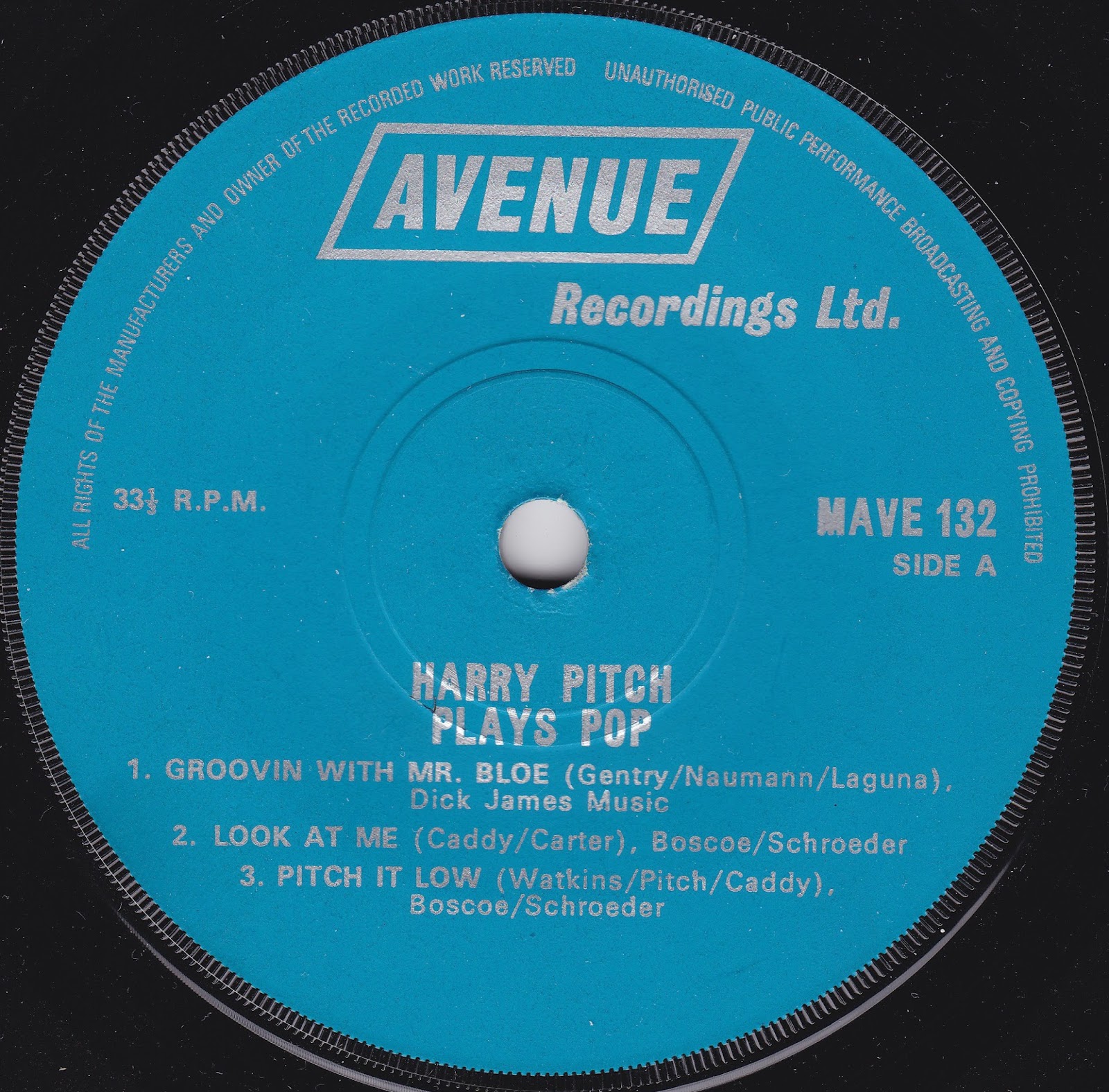
Budget sound-a-like label Avenue were quick to cash in on Mr Bloe mania with a six-track EP of harmonica based ditties, including "Groovin'". But here's the interesting part - whereas Avenue generally employed session men to replicate the noises as closely as possible, here they appeared to have taken on Harry Pitch, the gentlemen often credited as the 'original' Mr Bloe.

If this is actually correct, it must surely be the only example of a session performer fronting both the original record and the budget sound-a-like version. Pitch has his cake and eats it too, with five extra original new tracks to add to the tally. None are especially notable and some are even slow and sad atmosphere pieces, though some, such as "Blowin' With Mr Pitch", almost capture the in-studio zest of the original. 

One thing's for sure - we'll probably never see harmonica instrumentals nearly top the British charts again, and Mr. Bloe seems like a very peculiar anomaly these days, albeit one it's cheering to remember  actually happened.


5 July 2015

Mark Loyd - When I'm Gonna Find Her/ When Evening Falls


Label: Parlophone
Year of Release: 1966

Nish. Nowt. Zero. That's all the information I have available to me on this sixties artist, who released three flop singles during the middle part of the decade - "I Keep Thinking About You" and "Everybody Tries" in 1965, and this one in 1966. 

And that's a shame, because the B-side I'm presenting here, "When I'm Gonna Find Her" has since become a choice Northern Soul spin among those in the know, so favoured in fact that this bootleg reissue leaked out on to the marketplace a number of years ago. It's no surprise to see the track being admired by that crowd - "Find Her" is filled to the brim with all the yearning that great Northern Soul tracks have, but behind that is a minimalist arrangement and creeping bassline which gives the song a haunted feel, as if a stalking and faded phantom has buried itself away in the grooves. 

The A-side "When Evening Falls" isn't bad either, being a much more uptempo number and showing that Loyd, whoever he was, could pack a punch vocally.

I doubt we'll get to the bottom of his identity, but if anyone knows who he is, please leave a comment.

20 May 2015

The Amboy Dukes [UK] - Judy In Disguise/ Who's Foolin' Who/ Simon Says/ The Marquis


Label: Polydor
Year of Release: 1967

Cratediggers the length and breadth of the UK have regularly been confused by the fact that there were two Amboy Dukes releasing records at around roughly the same time. The one most people will keenly be searching out is obviously the US Garage Group featuring Ted Nugent, but there was also a British soul/ ska outfit sharing the moniker. 

Still, record collectors chancing a spare pound or two on the British group will very rarely go home disappointed. Many of their 45s - and they did gain quite a brace of releases on Polydor due to their strong reputation on the live circuit - are actually pretty nifty. The real prize of the pack, which tends to go for quite hard cash, is "High Life In Whitley Wood", a ska song about a housing estate in Reading which mentions various local facilities (such as the by-pass) in a joyous fashion. This is on my personal "wants" list.

But even their management's utterly cynical attempts at carving hit singles for the group contained gems on the flip side. The Amboys were given "Judy In Disguise" on the false understanding that the original version wouldn't otherwise be gaining a release in the UK. We all know what balderdash that proved to be, and sadly the group's sales suffered. Buried on the B-side, though, is a version of Arthur Conley's "Who's Foolin' Who" which is fine stuff indeed, and evidence of their powerful live sound.


Label: Polydor
Year of Release: 1968

And if at first you don't succeed, try again… and with much the same format and results as before. The version of "Simon Says" on offer here is frankly nothing to write home about, but once again, if you flip the side over you get a more remarkable B-side. "The Marquis" has become a northern soul spin in recent years and is as smooth as an eel, all prowling basslines and dramatic brass stings. 

Talking about the membership of the group is hard work, as they went through numerous different line-ups and at any given time seemed to have a cast of thousands. Nonetheless, by the point of these recordings it seems that the group consisted of the following:

Dave Kislingberry (Vocals)
Trevor Lock (Guitar)
Pete Howard (Bass Guitar)
Mick Jerome (Drums)
Rod Lee (Trumpet)
Steve Gregory (Tenor Sax & Flute)
Buddy Beadle (Baritone & Alto sax)


Steve Gregory went on to play the saxophone on George Michael's "Careless Whisper" - probably one of the most known pieces of popular saxophony after the work of not-Bob Holness on "Baker Street". Trevor Lock is now in "Magic", a Queen tribute band. Pete Howard became a sound engineer at the BBC, but sadly passed away in 2007. The whereabouts of the rest is slightly unclear.

23 April 2014

Dora Hall - Pretty Boy/ It's Time To Say Goodbye


Label: Reinbeau Records
Year of Release: 1965

Dora Hall has already featured twice on this blog, and if you want an adequate summary of her career, please go to this blog entry where all is explained. For those of you who don't have the patience, however, let's summarise her career as bluntly as this: Failed actress/ singer marries disposable cup and picnicware magnate, the aforementioned magnate then pours some of the company money into trying to make her a successful light entertainment star over several decades, then not a lot really happens except history remembering her as a very peculiar fluke on the very fringes of popular culture. 

At the risk of repeating myself further, there was a tendency at the time to regard all of Hall's output as being unspeakably naff, but that received wisdom is beginning to be challenged. In short, her husband had too much damn money in the bank to litter the world with cheap and nasty productions - it wouldn't have reflected well on him to have done so, and as a result a lot of her 45s swing brilliantly, though some admittedly do beg the question "What in thundering sodomy was everyone involved thinking?" But she did release hundreds of records.  Mark E Smith would balk at her work rate, in fact.

"Pretty Girl" is an example of a successful sounding disc, so respected now that it's actually a Northern Soul spin. It's not a 'borderline case' in the Northern Soul world either - listen to that joyous chiming, soaring brass section and uptempo, galloping rhythm combined with yearning vocals and you'll realise this absolutely fits the genre like a glove. Spin it next to Dobie Gray's "Out On The Floor" and few people will argue that it's the better record, but most will continue to dance as the atmosphere and celebratory feel remain intact. 

If you happen to be out crate-digging and spot a cheap Dora Hall single sitting unloved near the back of the pile, do take a punt on it. If you're living in the USA they're apparently pretty easy to come by. Here in Britain, she had one 45 out on the collectible indie King Records ("Hello Faithless") and that's it. You owe it to us to try. 

15 January 2014

Dora Hall - Did He Call Today Mama?/ Time To Say Goodbye


Label: Calamo
Year of Release: 1963

Dora Hall is an old friend of the blog, of course, and I've already gone into enormous depth about her absurd and almost certainly unprecedented and unrepeated career in vanity recording.  Whereas most self-released artistes press up 200 records for their friends and family and the people who fancy them, Dora was married to a millionaire plastic kitchen utensils magnate.  This meant her records were regularly given away free with purchases of picnic-ware, airtime on cable television was bought, and she ended up an ubiquitous presence in the USA for decades without ever having a hit single.

Of course, it would have been a lot more fun if Dora Hall had been an exponent of experimental noise or political agit-prop, but the fact her husband's money bought her time with some of the finest session musicians in the country often meant that some of her singles weren't bad free gifts at all.  Several veer towards the Northern Soul end of the spectrum and sound no worse (and in many cases better) than acclaimed efforts from small indie labels operating in that sphere, and her takes on tracks like The Rolling Stones' "Satisfaction" actually have kicking horn sections and a gritty edge that is surprising.  She chose her material and musicians wisely and was much more than a middle-of-the-road character.  

"Did He Call Today Mama" - by Randy Newman, no less - is another example of her picking a winner.  It's a swinging borderline Northern Soul song with an edge of desperation about its lyrics, a beautiful kick about its performance, and a world-weary vocal from Hall who doesn't have a fantastic voice, but knows how to deliver the sentiments.  It's true to say that her television appearances sometimes made her seem somewhat naff and perhaps distracted from the quality of her recorded work, so I'd ask doubters to listen with a fresh pair of ears.  Some of these singles are so cheering I only wish they were more easily available in the UK.

Dora died in 1988, but she'll always have a special place in this blog's heart. 

1 January 2014

Sounds of Lancashire - Sliced Tomatoes/ Back to Bach


Label: Pye Disco Demand
Year of Release: 1975

I suspect the fact that Fatboy Slim sampled large chunks of The Just Brothers "Sliced Tomatoes" and plastered them all over "Rockafeller Skank" is a known fact even to the laziest of sample-spotters these days.  Already a Northern Soul classic by the time Norman Cook found other uses for it, the Brothers' sparse yet strangely brilliant track enjoyed a revival in clubs and on the airwaves after his plundering, and hasn't really gone away since - in fact, Demon Records put out a 7" vinyl reissue only last month, much to my relief as I'd been after a reasonably priced copy for some time.

What is perhaps less appreciated is the fact that Fatboy Slim was not the first person to get his grubby paws on it.  Back in the seventies, numerous record labels in the UK - Pye and Spark being the most notable criminals here - were quick to spot trends on the Northern Soul circuit and often put out cover versions of the main floor fillers which had often been long unavailable over here, if they were ever available at all.  Largely consisting of session musicians watching the studio clock, these rush-released discs veered in quality from being fair facsimiles to downright shoddy.  If you look on ebay, you can still see many of them, even the rarest ones, up for sale at bargain basement prices. There's a simple reason for this - nobody wants them.  They're the vinyl equivalent of the boyfriend or girlfriend everyone went out for a week because they looked a tiny bit like somebody else they fancied a lot more.  Do not DJ with any of them if you value your life, or at the very least your reputation.

"Sliced Tomatoes" by the mysterious Sounds of Lancashire takes things one step further, however. Noting the sparseness of the original, the session musicians in this case have decided to "helpfully" spruce the gaps in the record up with some burbling analogue synthesiser tinsel, creating a Moogy Wonderland disco record where a Northern Soul one should more logically be.  It bubbles and squeaks its way through the familiar Just Brothers riff like something out of a parallel universe where a Lieutenant Norman Cook of NASA was born twenty years earlier and dicked around with early synthesisers rather than turntables, probably wearing a spacesuit and saluting a lot during his routines.  I'm not making a case for this actually being good, mind you. Anyone expecting a Northern Soul version of Stereolab is going to be horribly disappointed.  However, it's absurd enough to warrant coverage on a blog as ridiculous as this one.

The actual proper A-side "Back to Bach" is another remake, this time of the brilliant "Bok to Bach" by Father's Angels.  That version covers similar territory but doesn't do so in as interesting a way.

Happy New Year everyone, by the way! I do have some genuinely good and completely obscure records lined up for the next couple of months at least, so don't surf away just yet. Please.