JohnTem82387976

29 July 2020

Offered With Very Little Comment #8 - The Hood/ Jimmy Wilson/ Laughing Jack/ Peppi/ Les Reed

Five 45s long waiting for their moment on the blog

It's time again for me to flick through my vinyl to-do pile and upload a bunch of tunes which may or may not be of interest to readers - but to be honest, I couldn't think of much to say about.

Finding material for "Left and to the Back" is not an exact science, and frequently involves me returning from the record shop (or Discogs or eBay) with a lot of flotsam and jetsam. Some of this material is so uninteresting I never even get around to digitising it, while other bits are perfectly good but hard to get much interesting information about.

So then, behind the link please find five more 45s which have been gathering dust next to my record player for months now, waiting for the moment when I finally realised that the lead singer behind one of them was actually a future actress on Eastenders, or used to play bass for Joe Brown's backing band, or... I don't know, anything.

Feel free to fill in any blanks in the comments. If the previews don't seem to be working properly, go right to the file source to download them from there.


26 July 2020

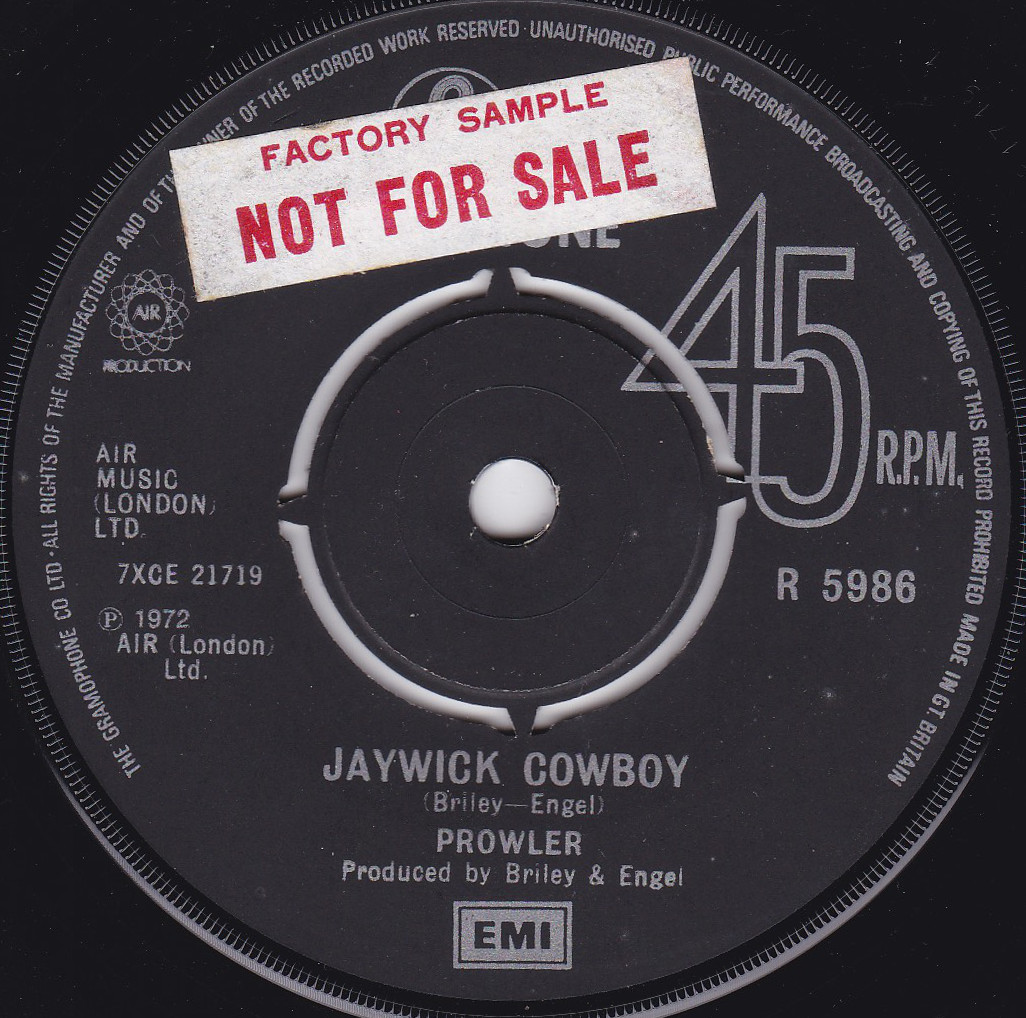
Reupload - Prowler - Pale Green (Hmmmm)/ Vauxhall Driving Man/ Starbuck - Do You Like Boys


None-more-seventies stranger danger 45 and camp glam rock about "mean aggressive bears"

Label: Parlophone
Year of Release: 1972

Mandrake Paddle Steamer's "Strange Walking Man" is one of the more widely compiled psychedelic singles of the sixties, and something of a collector's dream. Operating in a similar sonic space as the most woozy and uncertain sounding post-Barrett Pink Floyd tunes of the period, its exposure perhaps suffered due to it being released in 1969, long after the sun set on LSD-tinged pop.

Mandrake remained skint and struggling around the London gig circuit for some time after the single flopped. Their principle songwriters, Martin Briley and Brian Engel, do not remember the period fondly - somewhat ignobly for an underground circuit figure, Martin Briley remained living at home with his parents. When it became apparent that the group didn't have a viable future, Brian packed his bags first, and Briley followed a year later. 

Martin Briley quickly managed to land a job as a songwriter at George Martin's newly created Air Studios empire, and finding working by himself less successful than the collaborative work he had attempted with Engel before, he got on the blower to his old Mandrake mucker and the pair reunited again.

Scores of songs resulted from this, many of which have been compiled on the RPM Records CD "Between The Sea and The Sky". This, however, was the only single. "Pale Green Vauxhall Driving Man" is arguably one of the more deliberately oily, creepy pieces of work to slip out during the seventies, an era which contained plenty of competition. A slinking, swaggering guitar riff backs the story of a middle-aged pervert attempting to pick up very youthful women (how young? We're not told) in his Vauxhall vehicle, where he then attempts to drug them with "sticky brandy balls". 

To the credit of both Briley and Engel, the track doesn't attempt to remark upon the man in an approving way, stating quite clearly "I'm that nasty, shifty kind/ That greasy nineteen-fifties kind", making it closer to a piece of Lou Reed observational work than a Rolling Stones piece of glorification on the virtues of sleaziness. However, it's a distinctly unconventional subject matter backed with some absolutely killer songwriting - that winding guitar riff and the anthemic chorus are truly brilliant pieces of work.
Sadly, the pair ran into issues with the track almost immediately with the BBC, apparently not due to the subject matter so much as the "commercial placement" in the track, by mentioning the Vauxhall make of cars. The track was hastily redubbed to include a Moog humming noise over the offending "Vauxhall" line, rendering the lyrics a bit mangled, and also somewhat strangely ignoring the fact that "Vauxhall" is still clearly audible outside of the chorus. The title was also changed to the baffling "Pale Green (Hmmmm) Driving Man". What a peculiar situation. Suffice to say, the BBC still wouldn't play the track, and it flopped.

Both the A and the B side are compiled on the aforementioned "Between The Sea and The Sky" album, and I'd recommend you head off to your nearest online audio store to buy "Pale Green..." at least. The flip, "Jaywick Cowboy", is somewhat messy and less deserving of your attention. I've included sound samples below, but the A-side is readily available in full on YouTube.

For the next part of the Engel/ Briley story, please scroll past the soundfiles.


Label: Bradleys
Year of Release: 1973

Despite recording swathes of material for Air, only "Pale Green..." managed to get granted a release. The pair were on the Spark label for one LP under the name Liverpool Echo, and the pair's next dose of fortune would come courtesy of those Tin Pan Alley stalwarts Ken Howard and Alan Blaikley, who needed musicians to get involved in a glam rock project they had on the go.

Rumours have circulated the internet for some time that Starbuck (not to be confused with the identially named USA band) were a studio-based creation, but in fact both Briley and Engel toured with a full group, and they were a "functioning unit" on the British circuit. Three singles were issued by the band, "Wouldn't You Like It?" (on RCA), followed by "Do You Like Boys" and "Heart Throb" on Bradleys. Absolutely all of these are worth tracking down as supremely underrated pieces of glam, but "Do You Like Boys" is truly the jewel in their crown. 

Taking a camp and distinctly Bowie arrangement, the title of the song pulls no punches and the lyrics inevitably do exactly what you'd expect. Subtle references to homosexuality were common enough during this period, with androgynous looking aliens putting their arms around Mick Ronson on "Top of the Pops" being just about acceptable, but "Boys" is a total hammer blow. "Oh, do you LIKE boys?" Starbuck sing pleadingly, like Brett Anderson out of Suede pouting on the back of a pantomime horse, later going on to be more specific - "Do you really long to touch their hair?/ do you go for a mean, aggressive Bear?"

Howard and Blaikley really pushed their luck to the max here, and did so in a popular culture which apparently (according to gay singer-songwriter John Howard, who claims the BBC blacklisted him) was deeply uncomfortable with overt, unquestionable, non-comedic references to homosexuality. Starbuck, however, got utterly behind the material live, despite apparently being straight. They were once booked to play at a skinhead club at Chatham in possibly one of the more baffling decisions a promoter has ever made, and took the stage with full make-up, performing with the campery pushed up to the max. Amazingly, no violent incidents were recorded.

22 July 2020

The Sun Set - Easy Baby/ You Can Ride My Rainbow


British sunshine folk pop goodness

Label: Polydor
Year of Release: 1967

Yet another one to chalk up on the long list of "bloody obscure sixties Polydor singles which seemed to sell in the dozens rather than the thousands". Prior to having more significant success with The Bee Gees and Slade, the German label really did seem to limp along in the UK initially, releasing flop after flop.

Little is known about The Sun Set here, but this is a lovely single, with its top side being full to the brim with harmonies and sunshine. It's not a million miles away from something the Mamas and the Papas might have attempted at around the same time, with a tranquil, laidback and lovelorn feel. Slide on those harmonies towards the coast with a new love at your side, and you'll be as happy as Larry's even more optimistic and wealthier younger brother.

The B-side "You Can Ride My Rainbow", on the other hand, gets much closer to what I can only assume are the group's origins. This is pure folk with some devilishly accomplished guitar finger picking, and the only thing that makes it feel slightly iffy is the slight Rod, Jane and Freddyness of it all. To be fair to The Sun Set, though, Rod Jane and Freddy hadn't been invented as a children's folk combo yet, and if anything we can only really blame them for perhaps being ahead of their time in that respect.

19 July 2020

Erehwon - The Hero (I Might Have Been)/ Tiny Goddess


Godfathers of British Psychedelia decide to go New Wave - what you hear might really surprise you!!!

Label: Harvest
Year of Release: 1980

While most of the non-first division sixties groups focused on the nostalgia circuit to earn their crust when the decade ended, a few tried to move with the times to varying degrees of success. Perhaps one of the most successful were The Easybeats, who renamed themselves Flash and The Pan and bothered global hit parades with wigged-out New Wave styled tracks with Knopfler-esque vocals, such as "Down Among The Dead Men" and "Waiting For A Train". 

Were Patrick Campbell-Lyons and Alex Spyropoulos of Nirvana (the British psychedelic group, not the nineties grunge one, obviously) closely watching the activities of their antipodean friends closely, pencils and bookie's notepads in hand? If so, they've never said, but this one-off single under the name Erehwon certainly seems as if they were hoping for similar trojan horse action.

The A-side here is so far away from Nirvana's usual style it's actually genuinely astonishing. "The Hero" isn't just New Wave in its stylings, it also shows an art-school leaning that their sixties records perhaps never went overboard on. The droning synth rumbles and pulsing bass patterns of the track recall Gary Numan and eighties Wire far more than they do the light and airy world of their past. So dark and moody is the single that it sounds more like an album track than something which had any rightful place in the charts, but it's such an impressive shift away from the group's norm that I can only look on aghast. Very few groups can shift genres as convincingly and as successfully as this.

The track later re-emerged on Campbell-Lyons' solo LP of the same name in 1982, alongside tracks like the bafflingly titled "Naked Robots Watching Breakfast Television".

15 July 2020

Rich Fever - Song of a Sad Man/ Island Dreams


Obscure, intense seventies ballad from the mysterious Rich Fever

Label: Parlophone
Year of Release: 1971

Another puzzler to add to my long list of woes. Rich Fever had three singles out on Parlophone in the early seventies, which should theoretically have been enough major label exposure to ensure someone had logged some memories of him/them somewhere. But no! While their last single, an Elton/Taupin composition "Seasons", is hugely collectible these days and their first effort "Everything's Moving" gets a bit of popsike love, actual firm facts about them are hard to come by.

So far as I can gather they were a group rather than an artist, with Jeff Long and Dudley Smith acting as principle songwriters. Their records are a mixed bag indeed, ranging from the shimmering pop of the aforementioned "Everything's Moving" to the orchestral angst of this single, which I can only assume is autobiographical; at least, the lyrical theme appears to be a man's relationship in its death throes because the object of his romantic attentions cannot accept that he just has to spend a lot of his life dealing with his music. Not exactly a topic likely to appeal to the man or woman on the Clapham Omnibus, who were probably confronted with different relationship issues at the time - such as not being beautiful enough, or being too much of a scruff around the house - but it's balanced, lacking in self-pity and touching in the way these straightforward sentiments often are. Not the kind of material hits are made of, which makes it very surprising it became an A-side, but its towering arrangement suggests EMI were hoping for a "Bridge Over Troubled Water" styled smash.

After the failure of their third single, where their own self-penned efforts got ditched in favour of one of Elton's, Parlophone seem to have solved the problem of their music careers getting in the way of relationships by dropping them, and I can't find any trace of either member being involved in other groups or projects from that point on. The fact that they do seem to be causing collector's ears to prick up these days may be of some consolation, though.