JohnTem82387976
Showing posts with label prog rock. Show all posts

23 July 2023

Saft - People In Motion/ Albertine Hall


Norwegian folk/prog rockers with their one UK 45 release

Label: Polydor
Year of Release: 1971

The Eurovision Song Contest is huge fun but if there's one horrible way it blighted European society, it was the manner in which Norwegians were stereotyped as musical ignoramuses (in the UK media at least). For years the Norwegians slogged away at the contest valiantly, admittedly putting some ropey entries forward in the process, frequently finishing last and never bettering their record third place (in 1963) until they finally won in 1985, the same year A-Ha broke through into the global mainstream. 

Of course, the Eurovision Song Contest was no more a fair barometer of what was going on in Norwegian music than it was British music. If here in the UK we had more to offer than Black Lace, Cliff Richard and Brotherhood Of Man, it figures that somewhere beneath Norway's highest profile musical moments had to lie a raft of other, better stuff drifting somewhere beneath the televisual radar. 

Saft are a prime example of an inventive and constantly surprising rock band who put out plenty of material which found huge appreciation in Norway at the time, and has since managed to gain a small audience in the UK too. Formed in Bergen in 1969 by Ove Thue (lead vocals and guitar), Trygve Thue (guitars, piano, flute, vocals), Tom Harry (keyboards), Magne Lunde (drums) and Rolf Skogstrand (bass), the group were masterful prog musicians who nonetheless did not eschew melody in their search for impressive fretwork and arrangements. A live performance over on YouTube shows a group who were closer to jazzy or bluesy excursions than flashy freakouts or Stockhausen-esque experimentation. 

There were also folk elements to their music, and they were the first group in Norway to record in the rural Nynorsk language, which set them apart from their contemporaries.  

23 April 2023

Sweet Chariot - Angelina/ Young At Heart/ America


Extraordinarily high quality vanity pressed Salford progressive rock 

Label: TOG
Year of Release: 1977

Back when I first started writing this blog fifteen years ago, I quickly became suspicious of seventies vanity pressings. While they have a reputation for being bottomless gifts of both glorious tack and untapped potential, the reality is they're usually just some pedestrian cabaret band singing tepid covers of show tunes. 

Once every so often, though, you chance upon something so professionally produced, confidently written and arranged and punchily performed that you find yourself wondering why no proper record label wanted to go anywhere near it. This is one such example which is starting to get a little bit of attention in record collector's circles, though this is mainly for the flipside, a glorious mash-up of Paul Simon's song "America" (channeled through Yes's cover of it), Bernstein's song of the same name (channeled through The Nice) and, perhaps most unexpectedly of all, "Land Of Hope and Glory". All six minutes are as simultaneously daring and preposterous as you'd expect, and the group come across not necessarily as original thinkers - this is pretty much undiluted prog rock which owes a debt to the performances and interpretations of others - but certainly a powerful group. By the time "Land Of Hope and Glory" bleeds into the final moments, you're both laughing at the sheer audacity and applauding them. What daft, brilliant sods. 

The original material on the A-side is also noteworthy, though, with "Angelina" in particular sounding like an FM rock hit. In another dimension, those drum fills, fruity keyboard lines and impassioned, woebegone vocals would be heard regularly on late night local FM stations, interrupting everyone's cab journey home. Besides the more proggish elements, the group are clearly dining at the same messy bistros as Sad Cafe and having the same tough heartaches as Foreigner. 

This wasn't Sweet Chariot's only effort to grace vinyl; the group had a long history, starting as Dave Barron and The Chariots in 1962, before becoming Jackie Richmond and The Chariots in 1967, then morphing into Sweet Chariot by 1970. 

Their first recorded effort under that name was, somewhat bizarrely, a library music LP for the De Wolfe label in 1972 which consisted of vocal originals on Side A and instrumental versions of the same songs on side B. One of the tracks "What Would Your Momma Say" has worked its way on to YouTube and shows that all the components were neatly in place by then, though it seems unlikely their tracks got picked up for commercial use.

9 October 2022

Warm Dust - It's A Beautiful Day/ Magic Worm


Paul Carrack of Ace in early jazz prog mode

Label: Trend
Year of Release: 1971

Warm Dust is a very inviting band name for a record collector, evoking those summer days spent on your knees in dusty old second hand shops and bazaars, rifling through cartons of records coated in fluff... or perhaps the accumulated dust bunnies you pluck off the record players stylus, hot from the latest vinyl rotation... mmm, nice, even if these possibly aren't the images they were trying to put in people's minds.

The group possibly aren't every vinyl lover's cup of tea, though, being from that awkward, unfashionable and frequently pretentious progressive jazz rock genre. And it's certainly true to say that some of their material veered close to the pompous; their 1970 debut LP was entitled "Peace In Our Time" and subtitled "Neville Chamberlain 30th September 1938" and contained a lot of fussy, busy rhythms alongside the unexpectedly pretty melodies. 

While their excesses seem rather quaint from our current perspective, they weren't the kind of fools to let musicianship overshadow songwriting ideas, and both sides of this single are brief windows into that side of their world. "It's A Beautiful Day" is a jaunty skip through summer replete with puffing flutes and keen vocal melodies. Over on the flip, on the other hand, gives them a bit more room to stretch out and use the full ensemble to huge effect with some of the proggy fussiness leaking through. 

29 May 2022

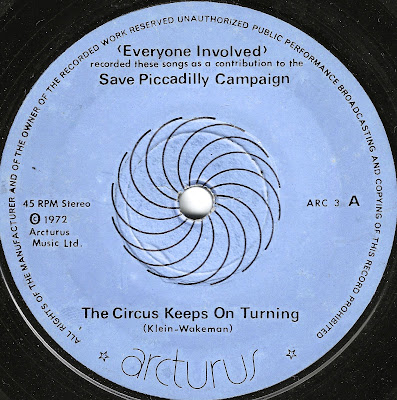
Everyone Involved - The Circus Keeps On Turning/ Motorcar Madness


Piccadilly redevelopment Prog-folk protest which is far better than you'd expect

Label: Arcturus
Year of Release: 1972

This particular single puts my blog into previously uncharted territory, as far from merely being a discarded flop from yore, it was actually one cog in a protest movement which has since become a long-forgotten issue. It also involves me delving a lot deeper than I usually would into city planning, architecture and transport infrastructure (and unless we find another similar record like the one about the Highgate redevelopment plan, I can't imagine I'll be doing this again).

The sixties were an interesting time for London in terms of urban planning, and if you wander into certain areas today you can get a distinct sense of what the capital might have looked like if a programme of mass modernisation had been taken to its logical conclusions. The Westway in Hammersmith is one example, a stub of a motorway cutting high over a neighbourhood and slamming itself - and its pollution - over the top of residential streets and Notting Hill market. Far from being a one-off experiment, there was a broader proposal to create a whole ringway of motorways around Central London just like this one, snaking through houses, parks and commercial areas all round the city, until protesters and funders jinxed it.

The Barbican Estate in Central London is, of course, another example, separating pedestrians from roadways via a network of disorientating elevated walkways which ruin the average person's internal compass - two wrong left turns and you're suddenly next to a dark row of flats near a derelict bar, nowhere near where you were supposed to be and taking illogical mental steps like suddenly believing in werewolves. Still, at the time urban planners felt that allowing cars the run of the streets while pedestrians strolled about in the sky wasn't just a fascinating piece of urban design, but a solution good enough to make both petrolheads and walkers happy. One set could have all the road width they wanted and travel easily while the others wandered merrily in peace above. Theoretically it's a fantastic idea, but creating an island of accommodation with no regular or easy routes back to other civilisation had (and still has) clear drawbacks for both visitors and residents alike.

The sixties and seventies in the capital were utterly riddled with protest as residents took aim at urban planners, having seen their existing work and found it wanting. Possibly one of the biggest and certainly most highly publicised campaigns of its day was this one, which saw the ignition keys of a number of bulldozers primed right in the heart of the West End. By 1962 there were growing concerns about the lack of free-flowing traffic around the Piccadilly area, and the powers-that-be began to put forward proposals to address the issue. The architect William Holford came forth with some ideas which were typically ambitious for the era, involving raised walkways (again), a series of 200 foot towers, and a seven-lane road cutting through the region. Work on this scale would have involved three-quarters of the Circus being demolished, retail outlets, residential units and office blocks alike.

On the plus side, Londoners would also have gained a skating rink and a floodlit viewing platform and a 400 foot bronze tower encased in glass, but perhaps inevitably the local population were never really on the side of the planners, and the campaign from business owners and residents was far from muted. The issue was the subject of debate on local radio and the local press, but as it dragged on for well over a decade inevitably campaigners had to find new ways of getting their voices heard.

Which (finally) brings us on to this 45, recorded by the progressive hippy collective Everyone Involved. Far from being put together solely to protest about that issue, they were a politically liberal and forward-thinking bunch who had already recorded an entire LP called "Either/Or" which they pressed up and gave away to random passers-by for free, containing songs about - among other things - the rights of homosexuals and environmental issues. Built around a nucleus of Freya Hogue who had previously worked with Sunforest, guitarist Lucinha Turnbull, environmental campaigner Alan Wakeman and bassist Arnaldo Filho of Os Mutantes, the group were unconventional, seemingly cared not a jot for commercial success and existed purely to play music and occasionally rattle cages about societal issues. 

31 January 2021

The Aliens - When The River Runs Dry/ Winds Of Time


Glistening melodic prog rock from Bracknell

Label: Alien
Year of Release: 1978

Pity the proggers who arrived too late to the party. Any groups who made the right noises in the early seventies were pretty much guaranteed a record contract and at least one LP in the shops. By the time the mid-70s arrived, however, excitement had waned and both music journalists and some members of the public were looking for different sounds.

The Aliens were from Bracknell and started up in 1977, a whole year after the media began talking about an exciting new phenomenon called punk rock. While I don't tend to buy into the myth that punk "killed" prog rock as such - sales of prog were broadly on the wane by 1975, long before most had become acquainted with John Lydon outside his social circle - it certainly hastened its demise, with column inches in the music press increasingly given over to three-chord teenage rock rather than intricate musicianship from earnest hairies.

Despite this, the audience for prog didn't entirely disappear, and the live circuit still cheered to the sounds of relative latecomers such as Druid and National Health, as well as all the old faithful who couldn't have been less interested in a New Wave styled change of direction. The Aliens were a faithful part of this gig circuit, particularly in the South East region of England, and in 1978 slipped out this self-released record in an attempt to increase the public's awareness of their existence.

For something without any major backing, "When The River Runs Dry" is surprisingly well produced and credit is also due to The Aliens for what is actually a very jangly, melodic piece of prog for a genre which was often littered with flash and showiness in place of emotive songwriting. Besides the strong guitar work, the song also has a brightness to it which might have been appealing to mainstream radio.

13 December 2020

The Dog That Bit People - Lovely Lady/ Merry-Go-Round


Short, snappy mellow prog from ex-Locomotive members
 
Label: Parlophone
Year of "Release": 1971
 
 The Dog That Bit People were another one of those here-today gone-tomorrow progressive bands which seemed to litter the early seventies almost as much as the roaches that probably festooned the ashtrays during their gigs. Formed by Michael Hincks and Bob Lamb from the rather more successful Locomotive after Norman Haines left that group, their only LP - the unimaginatively titled "Dog That Bit People" - is one of the scarcest of that era.

Stock copies for their only single "Lovely Lady" seem to be non-existent, and it's only ever turned up in its promotional form, which leads me to suspect it was only ever produced as bait for progressively minded radio DJs. Whatever the facts behind this, it's actually a breezy, summery affair with dashes of both Americana and McCartneyesque cheeriness amidst the mix. As long as you don't continually hear the phrase "lovely lady" being spoken in Jimmy Savile's sinister tones - he did, after all, love to say "Love-leh love-leh love-leh laaaay-deh!" - you're probably home dry with an appropriately flowery, bright and surprisingly straightforward 45 from an otherwise relatively elaborate bunch of proggers. This is one of the few singles I've come across which sits neatly on the crossroads of popsike and prog, and it's none the worse for it.

Besides having Hincks on vocals and bass and Lamb on drums, The Dog That Bit People also featured John Caswell on vocals and guitar and Keith Millar on vocals, guitar and keyboards. Caswell apparently went on to produce some solo material in the eighties on the MCA label and also played with the Steve Gibbons Band. Hincks and Lamb became backing musicians for Raymond Froggatt, and the whereabouts of Millar is - you guessed it - unclear. There's always one, isn't there?

2 September 2020

Spontaneous Combustion - Sabre Dance/ And Now For Something Completely Different


Prog trio attempt two different takes on Khachaturian's most famous moment

Label: Harvest
Year of Release: 1973


It's not unfair to say that Poole proggers Spontaneous Combustion were not the most critically acclaimed performers of the seventies. While they had a good friend and professional associate in Greg Lake, were signed to Harvest - which was a badge of quality most groups wore with pride - and performed on live tours with the likes of ELO, they've become something of a footnote in the prog rock story since.

In retrospect, it's difficult to understand why so many magazines were dismissive of their long, meandering instrumental indulgences, when these very same creative habits were seemingly tolerated and even applauded in the better known and most established acts of the era. Comments were also made about them playing with technique but no soul, and with their heads rather than their hearts, but the same could also be said - and indeed has since been said about - a great many of the biggest acts.

They've been afforded a certain amount of critical reappraisal since, and this blog entry over at Bournemouth Beat Boom offers a balanced view of their three LPs ("Spontaneous Combustion", "Triad" and "Time") and their excursions into 45rpm territory.

Their third and final single is something of a puzzler. "Sabre Dance" had been covered very successfully by Love Sculpture a mere five years before, and the A side here brings nothing new to the Khachaturian orientated party - in fact, it sounds much the same as Edmunds' take, except perhaps not quite as wild and furious. While his version went to number five in the charts, Spontaneous Combustion's version went ignored.

Resting on the flip, however, is a Robert Fripp designed take on the track which possibly might have made a more interesting A-side, though it seems unlikely it would have fared any better commercially. Erasing the rapid-fire showiness and instead slowing things down and throwing in arty clattering guitar chords and moody Mellotron excursions, it's genuinely interesting and proof that the old dog "Sabre Dance" could have new life breathed into it after all. The group also resist any temptation at all to "solo" and instead let the arrangement do the talking.

10 November 2019

The Squeal Band - Pour on Stardust/ Trailer Park Heaven


Call Jeremy Clarkson and the Top Gear boys! They'll lap up this driving prog.

Label: President
Year of Release: 1977

I admit I bought this single at a fairly low price because I saw the year of release, the group's name and the rather glammish A-side song title and assumed I might be getting some late period tinsel rock here. As commonly occurs when these kinds of assumptions are made, that wasn't what I heard when the needle hit the groove - both sides here are the work of skilled musicians showing off their chops very flamboyantly. Part Steely Dan, part Allman Brothers in their "Jessica" prime, it's hooky pop with lots of twiddly bits attached.

The A-side "Pour On Stardust" focuses on the hard knock life of a group attempting to impress management and record labels, who are urging them to "pour on stardust". It sounds very much like a satirical snipe at glam rock and plastic music industry mechanisations rather than the full-on stomp-a-thon I was hoping for, but there's no denying that the chirpy chorus with its painted-on smile is pretty poppy for a group of this nature.

The flip is more satisfying. "Trailer Park Heaven" is a cascade of warbling analogue keyboards and frantic fretboard activity, and it's concise prog rock at its fidgety best. If Yes or ELP had managed to create songs this detailed and kept them at a punchy three-and-a-half minutes, I might have had more interest in them.