JohnTem82387976

8 October 2014

J.J. Worthington - A Whiter Shade Of Pale/ Riding Down From Bangor


Label: Decca
Year of Release: 1969

I've stated the obvious and said it before, so there's probably little point in saying it twice - but "A Whiter Shade of Pale" really was considered a stone-cold classic within a few months of landing, one of those rare rock moments (like "Bohemian Rhapsody" or "A Day In The Life") where a track receives immediate awestruck acclaim and the public affection never really wanes. You might get a few people now who declare the single to be a lot of pretentious nonsense, and if we're talking about the lyrics I might be inclined to join them, but it remains one of the most heavily played records on international airwaves.

That this very easy-going, family friendly, almost baroque version of the track was released a mere two years later is no real surprise, then. It replaces the soulfulness of the original with a subtle, more ponderous delivery, which might work in its favour for some, but I must admit I have my doubts. I can't trace who Worthington was - I suspect he was/is a folk singer or singer-songwriter - but his polite voice turns what was a meltdown over ghostly-faced nuns into a calm if surreal anecdote. The flip "Riding Down From Bangor" is a bit better, at least if you're a jaded city type who enjoys the occasional bit of rural folk whimsy.

As for Worthington, the only other piece of information I can find on him is rather unfortunate. His carelessly titled album "If I Should Touch You" often crops up on internet websites dedicated to terrible or inappropriate album sleeves, and here it is in all its glory. Dearie me, Decca. Sometimes the way your marketed your artists makes me wonder if all those rumours about your offices being filled to the brim with retired Army sergeants waffling on about their "war efforts" were true. What a mistake to make.

5 October 2014

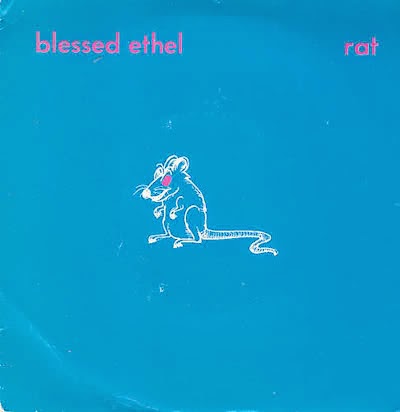
Reuploads - Blessed Ethel - Rat and Fat Star


Label: 2 Damn Loud
Year of Release: 1994

These days, when a consortium of critics and music industry insiders get together to name who the most important artists of the coming year will be, there's little danger involved.  Trends are easy to predict.  Does the band have 768,000 Facebook 'likes' already?  Have they just been signed for a lot of money by a cash-strapped major label who absolutely has to see a return on their investment?  Are they Brit School graduates?  With every year's announcements, you can almost hear the noise of check-boxes being ticked.

It wasn't always thus.  In the nineties, predictions were likely to be very wonky indeed, which is how Blessed Ethel infamously got voted above Oasis as being the band most likely to succeed at the Manchester "In The City" live event.  This isn't as unusual as it sounds.  In the early nineties, suspicions in the music press were rife that Oasis were nothing more than a re-heated baggy band.  Blessed Ethel, on the other hand, had vitriol and a sneering energy which sounded much more of the moment - elements of the still relatively topical Riot Grrrl movement were apparent, and much was made of the band's oddball outsiderness, an absolute virtue in those pre-Britpop days.  The NME and Melody Maker wanted weird kids in the charts back then, not everyman styled stars.

We all know how the story ended.  Blessed Ethel did not conquer the world, but "Rat" gives some clues as to how they might just have given the impression they could.  It's ferocious garage rock capped off with Sara Doran's urgent and hysterical vocals; breathless, desperate and really rather brilliant in its own way.  True, at the time this would have been no more or less original than Oasis' known output, but the full-throttle nature of the single showcases a band keen to leave a scalding great mark.  Compare it back-to-back with an Oasis demo such as "Cigarettes and Alcohol" (one of the limpest, weediest, least representative demo recordings I've ever heard in my life), and everyone's favourite monobrowed pop stars suddenly sound  less fierce, less full of themselves.

As for any musicians reading this who may have recently lost a "Battle of the Bands" contest... take heart.  It means nothing. (Scroll down past the mp3s for another Blessed Ethel single…)


"Fat Star" is a rather more subtle outing for the group, but great nonetheless - simmering with heated paranoia and relying on a central atmospheric guitar riff rather than sheer aggression, it was the band's last proper single. Released a mere year after "Rat" in 1995, the public had had their chance to familiarise themselves with the band and the major labels had seen their opportunities to wave cheque books around, but it seemed all for nought.

A pity, as Blessed Ethel had an oddness and tension about their work which was utterly missing from so many of the nineties 'big hitters'. They had enough of a pop sensibility to cut through, but somehow missed out completely, and one album ("Welcome to the Rodeo") later, it was all over.

2 October 2014

Cocktail Cabinet - Puppet on a String/ Breathalyser


Label: Page One
Year of Release: 1967

Well, this is downright odd. Bill Martin and Phil Coulter were the songwriting and production team responsible for Sandie Shaw's most well-known but least credible moment - "Puppet On A String". It shot the United Kingdom to Eurovision victory, but its incessant, irritating bounciness makes it seem like one of her least interesting singles now. 

Nonetheless, why on earth either Coulter or Martin wanted to subject the song to this treatment, I've no idea. It's their production, and the A-side is a comedy novelty cover version of "Puppet…" done by somebody - and I can't find any record at all of who - attempting an impersonation of the then Prime Minister Harold Wilson. The concept seems to be that he's being persuaded to cut a record by some slick PR man in an attempt to make himself seem accessible to the youth. Cassetteboy's David Cameron Rap this ain't - it's a clumsy piece of satire which leaves you strangely sympathising with Wilson. So what if he wasn't sharp and down with the kids? At least he wasn't David "I love The Smiths, me, oh honestly, yes" Cameron or Tony "I love David Bo-how-ie!" Blair. It's possibly partly our obsession with grinning, presentable media and business-friendly Prime Ministers washed ashore on an oil slick which is responsible for the mess we're in. I'm not accusing Martin and Coulter of starting the problem with a strange flop novelty single, but… they were WRONG, that's all. 

This record has only really achieved collectible status due to the B-side "Breathalyser", a sharp and rapid-fire instrumental Hammond groove which still lights up dancefloors. It's commercially available on iTunes and elsewhere these days, but you can find it on Youtube too. This, really, is the stuff - cool, fresh and slightly knowing, and still loved by those in the know to this day. Its wasted on the flip side, but so many tracks in the sixties were. 

27 September 2014

The Jaybirds - Tell Me When/ You Can't Do That


Label: Embassy
Year of Release: 1964

Regular readers will know the drill with Embassy Records - this was no ordinary record label, being a budget outlet which specialised in releasing quickie 45rpm cover versions of the hits of the day. I've already written about their history here, and I'll refrain from doing so again.

Side A in this case is actually a reasonably faithful cover of "Tell Me When" by The Applejacks, a group best known mainly for that hit. The Applejacks were the first Birmingham based group to hit the British top ten and there were high hopes they could continue that initial success, but in reality each subsequent release was greeted with less enthusiasm from the public. A deep pity, because one early flip side "Boom Boom Boom Boom (Everybody Fall Down)" could perhaps be seen to pre-empt The Housemartins sound by two whole decades, to the extent that it's nigh-on impossible to listen to it without imagining Hull's top turn doing goofy dancing along to it while Norman Cook dances properly and tries not to look embarrassed behind them. It's safe to say that while The Applejacks were not actually lost musical pioneers, they frequently bashed out a beat tune with more competence and enthusiasm than many of their better-selling peers. 

Side B is the puzzler. "You Can't Do That" was never a Beatles A-side, but it proves how popular the Fabs were in 1964 that even their flip sides were being covered for cheapo single releases. But surely the logical thing to have done would be to pair this with a cover of "Can't Buy Me Love"? What was going on in the minds of everyone at Embassy HQ at this point? It's impossible to say. The track is commercially available on iTunes and also a Beatles covers album these days, so you'll have to satisfy yourself with a YouTube link for it instead. I'll be blunt - it's utterly unremarkable. So many of the cover versions of Beatles songs during this era remind you never to underestimate the power the group - including the much-maligned Ringo - could pack into their songs. Other session musicians clearly struggled to replicate their sound, to the extent that an effective Beatles cover actually feels like a notable achievement. 

22 September 2014

Nicky Scott - Honey Pie/ No More Tomorrows


Label: Pye
Year of Release: 1969

The mania for covering Beatles albums tracks in the sixties is such that I'm genuinely past being surprised at each new discovery I make. If the Fabs hadn't put it out as a single, it would seem that somebody somewhere had their own take ready to go. In this case, step forward Mr Nicky Scott, with your version of "Honey Pie" off "The White Album". That's right, "Honey Pie". Hardly what you'd call a chart-bound sound, although I suppose somebody at Pye must have fancied that its old school music hall arrangements might sell to an older demographic. It didn't, though.

There's not much difference between this and McCartney's version, except Scott's strange Brummie accent at the start. It stays true to the original version, though perhaps adds a tiny bit more recording studio polish to the sound, taking away some of the 78rpm styled reediness of the original. It's still a truly bizarre choice for a single, though, irrespective of any new production flourishes. The truly old-school sound might have seemed more commercial in the era of the Bonzos and the New Vaudeville Band, but as a song this didn't come close to approaching the style or wit of either group, and it's been largely disregarded by most Beatles fans since. 

Nicky Scott had a long history in music prior to the release of this, having previously been discovered by Simon Napier-Bell and paired with the black female singer Diane Ferraz, creating an inter-racial duo which was, in the early sixties, a huge deal on the London gig circuit. Eventually Scott was signed to Immediate Records as a solo artist, and while there put out a couple of folk flavoured releases which are rather good - his version of the Jagger and Richards penned meditation on the pitfalls of hiring prostitutes "Backstreet Girl" is worthy of more than a casual listen. "Honey Pie" seems to have been the first release he attempted after Immediate lost interest, and did little to raise his profile.

Meanwhile, I await a 7" version of "Wild Honey Pie" with interest. There probably is one out there somewhere…